Chlorochroa ligata
Conchuela Bug
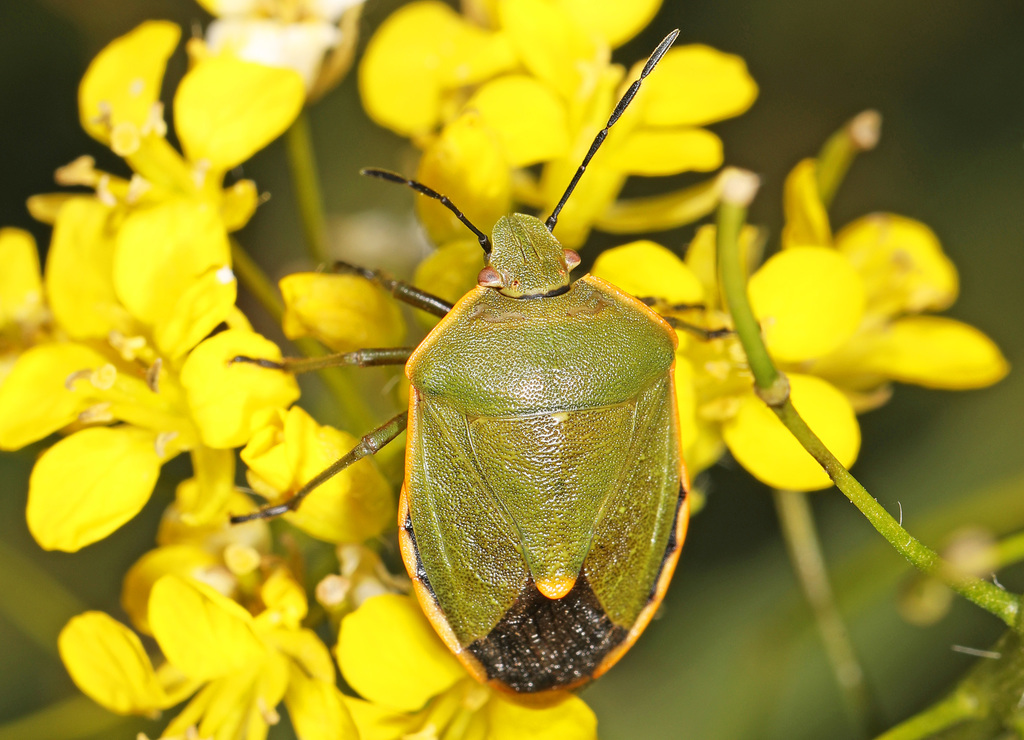
(c) Judy Gallagher, some rights reserved (CC BY-SA) · licence
Family: Pentatomidae · Class: Insecta · Order: Hemiptera
Chlorochroa ligata (Conchuela Bug) is a California animal in the Pentatomidae family.
The conchuela bug is a medium-sized shield bug belonging to the family Pentatomidae. Adults are typically brown to yellowish-brown in coloration with distinctive pentagonal shield-shaped bodies characteristic of stink bugs. Like other members of the family, this species produces defensive chemical compounds when disturbed. The body length ranges from approximately 10 to 15 millimeters (0.4 to 0.6 inches), with a broad, flattened appearance typical of pentatomid bugs. Chlorochroa ligata has an extensive distribution across western and central North America. According to BugGuide observations, the species occurs throughout California, with documented records from Arizona, Colorado, Idaho, British Columbia, and extending eastward to Iowa, Kansas, Minnesota, and Manitoba (BugGuide 2025). This broad range indicates the species' adaptability to diverse climatic conditions across multiple biogeographic regions. Within California, the species appears to be widely distributed, though specific county-level distribution data requires further documentation. The conchuela bug inhabits various terrestrial environments but shows a strong association with leguminous plants. The species functions primarily as a seed feeder, demonstrating a preference for leguminous host plants including mesquite (BugGuide 2025). According to field observations, when mesquite beans dry out, the bugs migrate to more succulent plant materials, indicating behavioral flexibility in response to resource availability. This feeding behavior suggests the species occupies habitats ranging from arid environments with mesquite to areas supporting other legume species. Seasonal activity patterns based on observational data show the species is active from March through November across its range (BugGuide 2025). Peak activity appears to occur during summer months, with substantial numbers observed in July through September in Arizona and August through October in British Columbia. California records show activity from March through November, with observations distributed across spring, summer, and fall months. The species likely overwinters as adults in protected locations. Field observations have documented eggs and nymphs, indicating successful reproduction across the documented range. Currently, Chlorochroa ligata has no federal or California state conservation listing status. NatureServe ranks the species as G4, indicating it is apparently secure globally with no immediate conservation concerns (NatureServe 2025). The species' broad distribution and apparent ecological flexibility suggest stable populations across its range. However, comprehensive population studies and trend analyses have not been conducted. The species was mentioned in the Kearney's blue star recovery plan as a potential factor affecting that endangered plant species, though the nature of this interaction requires further study (USFWS 1993). Like many invertebrate species, the conchuela bug would benefit from broader surveys to better document its distribution and population trends across California and the broader range.
Classification
Class: Insecta · Order: Hemiptera · Family: Pentatomidae
Frequently asked questions
How is Chlorochroa ligata classified?
Chlorochroa ligata belongs to class Insecta, order Hemiptera, family Pentatomidae.
What family does Chlorochroa ligata belong to?
Chlorochroa ligata is in the Pentatomidae family.
What is Chlorochroa ligata?
The conchuela bug is a medium-sized shield bug belonging to the family Pentatomidae.
Is Chlorochroa ligata found in California?
Yes. Chlorochroa ligata is recorded in California in The California Species Project's catalogue.
Related species
Other California species in the same genus, family, or bioregion.
Data from The California Species Project — 14,000+ California species with verified data from CNPS, CDFW, USFWS, and more.