Chlorochroa uhleri
Uhler's Stink Bug
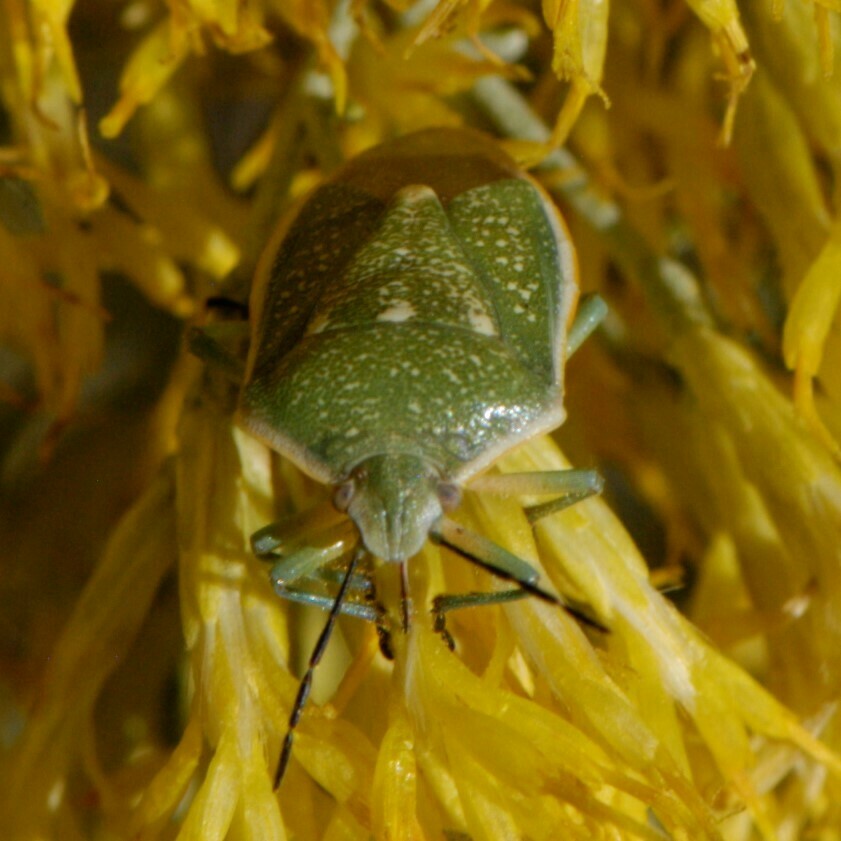
(c) Elliott Gordon, some rights reserved (CC BY) · licence
Family: Pentatomidae · Class: Insecta · Order: Hemiptera
Chlorochroa uhleri (Uhler's Stink Bug) is a California animal in the Pentatomidae family.
Uhler's Stink Bug is a medium-sized hemipteran insect in the family Pentatomidae, measuring approximately 10-14 mm in length. Adults display the characteristic shield-shaped body typical of stink bugs, with a broad, flattened appearance. The species exhibits green to brownish-green coloration on the dorsal surface, often with darker markings along the edges of the scutellum and corium. The antennae are five-segmented, and the rostrum extends to approximately the middle coxae. Like other pentatomids, this species possesses well-developed scent glands that produce defensive compounds when disturbed. Chlorochroa uhleri occurs across western North America, with documented populations extending from British Columbia south through California and east to Colorado and New Mexico. The species appears to have a disjunct distribution, with populations recorded in the Pacific Northwest, California's Central Valley and coastal regions, and scattered locations throughout the Intermountain West. According to BugGuide, the species ranges from the Pacific Coast eastward to the Rocky Mountain region. This stink bug inhabits a variety of terrestrial ecosystems, including grasslands, agricultural areas, and open woodlands. The species shows particular association with areas containing its preferred host plants, primarily members of the Asteraceae family. Chlorochroa uhleri is commonly found in disturbed habitats and agricultural margins, where it can access both native and cultivated host plants. The species appears to tolerate a range of elevations, from sea level to montane environments. Uhler's Stink Bug is a phytophagous species that feeds primarily on the seeds and developing fruits of composite plants (Asteraceae). Adults and nymphs insert their piercing-sucking mouthparts into plant tissues to extract fluids. The species exhibits seasonal activity patterns typical of temperate pentatomids, with adults overwintering in protected locations such as leaf litter or under bark. Mating occurs in spring and early summer, with females depositing barrel-shaped eggs in clusters on host plant foliage. Development proceeds through five nymphal instars before reaching adulthood. The species may produce one to two generations per year depending on local climatic conditions. Chlorochroa uhleri currently lacks formal conservation status designation at federal or state levels. The species does not appear on the U.S. Fish and Wildlife Service's list of threatened or endangered species, nor is it included in California's list of species of special concern as of December 2025. Population trends for this species have not been systematically monitored, though it appears to maintain stable populations throughout much of its range. As a generalist herbivore capable of utilizing both native and cultivated host plants, the species may benefit from agricultural practices that maintain diverse plant communities. However, intensive pesticide applications in agricultural areas could potentially impact local populations. Recent genetic diversity studies have examined this species alongside other economically important stink bugs (Barman et al. 2017), suggesting continued scientific interest in understanding population structure and evolutionary relationships within the genus Chlorochroa.
Classification
Class: Insecta · Order: Hemiptera · Family: Pentatomidae
Frequently asked questions
How is Chlorochroa uhleri classified?
Chlorochroa uhleri belongs to class Insecta, order Hemiptera, family Pentatomidae.
What family does Chlorochroa uhleri belong to?
Chlorochroa uhleri is in the Pentatomidae family.
What is Chlorochroa uhleri?
Uhler's Stink Bug is a medium-sized hemipteran insect in the family Pentatomidae, measuring approximately 10-14 mm in length.
Is Chlorochroa uhleri found in California?
Yes. Chlorochroa uhleri is recorded in California in The California Species Project's catalogue.
Related species
Other California species in the same genus, family, or bioregion.
Data from The California Species Project — 14,000+ California species with verified data from CNPS, CDFW, USFWS, and more.