Chlosyne gabbii
Gabb's Checkerspot
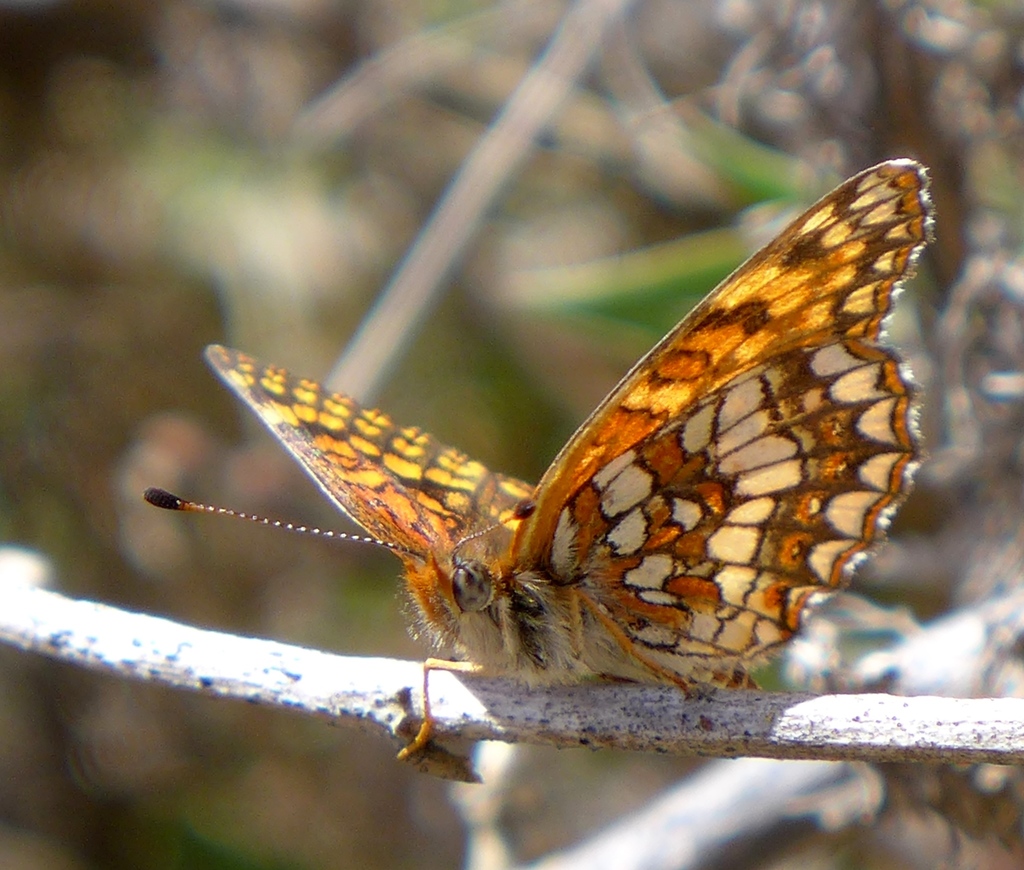
(c) John Hibbard, some rights reserved (CC BY) · licence
Family: Nymphalidae · Class: Insecta · Order: Lepidoptera
Chlosyne gabbii (Gabb's Checkerspot) is a California animal in the Nymphalidae family.
Gabb's Checkerspot is a medium-sized butterfly in the brush-footed butterfly family (Nymphalidae). Adults display the characteristic checkerspot pattern with orange, black, and white markings arranged in a complex mosaic across both forewings and hindwings. The wingspan typically ranges from 32 to 44 mm (1.3 to 1.7 inches). Males are generally smaller and more brightly colored than females, with more pronounced orange patches. The underside of the hindwings features a distinctive pattern of pale spots on a darker background, which aids in field identification when the butterfly is at rest. Gabb's Checkerspot occurs in the California Coast Ranges and Nevada foothills, ranging from Monterey County south to Baja California. The species is found primarily in coastal sage scrub and chaparral habitats, with populations documented in the Santa Monica Mountains, San Gabriel Mountains, and various locations throughout Southern California. The distribution follows the range of its primary host plants and is generally restricted to elevations below 1,500 meters (4,900 feet). This species inhabits dry slopes and ridges in coastal sage scrub, chaparral, and oak woodland communities. Adults are typically found in areas with scattered shrubs and open patches where nectar sources are available. The habitat requirements are closely tied to the presence of host plants in the sunflower family (Asteraceae), particularly Hazardia (formerly Haplopappus squarrosus) and beach aster (Corethrogyne filaginifolia). These habitats are characterized by Mediterranean climate conditions with hot, dry summers and mild, wet winters. Gabb's Checkerspot exhibits a univoltine life cycle, producing one generation per year. Adults typically emerge in late spring to early summer, with peak flight periods occurring from April through June. Females deposit eggs in clusters on the leaves of host plants, where larvae feed exclusively on Hazardia and beach aster species. The caterpillars are gregarious in early instars, feeding together on host plant foliage before dispersing as they mature. Adults feed on nectar from various wildflowers, including buckwheat, ceanothus, and other native flowering plants. Males engage in hilltopping behavior, congregating on ridgetops and elevated areas to seek mates. While Gabb's Checkerspot currently lacks formal state or federal listing status, the species faces ongoing threats from habitat loss and fragmentation throughout its range. Urban development, fire suppression, and invasive plant species have reduced available habitat in many areas. Coastal sage scrub communities have experienced significant decline due to human activities, with some estimates suggesting over 70% habitat loss in Southern California. Climate change may further impact the species by altering the timing of host plant availability and adult emergence. Conservation efforts focus on habitat preservation and restoration of native plant communities, particularly in areas where host plants remain abundant. The species' dependence on specific host plants makes it vulnerable to ecosystem changes that affect Asteraceae community composition.
Classification
Class: Insecta · Order: Lepidoptera · Family: Nymphalidae
Frequently asked questions
How is Chlosyne gabbii classified?
Chlosyne gabbii belongs to class Insecta, order Lepidoptera, family Nymphalidae.
What family does Chlosyne gabbii belong to?
Chlosyne gabbii is in the Nymphalidae family.
What is Chlosyne gabbii?
Gabb's Checkerspot is a medium-sized butterfly in the brush-footed butterfly family (Nymphalidae).
Is Chlosyne gabbii found in California?
Yes. Chlosyne gabbii is recorded in California in The California Species Project's catalogue.
Related species
Other California species in the same genus, family, or bioregion.
Data from The California Species Project — 14,000+ California species with verified data from CNPS, CDFW, USFWS, and more.