Chlosyne leanira
Leanira Checkerspot
no rights reserved · CC0
Family: Nymphalidae · Class: Insecta · Order: Lepidoptera
Chlosyne leanira (Leanira Checkerspot) is a California animal in the Nymphalidae family.
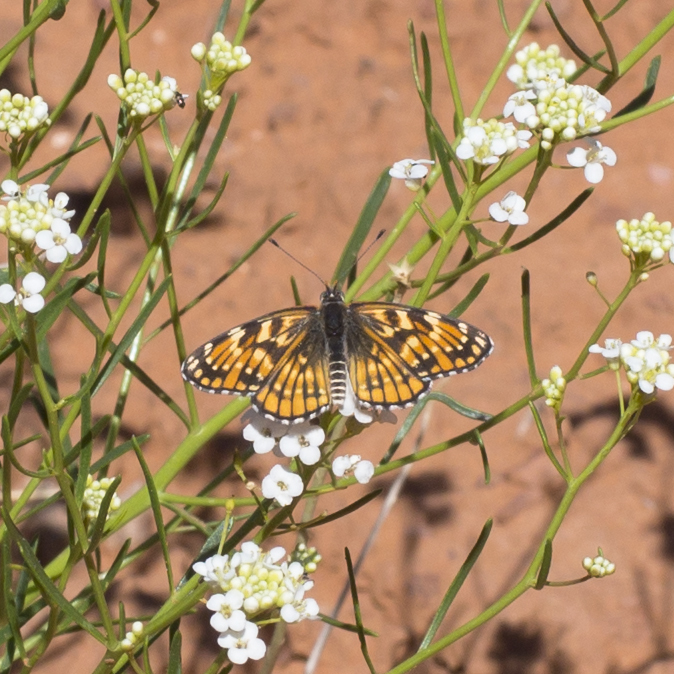
The Leanira Checkerspot is a medium-sized butterfly in the family Nymphalidae, with adults measuring approximately 32-44 mm (1.3-1.7 inches) in wingspan. The dorsal wing surfaces display the characteristic checkerspot pattern of alternating orange, black, and white patches arranged in bands across the forewings and hindwings. The ventral surfaces are lighter, with cream-colored bands separated by darker markings. Males and females are similar in appearance, though females are typically slightly larger with more subdued coloration. The species occurs in scattered populations across western North America, ranging from western Oregon south through California, Nevada, Utah, and western Colorado, extending into Baja California, Mexico. Within California, populations are documented from the Sierra Nevada foothills, Coast Ranges, and desert mountains. The distribution pattern reflects the species' specialized habitat requirements and localized population structure, with many populations isolated from one another by unsuitable habitat. Leanira Checkerspots inhabit open woodlands, chaparral, and scrubland environments, typically at elevations ranging from 300 to 2,400 meters (1,000 to 8,000 feet). The species shows a strong association with areas containing their host plants and requires sites with appropriate microclimatic conditions. Adults are most commonly observed on south-facing slopes and in clearings where host plants grow in association with other native vegetation. Suitable habitat often includes areas with rocky outcrops or scattered trees that provide nectar sources and shelter. This butterfly is univoltine, producing one generation per year. Adults emerge from late spring through early summer, typically flying from April through July depending on elevation and local conditions. Mating occurs soon after emergence, with females laying clusters of small, pale yellow eggs on the undersides of host plant leaves. The larvae are specialized feeders on paintbrush species (Castilleja), with different populations potentially utilizing different Castilleja species depending on local availability. Caterpillars develop through five instars before pupating, with the pupal stage lasting approximately two weeks. Adults nectar on various flowering plants including their host species, buckwheat, and other native wildflowers. The Leanira Checkerspot currently holds no federal or state listing status, though local populations may face conservation challenges. The species' scattered distribution pattern and specialized host plant requirements make it potentially vulnerable to habitat fragmentation and loss. Urban development, livestock grazing, and altered fire regimes can impact both host plant availability and suitable breeding habitat. Climate change may affect the timing of emergence relative to host plant phenology, potentially disrupting reproductive success. Conservation of this species depends on maintaining intact native plant communities that support both Castilleja host plants and nectar sources. Some populations occur within protected areas, but many are on private lands where habitat management practices can significantly influence population persistence.
Classification
Class: Insecta · Order: Lepidoptera · Family: Nymphalidae
Frequently asked questions
How is Chlosyne leanira classified?
Chlosyne leanira belongs to class Insecta, order Lepidoptera, family Nymphalidae.
What family does Chlosyne leanira belong to?
Chlosyne leanira is in the Nymphalidae family.
What is Chlosyne leanira?
The Leanira Checkerspot is a medium-sized butterfly in the family Nymphalidae, with adults measuring approximately 32-44 mm (1.3-1.7 inches) in wingspan.
Is Chlosyne leanira found in California?
Yes. Chlosyne leanira is recorded in California in The California Species Project's catalogue.
Related species
Other California species in the same genus, family, or bioregion.
Data from The California Species Project — 14,000+ California species with verified data from CNPS, CDFW, USFWS, and more.