Choeronycteris mexicana
Mexican Long-tongued Bat
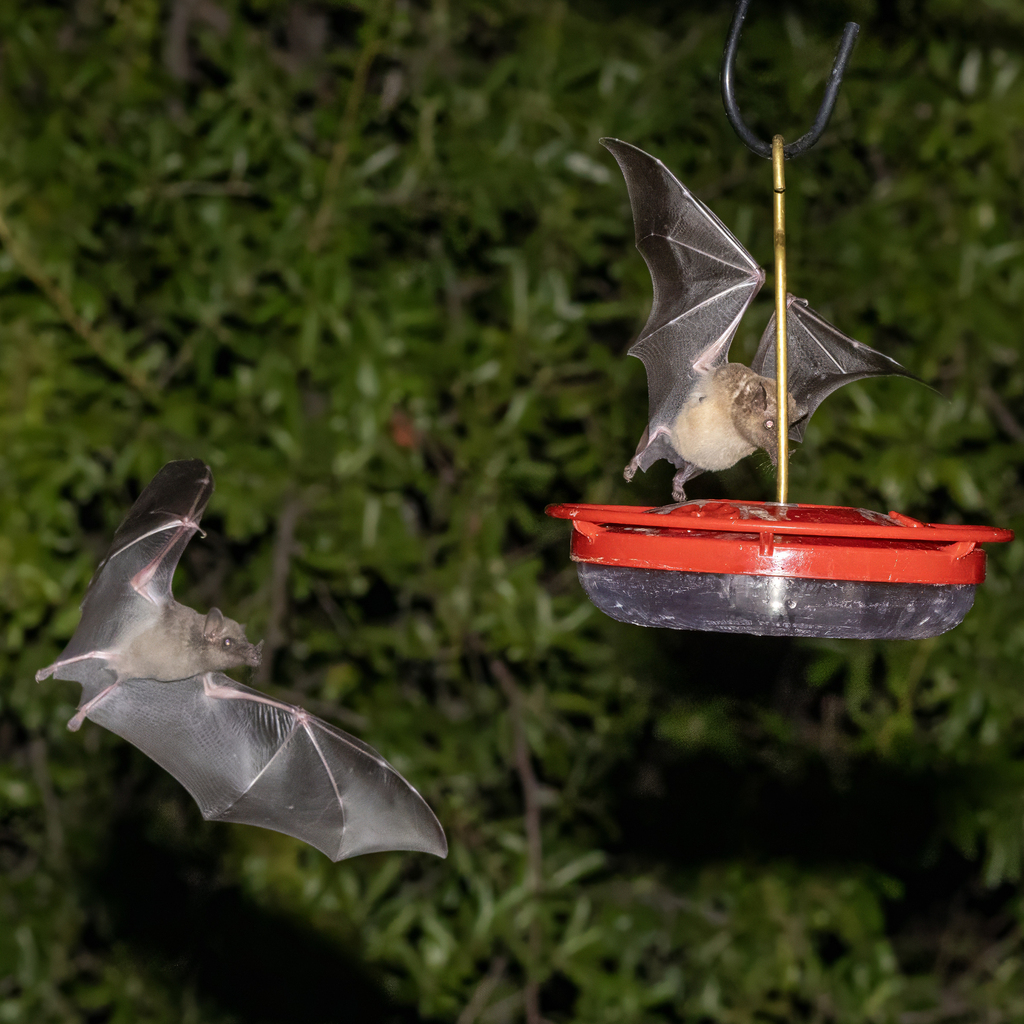
(c) Dan Vickers, some rights reserved (CC BY) · licence
Family: Phyllostomidae · Class: Mammalia · Order: Chiroptera
Conservation status: G3G4 S1
Choeronycteris mexicana (Mexican Long-tongued Bat) is a California animal in the Phyllostomidae family.
The Mexican Long-tongued Bat is a medium-sized nectar-feeding bat with distinctive morphological adaptations for its specialized diet. Adults measure 75 to 100 mm (3.0 to 3.9 inches) in total length with a forearm length of 40 to 46 mm (1.6 to 1.8 inches). Body weight ranges from 10 to 25 grams (0.35 to 0.88 ounces). The species exhibits a notably elongated rostrum and an extensible tongue that can reach up to 76 mm (3 inches) in length, representing approximately one-third of the bat's total body length. The pelage is dark brown to grayish-brown dorsally with slightly paler ventral coloration. The ears are large and pointed, and the nose leaf is well-developed, contributing to its alternative common name, Hog-nosed Bat. The species ranges from the southwestern United States through Mexico and Central America to northern South America. In California, the Mexican Long-tongued Bat is known from very few records in the extreme southern portion of the state, primarily in Imperial and San Diego counties. Historical records exist from desert regions near the Mexican border, though confirmed recent occurrences are extremely limited. The species reaches the northern limit of its range in Arizona, New Mexico, and southern California. Mexican Long-tongued Bats inhabit arid and semi-arid environments, including desert scrub, thornscrub, and oak-pine woodlands at elevations from sea level to approximately 2,300 meters (7,500 feet). In California, they are associated with Sonoran Desert habitats characterized by columnar cacti, agaves, and other desert flowering plants. The species requires access to both roosting sites, typically caves, mines, or buildings, and abundant nectar sources within foraging range. This species is highly specialized as a nectar feeder, with co-evolutionary relationships with various flowering plants including agaves, columnar cacti, and certain trees. The bat's long tongue and hovering flight capability allow it to extract nectar from deep tubular flowers. Reproduction is seasonal, typically coinciding with peak flowering periods of preferred food plants. Females form maternity colonies during the breeding season, with gestation lasting approximately 6 to 7 months. A single pup is born annually, usually between May and July. The Mexican Long-tongued Bat is not federally listed but is considered extremely rare in California with a state rank of S1, indicating it is critically imperiled. The global rank of G3G4 suggests the species is vulnerable to moderately secure range-wide. Primary threats include habitat loss due to urbanization and agricultural conversion, disturbance of roosting sites, and potential impacts from climate change on flowering phenology of food plants. The species' specialized ecological requirements and apparent rarity in California make it particularly vulnerable to environmental changes. Conservation efforts should focus on protecting known roosting sites and maintaining corridors of native desert vegetation that support nectar-producing plants essential to the species' survival.
Classification
Class: Mammalia · Order: Chiroptera · Family: Phyllostomidae
Conservation status
G3G4 S1
Frequently asked questions
How is Choeronycteris mexicana classified?
Choeronycteris mexicana belongs to class Mammalia, order Chiroptera, family Phyllostomidae.
What family does Choeronycteris mexicana belong to?
Choeronycteris mexicana is in the Phyllostomidae family.
Is Choeronycteris mexicana protected or of conservation concern?
Choeronycteris mexicana carries the following status: G3G4 S1.
What is Choeronycteris mexicana?
The Mexican Long-tongued Bat is a medium-sized nectar-feeding bat with distinctive morphological adaptations for its specialized diet.
Is Choeronycteris mexicana found in California?
Yes. Choeronycteris mexicana is recorded in California in The California Species Project's catalogue.
Related species
Other California species in the same genus, family, or bioregion.
Data from The California Species Project — 14,000+ California species with verified data from CNPS, CDFW, USFWS, and more.