Chordeiles acutipennis
Lesser Nighthawk
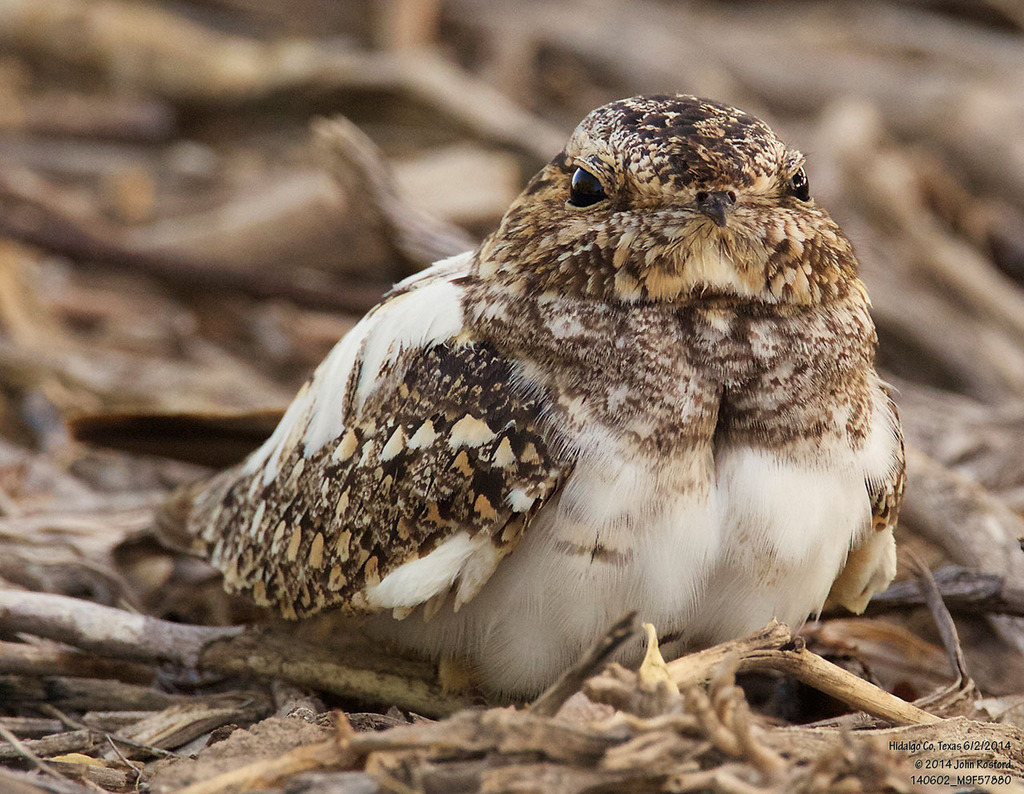
(c) John Rosford, some rights reserved (CC BY) · licence
Family: Caprimulgidae · Class: Aves · Order: Caprimulgiformes
Chordeiles acutipennis (Lesser Nighthawk) is a California animal in the Caprimulgidae family.
The Lesser Nighthawk is a medium-sized nightjar measuring 20 to 23 cm (8 to 9 inches) in length with a wingspan of 53 to 58 cm (21 to 23 inches). Adults weigh between 40 to 65 grams. The species exhibits cryptic plumage with mottled brown, gray, and buff coloration that provides effective camouflage against soil and vegetation. Males display white throat patches and white wing bars visible during flight, while females show buff-colored throat patches. The wings are relatively long and pointed, with white patches near the wingtips that distinguish this species from the Common Nighthawk. When perched, Lesser Nighthawks sit lengthwise on branches rather than across them, a distinctive behavioral characteristic. The Lesser Nighthawk occurs across the southwestern United States and extends south through Mexico and Central America. In California, the species is found primarily in the Central Valley, southern coastal regions, and desert areas of the Mojave and Sonoran deserts. The breeding range includes Imperial, Riverside, San Bernardino, Kern, Fresno, Kings, Tulare, and Merced counties. Some populations are year-round residents in southern California, while northern populations migrate south for winter. The species has expanded its range northward in California over recent decades, likely in response to agricultural development and urbanization. Lesser Nighthawks inhabit open areas including desert scrub, agricultural fields, riparian corridors, urban parks, and suburban areas with scattered trees. The species occurs from sea level to approximately 2,000 meters (6,500 feet) elevation. They require open ground for foraging and low perches such as fence posts, power lines, or bare branches for roosting during daylight hours. Nesting occurs directly on bare ground, gravel surfaces, or flat rooftops, often with minimal or no nest construction. These insectivorous birds are crepuscular and nocturnal hunters, capturing flying insects through aerial hawking. Their diet consists primarily of moths, beetles, flying ants, and other small insects. Lesser Nighthawks employ a distinctive hunting strategy, flying low over open areas with erratic, bat-like flight patterns. Breeding occurs from April through August, with females laying one to two eggs directly on the ground. The incubation period lasts 18 to 19 days, and both parents participate in caring for the young. Chicks are precocial and able to move short distances within hours of hatching. Adults perform distraction displays when threatened, feigning injury to draw predators away from eggs or young. The Lesser Nighthawk is not federally listed and maintains stable populations across much of its range as of December 2025. However, the species faces threats from habitat loss due to agricultural intensification, urban development, and pesticide use that reduces insect prey availability. Collisions with vehicles and structures pose additional mortality risks. Climate change may affect insect prey abundance and distribution patterns. Conservation efforts focus on maintaining open habitat areas and reducing pesticide applications in agricultural regions where the species occurs.
Classification
Class: Aves · Order: Caprimulgiformes · Family: Caprimulgidae
Frequently asked questions
How is Chordeiles acutipennis classified?
Chordeiles acutipennis belongs to class Aves, order Caprimulgiformes, family Caprimulgidae.
What family does Chordeiles acutipennis belong to?
Chordeiles acutipennis is in the Caprimulgidae family.
What is Chordeiles acutipennis?
The Lesser Nighthawk is a medium-sized nightjar measuring 20 to 23 cm (8 to 9 inches) in length with a wingspan of 53 to 58 cm (21 to 23 inches).
Is Chordeiles acutipennis found in California?
Yes. Chordeiles acutipennis is recorded in California in The California Species Project's catalogue.
Related species
Other California species in the same genus, family, or bioregion.
Data from The California Species Project — 14,000+ California species with verified data from CNPS, CDFW, USFWS, and more.