Chordeiles minor
Common Nighthawk
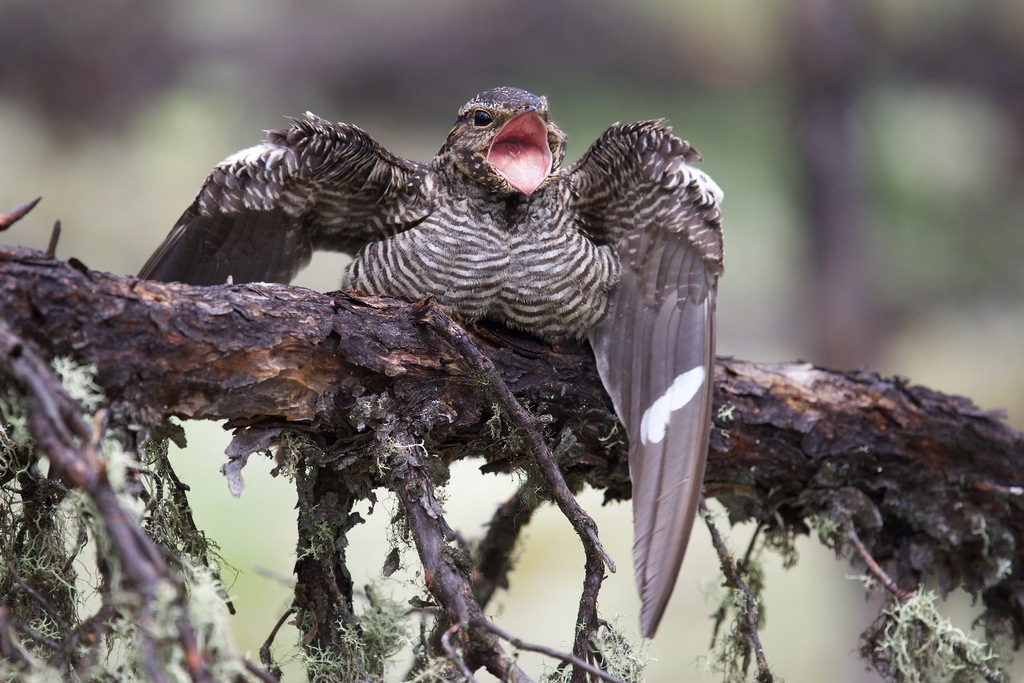
(c) Owen Strickland, some rights reserved (CC BY) · licence
Family: Caprimulgidae · Class: Aves · Order: Caprimulgiformes
Chordeiles minor (Common Nighthawk) is a California animal in the Caprimulgidae family.
The Common Nighthawk is a medium-sized aerial insectivore measuring 21 to 25 cm (8.3 to 9.8 inches) in length with a wingspan of 51 to 61 cm (20 to 24 inches). Adults weigh 65 to 98 grams. The species exhibits cryptic plumage with mottled gray, brown, and black coloration that provides camouflage against bark and ground surfaces. Males display a distinctive white throat patch and white bands across the tail and wings, while females have buff-colored throats and lack the prominent white tail bands. Both sexes show conspicuous white patches near the wing tips that are visible in flight. Common Nighthawks breed across most of North America, from southern Canada to Central America. In California, the species occurs primarily in the northern and eastern portions of the state, including the Cascade Range, Sierra Nevada, and portions of the Central Valley. Breeding populations are found in Siskiyou, Modoc, Lassen, and Shasta counties, with scattered records extending south through the Sierra Nevada to Inyo and Mono counties. The species is largely absent from coastal regions and the southern deserts. The species inhabits open habitats including grasslands, agricultural areas, burned forests, urban environments, and rocky outcrops. Common Nighthawks nest on bare ground, gravel rooftops, or sparsely vegetated surfaces from sea level to elevations exceeding 2,400 meters (7,900 feet). Urban populations commonly utilize flat gravel roofs of commercial and industrial buildings. The species requires open areas for foraging and minimal vegetation cover at nest sites. Common Nighthawks are crepuscular and nocturnal, feeding exclusively on flying insects captured during aerial foraging. Their diet consists primarily of flying ants, beetles, moths, mosquitoes, and other small flying arthropods. Breeding occurs from May through August, with females laying one to two eggs directly on bare substrate without constructing a formal nest. Incubation lasts 18 to 19 days, and young fledge after 17 to 18 days. Males perform distinctive courtship displays involving steep aerial dives that produce loud booming sounds created by air rushing through their primary flight feathers. The Common Nighthawk is not federally listed but has experienced significant population declines across much of its North American range. According to the North American Breeding Bird Survey, continental populations declined by approximately 61 percent between 1966 and 2015. In California, breeding populations appear stable but remain limited in distribution. Primary threats include habitat loss from development, pesticide use that reduces insect prey availability, and collisions with vehicles and structures. Climate change may affect insect abundance and alter suitable breeding habitat. The species benefits from habitat management that maintains open areas and reduces pesticide applications in breeding territories.
Classification
Class: Aves · Order: Caprimulgiformes · Family: Caprimulgidae
Frequently asked questions
How is Chordeiles minor classified?
Chordeiles minor belongs to class Aves, order Caprimulgiformes, family Caprimulgidae.
What family does Chordeiles minor belong to?
Chordeiles minor is in the Caprimulgidae family.
What is Chordeiles minor?
The Common Nighthawk is a medium-sized aerial insectivore measuring 21 to 25 cm (8.3 to 9.8 inches) in length with a wingspan of 51 to 61 cm (20 to 24 inches).
Is Chordeiles minor found in California?
Yes. Chordeiles minor is recorded in California in The California Species Project's catalogue.
Related species
Other California species in the same genus, family, or bioregion.
Data from The California Species Project — 14,000+ California species with verified data from CNPS, CDFW, USFWS, and more.