Choristoneura conflictana
Large Aspen Tortrix Moth
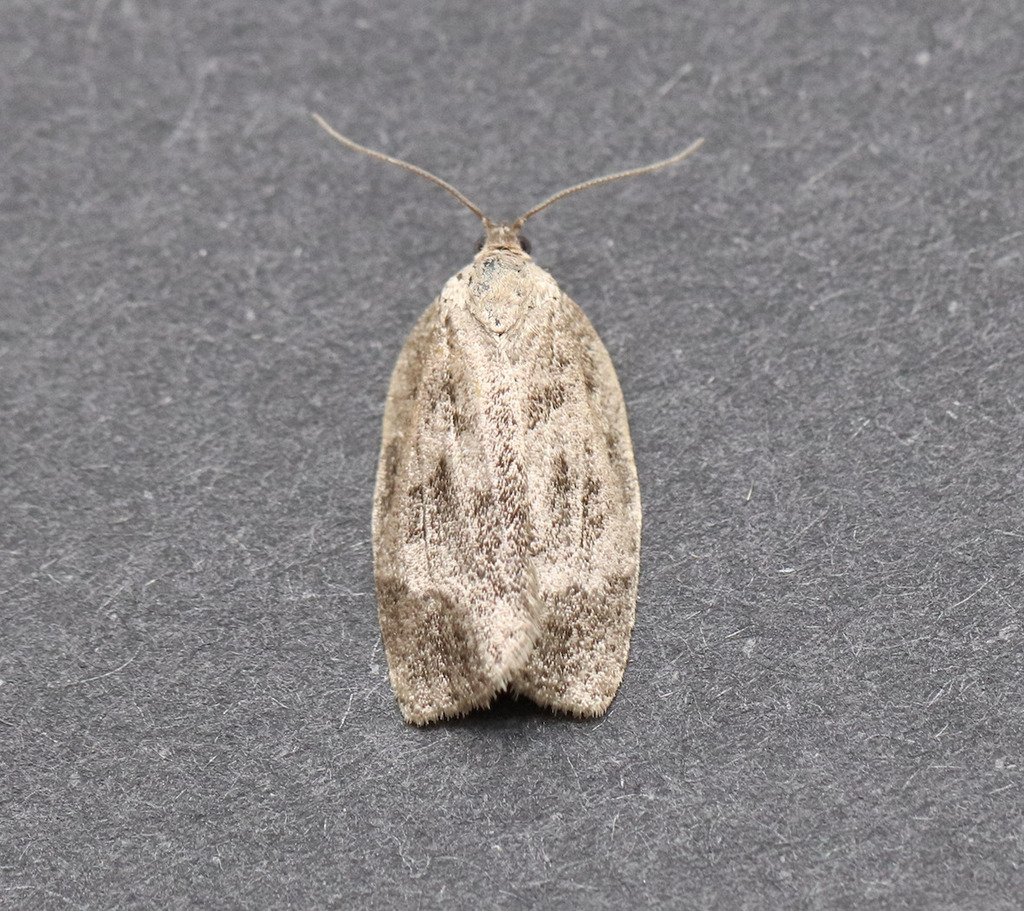
(c) Jason Grant, some rights reserved (CC BY) · licence
Family: Tortricidae · Class: Insecta · Order: Lepidoptera
Choristoneura conflictana (Large Aspen Tortrix Moth) is a California animal in the Tortricidae family.
The Large Aspen Tortrix Moth (Choristoneura conflictana) is a moderately-sized lepidopteran in the family Tortricidae, distinguished by its distinctive wing patterns and ecological association with aspen forests. Adults typically measure 18 to 25 mm in wingspan, with forewings displaying a mottled brown and gray coloration marked by darker transverse bands and pale reticulated patterns. The hindwings are pale gray to whitish. At rest, the moth holds its wings in a characteristic bell-shaped profile typical of tortricid moths. This species exhibits one of the broadest distributions among North American tortricid moths, occurring from the Pacific to the Atlantic coasts and ranging from Alaska south to California, Arizona, and New Mexico. The distribution closely mirrors that of its primary host plant, trembling aspen (Populus tremuloides), creating a transcontinental range across the boreal and montane regions of North America. In California, populations are found in the Sierra Nevada and other mountainous regions where aspen stands occur. The Large Aspen Tortrix inhabits deciduous and mixed forests dominated by trembling aspen, typically at elevations ranging from 1,500 to 3,000 meters in western North America. These habitats include aspen groves in montane meadows, riparian zones, and forest edges where aspen regeneration is active. The species requires areas with sufficient aspen density to support larval development and is most abundant in younger aspen stands with vigorous foliage growth. Larvae are leaf-tiers and defoliators, feeding primarily on trembling aspen but also utilizing other associated broad-leaved trees including willows (Salix species), birches (Betula species), and occasionally poplars (Populus species). Female moths deposit eggs in masses on aspen bark, typically in July and August. Eggs overwinter and hatch in spring coinciding with aspen bud break. Larvae feed within silken shelters constructed by tying leaves together, progressing through five instars over approximately six weeks. Pupation occurs within the leaf shelter in late June to early July. Adults emerge in mid to late summer, with peak flight activity occurring from July through September depending on elevation and latitude. The species exhibits cyclical population dynamics characteristic of many forest defoliators, with outbreaks occurring at irregular intervals of 8 to 15 years. During outbreak years, larvae can cause significant defoliation of aspen stands, though healthy trees typically recover through refoliation later in the growing season. Choristoneura conflictana is not federally or state-listed and appears to maintain stable populations across its range. The species benefits from the widespread distribution of trembling aspen and generally faces few conservation threats. Climate change may affect population dynamics by altering aspen distribution and phenology, particularly at southern range margins where warming temperatures could reduce suitable habitat. Forest management practices that maintain aspen ecosystem health support stable moth populations.
Classification
Class: Insecta · Order: Lepidoptera · Family: Tortricidae
Frequently asked questions
How is Choristoneura conflictana classified?
Choristoneura conflictana belongs to class Insecta, order Lepidoptera, family Tortricidae.
What family does Choristoneura conflictana belong to?
Choristoneura conflictana is in the Tortricidae family.
What is Choristoneura conflictana?
The Large Aspen Tortrix Moth (Choristoneura conflictana) is a moderately-sized lepidopteran in the family Tortricidae, distinguished by its distinctive wing patterns and ecological association with aspen forests.
Is Choristoneura conflictana found in California?
Yes. Choristoneura conflictana is recorded in California in The California Species Project's catalogue.
Related species
Other California species in the same genus, family, or bioregion.
Data from The California Species Project — 14,000+ California species with verified data from CNPS, CDFW, USFWS, and more.