Chroicocephalus ridibundus
Black-headed Gull
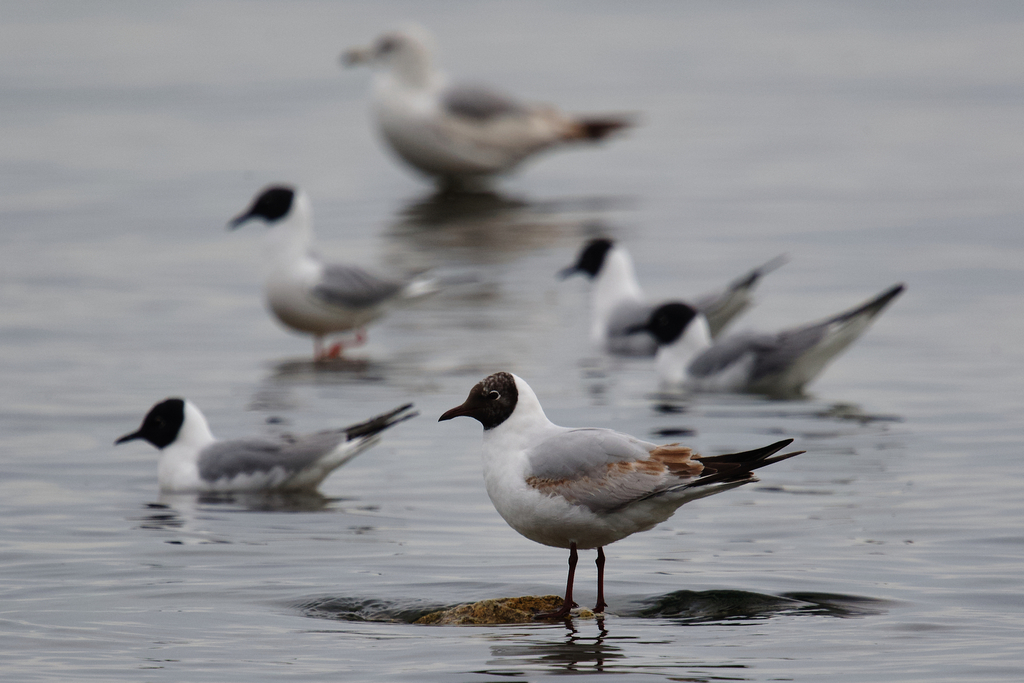
(c) Owen Strickland, some rights reserved (CC BY) · licence
Family: Laridae · Class: Aves · Order: Charadriiformes
Chroicocephalus ridibundus (Black-headed Gull) is a California animal in the Laridae family.
The Black-headed Gull is a medium-sized seabird measuring 35 to 40 cm (14 to 16 inches) in length with a wingspan of 86 to 99 cm (34 to 39 inches). Adults in breeding plumage display a distinctive dark brown hood that extends to the nape, contrasting with white underparts and pale gray upperparts. The bill is bright red with a dark tip, and the legs are orange-red. In non-breeding plumage, the dark hood is replaced by a partial dark ear patch and smudged crown markings. The wings show white leading edges and black wingtips with white spots, creating a distinctive pattern visible in flight. The Black-headed Gull is primarily a Eurasian species with breeding populations extending from Iceland and the British Isles east across northern Europe and Asia. In North America, it occurs as a rare vagrant, with documented records along the Atlantic, Pacific, and Gulf coasts. California records are infrequent but regular, with sightings reported from coastal areas including San Francisco Bay, Monterey Bay, and southern California beaches. The species has been recorded at various inland locations including the Salton Sea and scattered freshwater bodies throughout the state. This gull inhabits a diverse range of aquatic environments including coastal waters, estuaries, harbors, lakes, reservoirs, and agricultural areas. During the breeding season in its native range, it frequents marshes, prairie potholes, and inland wetlands with emergent vegetation. In California, vagrant individuals are most commonly observed in mixed gull flocks along beaches, mudflats, and coastal lagoons. The species adapts readily to human-modified environments including sewage treatment facilities, garbage dumps, and urban parks with water features. Black-headed Gulls are opportunistic omnivores with a varied diet including small fish, marine invertebrates, insects, earthworms, and plant matter. They employ diverse foraging strategies including surface dipping, shallow diving, gleaning from substrates, and following agricultural equipment to capture disturbed prey. The species breeds colonially, typically nesting on the ground in dense vegetation or on artificial structures. Nests are constructed from grass, reeds, and other plant material. Females lay 2 to 3 olive-brown eggs with dark markings, which are incubated for 23 to 26 days. Both parents participate in incubation and chick-rearing duties. The Black-headed Gull holds no special conservation status in California due to its vagrant occurrence. Globally, the species is classified as Least Concern by the International Union for Conservation of Nature, with stable or increasing populations across most of its range. In Europe, populations have expanded significantly since the mid-20th century, with breeding range extensions and population growth attributed to reduced persecution, habitat creation, and adaptation to human-modified landscapes. Climate change may influence future distribution patterns and migration routes, potentially affecting the frequency of vagrant occurrences in California waters.
Classification
Class: Aves · Order: Charadriiformes · Family: Laridae
Frequently asked questions
How is Chroicocephalus ridibundus classified?
Chroicocephalus ridibundus belongs to class Aves, order Charadriiformes, family Laridae.
What family does Chroicocephalus ridibundus belong to?
Chroicocephalus ridibundus is in the Laridae family.
What is Chroicocephalus ridibundus?
The Black-headed Gull is a medium-sized seabird measuring 35 to 40 cm (14 to 16 inches) in length with a wingspan of 86 to 99 cm (34 to 39 inches).
Is Chroicocephalus ridibundus found in California?
Yes. Chroicocephalus ridibundus is recorded in California in The California Species Project's catalogue.
Related species
Other California species in the same genus, family, or bioregion.
Data from The California Species Project — 14,000+ California species with verified data from CNPS, CDFW, USFWS, and more.