Chrysis angolensis
Metallic Bluish-green Cuckoo Wasp
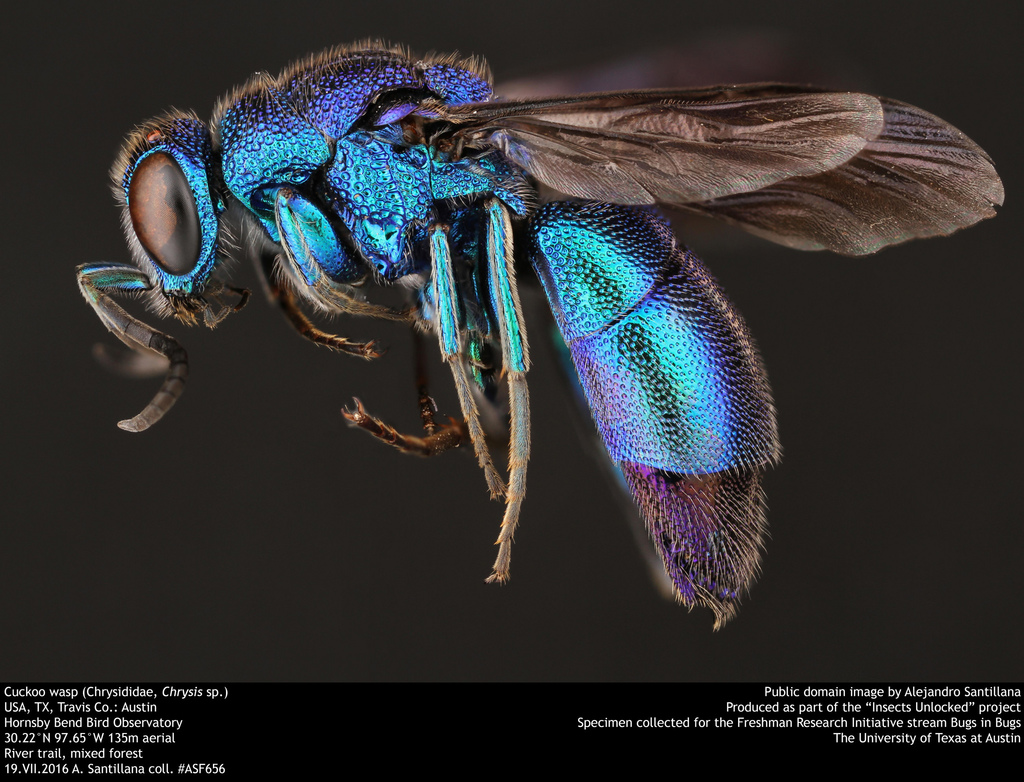
no rights reserved · CC0
Family: Chrysididae · Class: Insecta · Order: Hymenoptera
Chrysis angolensis (Metallic Bluish-green Cuckoo Wasp) is a California animal in the Chrysididae family.
The metallic bluish-green cuckoo wasp (Chrysis angolensis) is a small parasitoid wasp in the family Chrysididae, characterized by its distinctive iridescent metallic coloration. Adults typically measure 3 to 8 mm in length, displaying brilliant emerald green and blue metallic surfaces that shimmer in sunlight. The body appears nearly hairless with a smooth, polished exoskeleton, and the wings are typically dark or smoky. When threatened, individuals curl their abdomen defensively and may exhibit distinctive wing-waggling behavior, alternating extension of wings from side to side (BugGuide 2017). Chrysis angolensis has a nearly cosmopolitan distribution, occurring worldwide except for Europe (USFWS Hawaii Biological Survey). This non-native species was introduced to North America from the Palaearctic region during the 1940s and has since established populations across the continent (BugGuide). In California, the species occurs throughout various regions, though specific county-level distribution data remains limited. The species has been documented as far north as Georgia and across multiple western states. This cuckoo wasp inhabits diverse environments including urban gardens, overgrown fields, forest edges, and areas with abundant flowering vegetation. Adults are commonly observed on vegetative parts of plants rather than flowers, distinguishing them from many bee species. They frequent areas near compost piles, shrublands with sweetgum trees, and other disturbed habitats. The species appears adaptable to various elevation ranges and habitat types, contributing to its successful establishment as an introduced species. As a member of the cuckoo wasp family, C. angolensis exhibits kleptoparasitic behavior, with females seeking out nests of solitary bees and wasps to lay their eggs. The larvae consume the host's provisions and may also parasitize the host larvae directly. Adults are active during warm months, with peak activity observed in summer. When approached, adults display characteristic defensive behaviors including abdominal curling and rapid circular movements. The species demonstrates strong flight capabilities and can be observed perching on various shrubs and low vegetation. Currently, Chrysis angolensis has no formal conservation status listings at federal, state, or global levels. NatureServe lists the global status as GNR (Global Not Ranked), indicating insufficient data for conservation assessment. As an established non-native species, it faces no apparent conservation threats and may actually benefit from habitat modification and urbanization. The species' successful colonization of North America demonstrates its ecological adaptability. However, its impact on native bee and wasp populations requires further study, as cuckoo wasps can affect native host species through parasitism. Population trends and ecological interactions with California's native fauna remain poorly documented, highlighting the need for additional research on this widespread introduced species.
Classification
Class: Insecta · Order: Hymenoptera · Family: Chrysididae
Frequently asked questions
How is Chrysis angolensis classified?
Chrysis angolensis belongs to class Insecta, order Hymenoptera, family Chrysididae.
What family does Chrysis angolensis belong to?
Chrysis angolensis is in the Chrysididae family.
What is Chrysis angolensis?
The metallic bluish-green cuckoo wasp (Chrysis angolensis) is a small parasitoid wasp in the family Chrysididae, characterized by its distinctive iridescent metallic coloration.
Is Chrysis angolensis found in California?
Yes. Chrysis angolensis is recorded in California in The California Species Project's catalogue.
Related species
Other California species in the same genus, family, or bioregion.
Data from The California Species Project — 14,000+ California species with verified data from CNPS, CDFW, USFWS, and more.