Chrysochus cobaltinus
Cobalt Milkweed Beetle
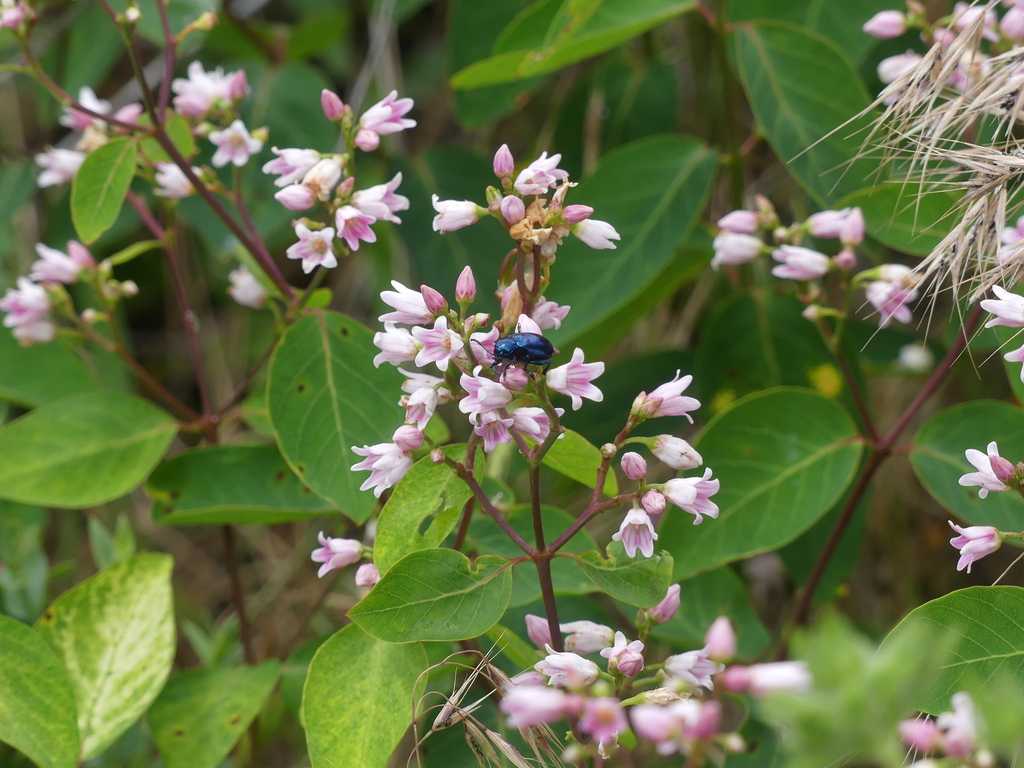
(c) Aiva Noringseth, some rights reserved (CC BY) · licence
Family: Chrysomelidae · Class: Insecta · Order: Coleoptera
Chrysochus cobaltinus (Cobalt Milkweed Beetle) is a California animal in the Chrysomelidae family.
The cobalt milkweed beetle is a small, metallic leaf beetle measuring 6 to 9 millimeters (0.24 to 0.35 inches) in length. The head, body, and antennae display a metallic cobalt-blue to blue-green coloration, sometimes appearing almost black depending on lighting conditions (Xerces Society 2018). This distinctive metallic sheen distinguishes it from other leaf beetles in its range. Chrysoschus cobaltinus occurs throughout the western United States, with its distribution restricted to California, Oregon, Washington, Idaho, western Nevada, western Montana, and central Utah (Dobler and Farrell 1999). The species' range is nearly exclusive from its eastern relative, the dogbane leaf beetle (C. auratus), with only limited overlap in south-central British Columbia and portions of Washington and Oregon (Peterson et al. 2001). In California, the beetle is found across suitable habitat types that support its milkweed host plants. The species inhabits areas where its host plants occur, primarily in grasslands, meadows, riparian zones, and disturbed areas where milkweeds thrive. Adults are commonly observed on milkweed foliage during the growing season, while larvae develop in the soil around host plant root systems. The beetle shows a preference for open to semi-open habitats where milkweeds receive adequate sunlight. Cobalt milkweed beetles are specialized herbivores with a narrow host plant range. Adults feed extensively on milkweed foliage, particularly woolypod milkweed (Asclepias eriocarpa), showy milkweed (A. speciosa), narrowleaf milkweed (A. fascicularis), and heartleaf milkweed (A. cordifolia), as well as dogbane (Apocynum cannabinum) (Xerces Society 2018). Their feeding can cause significant leaf defoliation on individual plants. Larvae feed on the root systems of these same host plants, completing their development underground. The beetle's ability to process the toxic cardiac glycosides found in milkweeds represents a specialized evolutionary adaptation. Adults are most active during the warmer months when milkweeds are actively growing, with peak activity typically occurring in summer. Chrysoschus cobaltinus is not federally or state listed and appears to maintain stable populations throughout its range. According to NatureServe, the species has a global conservation rank of G5 (Secure), indicating no immediate conservation concerns (NatureServe 2025). However, the beetle's dependence on milkweed host plants makes it potentially vulnerable to habitat loss and changes in land management practices that affect native plant communities. In agricultural settings where milkweeds are cultivated for monarch butterfly conservation, the cobalt milkweed beetle can reach pest densities requiring management intervention (Xerces Society 2017). Conservation of native grassland and riparian habitats that support diverse milkweed populations benefits both this beetle and other milkweed-dependent species, including the monarch butterfly. Climate change and continued habitat conversion represent potential long-term threats to the species' distribution and abundance.
Classification
Class: Insecta · Order: Coleoptera · Family: Chrysomelidae
Frequently asked questions
How is Chrysochus cobaltinus classified?
Chrysochus cobaltinus belongs to class Insecta, order Coleoptera, family Chrysomelidae.
What family does Chrysochus cobaltinus belong to?
Chrysochus cobaltinus is in the Chrysomelidae family.
What is Chrysochus cobaltinus?
The cobalt milkweed beetle is a small, metallic leaf beetle measuring 6 to 9 millimeters (0.24 to 0.35 inches) in length.
Is Chrysochus cobaltinus found in California?
Yes. Chrysochus cobaltinus is recorded in California in The California Species Project's catalogue.
Related species
Other California species in the same genus, family, or bioregion.
Data from The California Species Project — 14,000+ California species with verified data from CNPS, CDFW, USFWS, and more.