Chrysolina hyperici
Saint John's Wort Beetle
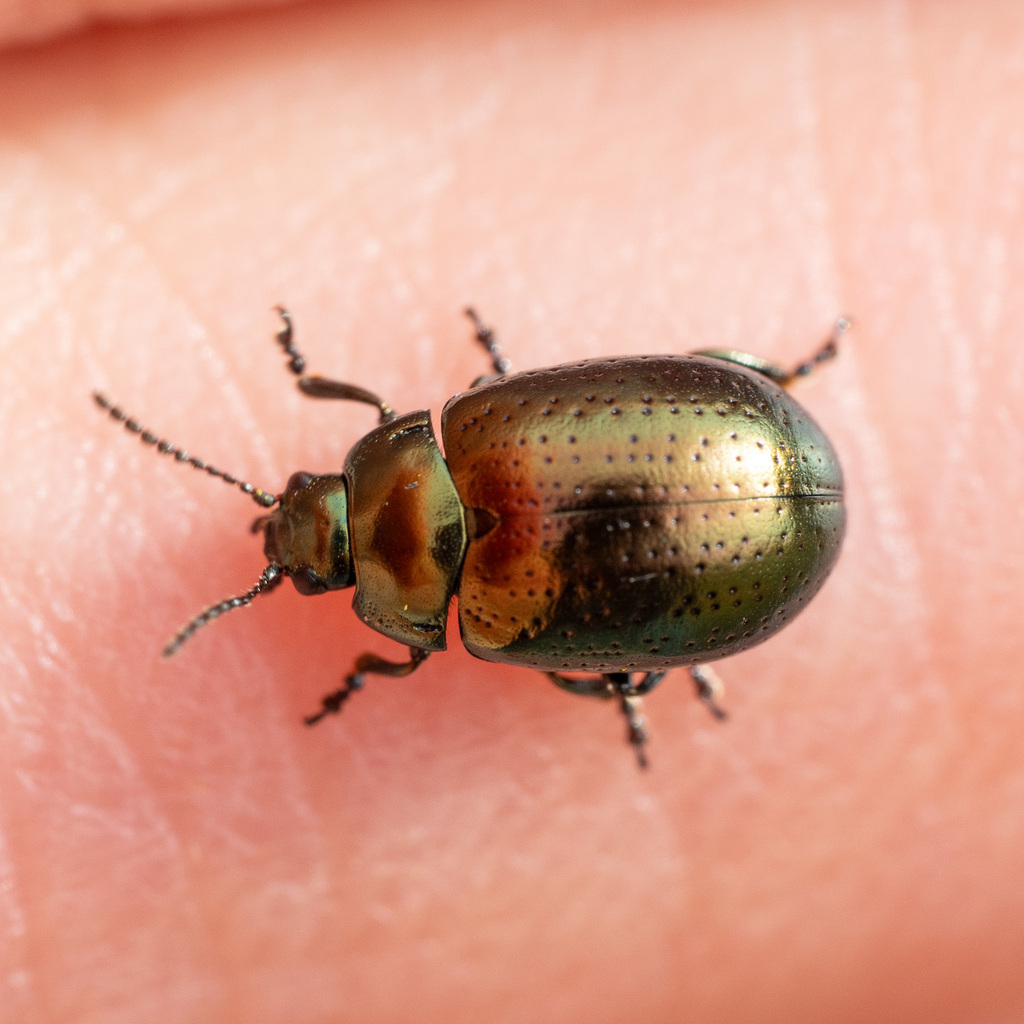
(c) Andrew McKinlay, some rights reserved (CC BY) · licence
Family: Chrysomelidae · Class: Insecta · Order: Coleoptera
Chrysolina hyperici (Saint John's Wort Beetle) is a California animal in the Chrysomelidae family.
The Saint John's Wort Beetle (Chrysolina hyperici) is a small metallic leaf beetle in the family Chrysomelidae, originally native to the western Palearctic region. Adults measure approximately 4-7 mm in length and display a distinctive bronze to coppery-green metallic sheen. The oval-shaped body is convex dorsally with short antennae and robust legs typical of chrysomelid beetles. The elytra (wing covers) are punctate with fine rows of small depressions, and the species can be distinguished from related Chrysolina species by its smaller size and specific coloration pattern. This species was intentionally introduced to North America as a biological control agent for Saint John's wort (Hypericum perforatum), an invasive European plant species. In California, the beetle has become established in areas where its host plant occurs, primarily in disturbed habitats, grasslands, and open woodlands. The species has been documented in multiple western states including California, Washington, Oregon, and Montana, typically following the distribution of its target weed species (BugGuide). Chrysolina hyperici inhabits areas where Saint John's wort grows, including roadsides, abandoned fields, pastures, and rangeland. The beetle tolerates a wide range of elevations and climatic conditions, adapting to various habitat types as long as suitable host plants are present. Adults are most commonly found on or near Saint John's wort plants during the growing season, particularly in areas with moderate moisture and partial to full sun exposure. The species exhibits a typical chrysomelid life cycle with complete metamorphosis. Adults emerge in late spring and feed extensively on Saint John's wort foliage, creating characteristic feeding damage through skeletonizing leaves and consuming flower buds. Females deposit clusters of yellow eggs on the undersides of host plant leaves during summer months. Larvae develop through three instars, continuing to feed on the same host plant before pupating in the soil. The species typically completes one generation per year in most climatic zones, though this may vary with local conditions and latitude. As a deliberately introduced biological control agent, Chrysolina hyperici serves an important ecological function in managing Saint John's wort populations. The beetle's feeding activity can significantly reduce the vigor and reproductive capacity of its host plant, helping to control this invasive species that competes with native vegetation and can be toxic to livestock. The species has been considered successful in many areas where it has been released, demonstrating effective host specificity and population regulation of the target weed. However, its long-term population dynamics and ecological interactions with native insect communities continue to be monitored as part of ongoing biological control assessment programs.
Classification
Class: Insecta · Order: Coleoptera · Family: Chrysomelidae
Frequently asked questions
How is Chrysolina hyperici classified?
Chrysolina hyperici belongs to class Insecta, order Coleoptera, family Chrysomelidae.
What family does Chrysolina hyperici belong to?
Chrysolina hyperici is in the Chrysomelidae family.
What is Chrysolina hyperici?
The Saint John's Wort Beetle (Chrysolina hyperici) is a small metallic leaf beetle in the family Chrysomelidae, originally native to the western Palearctic region.
Is Chrysolina hyperici found in California?
Yes. Chrysolina hyperici is recorded in California in The California Species Project's catalogue.
Related species
Other California species in the same genus, family, or bioregion.
Data from The California Species Project — 14,000+ California species with verified data from CNPS, CDFW, USFWS, and more.