Chrysops excitans
Bothersome Deer Fly
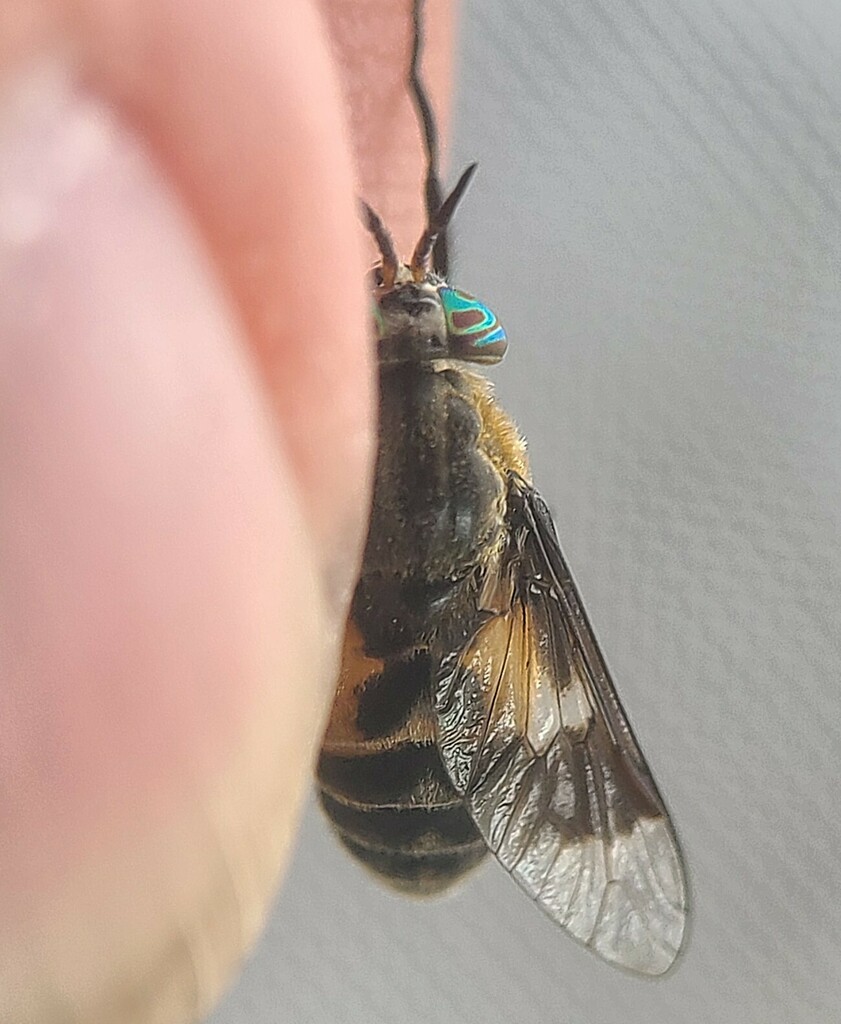
(c) Jimmy Dee, some rights reserved (CC BY-SA) · licence
Family: Tabanidae · Class: Insecta · Order: Diptera
Chrysops excitans (Bothersome Deer Fly) is a California animal in the Tabanidae family.
The Bothersome Deer Fly (Chrysops excitans) is a medium-sized fly in the family Tabanidae, commonly known as deer flies or yellow flies. Adults typically measure 8-12 mm in body length and are characterized by their distinctive wing patterns and robust build. The species displays the typical deer fly morphology with large, prominent compound eyes that are often iridescent green or gold, particularly in males. Wings are broad and feature distinctive dark markings or bands, which help distinguish this species from other Chrysops flies. The thorax is typically dark with lighter markings, while the abdomen shows variable patterns of dark and light coloration. Chrysops excitans has a broad distribution across North America, extending from Canada southward through the United States. According to the British Columbia Conservation Data Centre, the species is present in western Canada, and distribution records indicate occurrence throughout much of the continental United States. The species appears to have a transcontinental range, though specific California distribution patterns require further documentation. Based on the general ecology of Chrysops species, populations likely occur in suitable habitats throughout California's diverse regions. This species inhabits a variety of environments but shows preference for areas near water sources, including wetlands, marshy areas, stream corridors, and lake margins. Adult deer flies are commonly found in wooded areas adjacent to aquatic habitats, as these environments provide both breeding sites and host animals for blood meals. The species can occur from near sea level to moderate elevations, adapting to various forest types and riparian zones where moisture levels support larval development. According to Animal Diversity Web, female Chrysops excitans are ectoparasites that require blood meals from various vertebrates to mature their eggs. Females are aggressive biters and will feed on mammals, birds, and other vertebrates, while males typically feed on nectar and other plant fluids. The common name "Bothersome Deer Fly" reflects their persistent biting behavior and tendency to circle around potential hosts. Larvae develop in aquatic or semi-aquatic environments, typically in mud or organic matter near water sources. The species likely has one generation per year in most regions, with adults most active during warmer months. Mating occurs after females have obtained blood meals, and eggs are typically deposited on vegetation or substrates near water. Chrysops excitans maintains a secure conservation status globally. NatureServe assigns the species a Global Rank of G5 (Secure), indicating stable populations without significant conservation concerns. In Canada, the species holds a national rank of N5 (Secure), reflecting its abundance and lack of significant threats according to available sources. The species is not federally listed in the United States and appears to maintain stable populations across its range. As a native North American species with broad habitat tolerance, C. excitans does not face immediate conservation challenges, though like many insects, populations may be influenced by habitat modification, pesticide use, and climate change impacts on wetland ecosystems.
Classification
Class: Insecta · Order: Diptera · Family: Tabanidae
Frequently asked questions
How is Chrysops excitans classified?
Chrysops excitans belongs to class Insecta, order Diptera, family Tabanidae.
What family does Chrysops excitans belong to?
Chrysops excitans is in the Tabanidae family.
What is Chrysops excitans?
The Bothersome Deer Fly (Chrysops excitans) is a medium-sized fly in the family Tabanidae, commonly known as deer flies or yellow flies.
Is Chrysops excitans found in California?
Yes. Chrysops excitans is recorded in California in The California Species Project's catalogue.
Related species
Other California species in the same genus, family, or bioregion.
Data from The California Species Project — 14,000+ California species with verified data from CNPS, CDFW, USFWS, and more.