Cicindela depressula
Dispirited Tiger Beetle
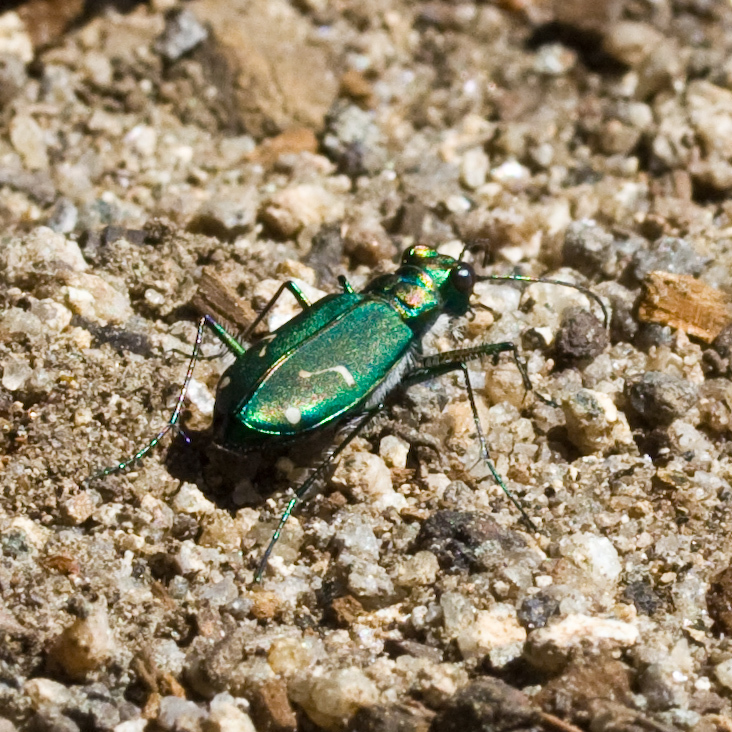
(c) Ken-ichi Ueda, some rights reserved (CC BY) · licence
Family: Cicindelidae · Class: Insecta · Order: Coleoptera
Cicindela depressula (Dispirited Tiger Beetle) is a California animal in the Cicindelidae family.
The Dispirited Tiger Beetle (Cicindela depressula) is a medium-sized predatory beetle belonging to the family Cicindelidae. Adults measure approximately 20 mm (0.8 inches) in length, with a metallic bronze to copper-colored dorsal surface and distinctive pale markings on the elytra (Evans & Hogue 2006). The body is elongated and robust, typical of tiger beetles, with prominent mandibles adapted for capturing prey and long legs designed for rapid pursuit of insects across sandy substrates. This species occurs along the Pacific Coast from extreme northern California north to British Columbia, Canada. In California, the Dispirited Tiger Beetle is primarily found in coastal counties, with documented populations in areas including the Lake Tahoe Basin in Alpine County (BugGuide 2009). The species' range extends inland to mountainous regions of the Sierra Nevada, where it inhabits suitable sandy and gravelly shoreline habitats. The Dispirited Tiger Beetle occupies specialized microhabitats along shorelines, particularly moist sand and gravel at the water's edge of lakes, streams, and coastal areas. Unlike the closely related Pacific Coast Tiger Beetle (Cicindela bellissima frechini), which ventures onto drier sand dunes, C. depressula shows a strong preference for the wet sand zone where moisture levels remain consistently high (BugGuide 2013). This habitat specificity makes the species dependent on undisturbed shoreline environments with natural water level fluctuations. As active predators, Dispirited Tiger Beetles hunt during daylight hours, running rapidly across sandy surfaces to capture small arthropods including flies, ants, and other insects. Adults are most active during warm, sunny conditions and exhibit the characteristic tiger beetle behavior of flying short distances when approached, then landing and resuming their hunting activities. Larvae develop in vertical burrows excavated in sandy soil, where they function as ambush predators, capturing prey that ventures near their burrow entrances. The species likely has a univoltine life cycle, with adults emerging in summer months and remaining active through early fall. The conservation status of Cicindela depressula has not been formally assessed at the federal or state level in California. However, one subspecies, C. d. eureka, has been assigned a global conservation rank of G5T2T4 by NatureServe, indicating the subspecies may be imperiled to vulnerable (NatureServe 2005). The species faces potential threats from coastal development, recreational activities that disturb shoreline habitats, and climate change impacts on water levels. Habitat modification and human foot traffic in sensitive beach and lakshore areas may fragment populations and reduce available breeding sites. Scientific documentation for this species remains limited compared to other tiger beetle species. The information presented here synthesizes available observations from taxonomic references and citizen science platforms. Additional research on population trends, detailed habitat requirements, and subspecific variation would enhance understanding of this Pacific Coast endemic's conservation needs.
Classification
Class: Insecta · Order: Coleoptera · Family: Cicindelidae
Frequently asked questions
How is Cicindela depressula classified?
Cicindela depressula belongs to class Insecta, order Coleoptera, family Cicindelidae.
What family does Cicindela depressula belong to?
Cicindela depressula is in the Cicindelidae family.
What is Cicindela depressula?
The Dispirited Tiger Beetle (Cicindela depressula) is a medium-sized predatory beetle belonging to the family Cicindelidae.
Is Cicindela depressula found in California?
Yes. Cicindela depressula is recorded in California in The California Species Project's catalogue.
Related species
Other California species in the same genus, family, or bioregion.
Data from The California Species Project — 14,000+ California species with verified data from CNPS, CDFW, USFWS, and more.