Cicindela latesignata
Western Beach Tiger Beetle
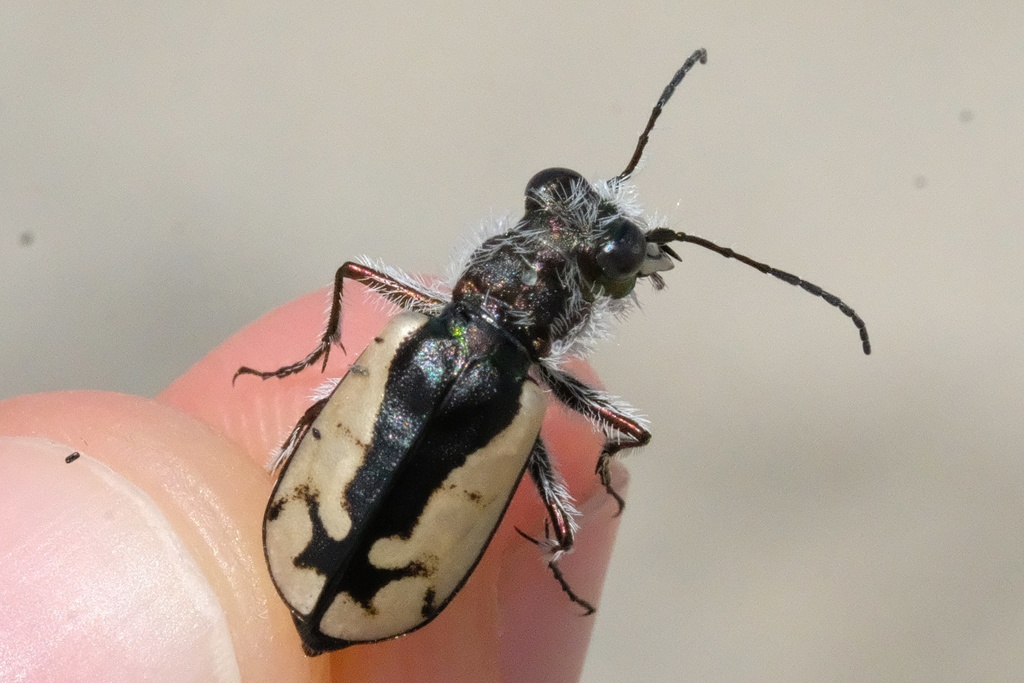
(c) Madeleine Claire, some rights reserved (CC BY) · licence
Family: Cicindelidae · Class: Insecta · Order: Coleoptera
Conservation status: G2G3 S1
Cicindela latesignata (Western Beach Tiger Beetle) is a California animal in the Cicindelidae family.
The Western Beach Tiger Beetle is a small, predatory ground beetle measuring 10 to 15 millimeters (0.4 to 0.6 inches) in length. Adults display a distinctive metallic bronze to copper-colored dorsal surface with pale markings, including a characteristic front marking that varies among populations. The species belongs to the subfamily Cicindelinae within the family Cicindelidae and is classified under the subgenus Cicindela (Cicindela). Historically, the Western Beach Tiger Beetle occurred along the Pacific Coast from British Columbia to Baja California, Mexico. Current populations are severely fragmented, with confirmed occurrences limited to scattered coastal locations in California. The species has been documented in Ventura County, where it inhabits specific beach and dune environments. The subspecies Cicindela latesignata obliviosa is known to occur in California, though the extent of its current distribution remains poorly documented. This species exclusively inhabits coastal sandy beaches and adjacent dune systems. Adults and larvae require specific microhabitat conditions, including areas with appropriate sand grain size, moisture levels, and minimal vegetation cover. The species shows strong fidelity to open sandy substrates near the high tide line and in back-dune areas where wave action and wind maintain suitable habitat conditions. Larvae construct vertical burrows in the sand, requiring specific moisture gradients for successful development. Western Beach Tiger Beetles are active predators in both larval and adult stages. Adults are fast-running hunters that pursue small arthropods and other invertebrates across the sand surface. Larvae are ambush predators that position themselves at burrow entrances to capture passing prey. The species exhibits seasonal activity patterns, with adults typically active during warmer months. Larvae develop through multiple instars in their sand burrows, which can extend 20 to 30 centimeters deep. The complete life cycle spans multiple years, with overwintering occurring in either larval or adult stages depending on population and environmental conditions. The Western Beach Tiger Beetle faces severe conservation challenges, reflected in its Global/State Rank of G2G3 S1, indicating it is critically imperiled in California. This species is included on the California Department of Fish and Wildlife's Special Animals List. NatureServe ranks the nominate subspecies as T1, noting that populations have been "greatly reduced in the US" with status in Mexico uncertain but probably no better than G3. Primary threats include coastal development, recreational beach use, sand mining, and sea level rise associated with climate change. Habitat fragmentation has isolated remaining populations, reducing genetic exchange and increasing vulnerability to local extinctions. Beach stabilization projects and altered sediment transport patterns have further degraded suitable habitat. The species' specialized habitat requirements and limited dispersal ability make it particularly vulnerable to anthropogenic disturbances. Conservation efforts require protection of remaining beach and dune habitats, management of human recreational impacts, and restoration of natural coastal processes that maintain suitable sand environments.
Classification
Class: Insecta · Order: Coleoptera · Family: Cicindelidae
Conservation status
G2G3 S1
Frequently asked questions
How is Cicindela latesignata classified?
Cicindela latesignata belongs to class Insecta, order Coleoptera, family Cicindelidae.
What family does Cicindela latesignata belong to?
Cicindela latesignata is in the Cicindelidae family.
Is Cicindela latesignata protected or of conservation concern?
Cicindela latesignata carries the following status: G2G3 S1.
What is Cicindela latesignata?
The Western Beach Tiger Beetle is a small, predatory ground beetle measuring 10 to 15 millimeters (0.4 to 0.6 inches) in length.
Is Cicindela latesignata found in California?
Yes. Cicindela latesignata is recorded in California in The California Species Project's catalogue.
Related species
Other California species in the same genus, family, or bioregion.
Data from The California Species Project — 14,000+ California species with verified data from CNPS, CDFW, USFWS, and more.