Cicindela longilabris
Boreal Long-lipped Tiger Beetle
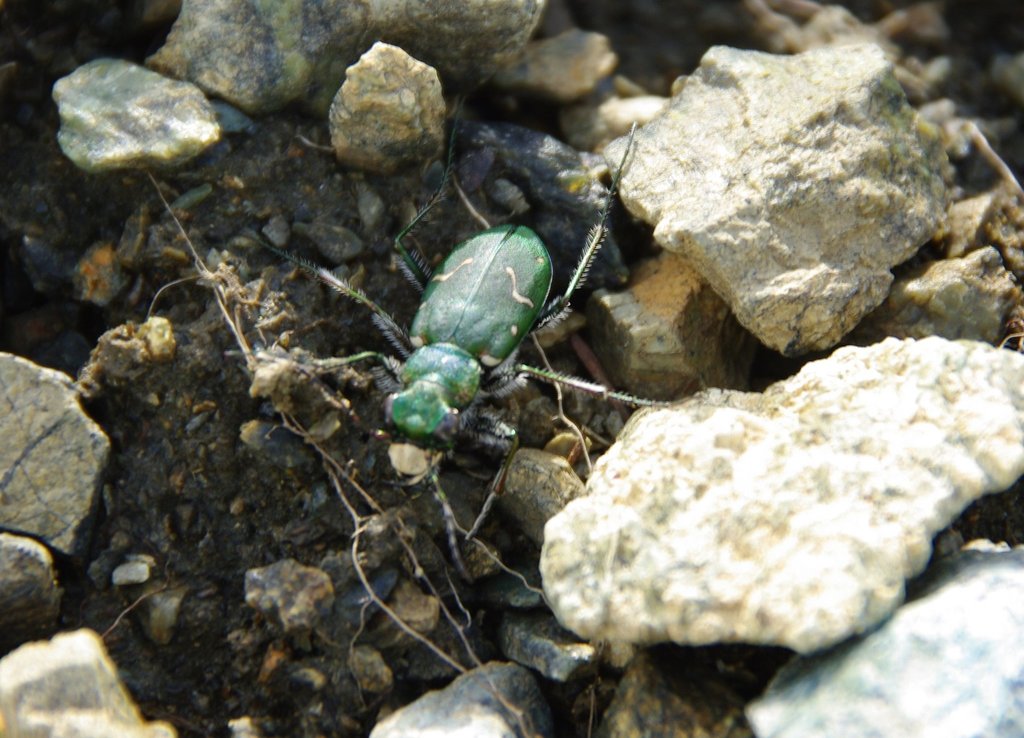
(c) Doug Macaulay, some rights reserved (CC BY) · licence
Family: Cicindelidae · Class: Insecta · Order: Coleoptera
Cicindela longilabris (Boreal Long-lipped Tiger Beetle) is a California animal in the Cicindelidae family.
The Boreal Long-lipped Tiger Beetle is a member of the family Cicindelidae, subfamily Cicindelinae, representing one of North America's predatory ground beetles. As with other tiger beetles, this species exhibits the characteristic elongated mandibles and fast-running hunting behavior typical of the group. Adult beetles measure approximately 10-15 mm in length, displaying the metallic coloration common to Cicindela species, though specific morphological details for this particular species remain poorly documented in available literature. Cicindela longilabris occurs across boreal and northern temperate regions of North America, with the nominate subspecies C. l. longilabris distributed primarily in northern areas and the subspecies C. l. laurentii (Laurent's Long-lipped Tiger Beetle) found in more specific regional populations. According to NatureServe, the subspecies C. l. longilabris maintains a global conservation status of G5T5, indicating it is secure at both the species and subspecies levels (NatureServe 2018). The species' range extends across northern forest regions, though precise distributional boundaries and population densities have not been thoroughly documented in recent literature. Boreal Long-lipped Tiger Beetles inhabit forest and woodland environments typical of northern boreal ecosystems. Like other tiger beetles, they prefer areas with suitable substrate for burrowing larvae and adequate prey availability. The species likely occurs in forest clearings, woodland edges, and disturbed areas where soil conditions support larval development. Specific habitat preferences, including soil type requirements and microhabitat selection, have not been well characterized in published studies. As predatory beetles, adults are active hunters that pursue prey on foot, using their speed and powerful mandibles to capture smaller arthropods. The species exhibits the typical tiger beetle life cycle, with larvae developing in vertical burrows in soil where they function as ambush predators, capturing prey that ventures near their burrow openings. Adult activity periods, breeding behavior, and specific dietary preferences have not been extensively studied for this species. Larval development likely follows the multi-year pattern characteristic of northern tiger beetles, with extended development periods adapted to shorter growing seasons. Currently, C. longilabris appears to face no immediate conservation concerns, with stable populations across its range. The species is not listed under federal or state endangered species legislation, and its secure conservation status suggests populations remain viable throughout its distribution. However, like many boreal forest species, long-term threats may include habitat fragmentation from logging activities, climate change impacts on northern forest ecosystems, and potential shifts in prey availability. The lack of detailed ecological studies limits comprehensive threat assessment and monitoring capabilities for this species. Scientific documentation for this species remains limited, with most information derived from taxonomic references and conservation status databases rather than detailed ecological research.
Classification
Class: Insecta · Order: Coleoptera · Family: Cicindelidae
Frequently asked questions
How is Cicindela longilabris classified?
Cicindela longilabris belongs to class Insecta, order Coleoptera, family Cicindelidae.
What family does Cicindela longilabris belong to?
Cicindela longilabris is in the Cicindelidae family.
What is Cicindela longilabris?
The Boreal Long-lipped Tiger Beetle is a member of the family Cicindelidae, subfamily Cicindelinae, representing one of North America's predatory ground beetles.
Is Cicindela longilabris found in California?
Yes. Cicindela longilabris is recorded in California in The California Species Project's catalogue.
Related species
Other California species in the same genus, family, or bioregion.
Data from The California Species Project — 14,000+ California species with verified data from CNPS, CDFW, USFWS, and more.