Cicindela senilis frosti
Senile Tiger Beetle
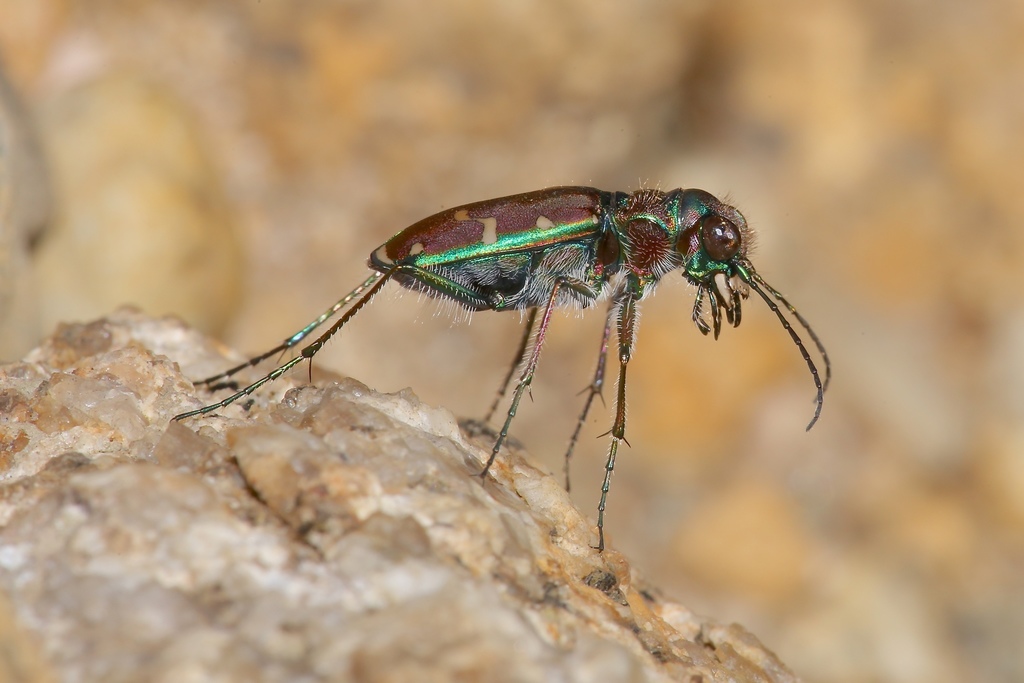
(c) Laura Gaudette, some rights reserved (CC BY) · licence
Family: Cicindelidae · Class: Insecta · Order: Coleoptera
Conservation status: G2G3T1T3 S1
Cicindela senilis frosti (Senile Tiger Beetle) is a California animal in the Cicindelidae family.
Cicindela senilis frosti is a small tiger beetle measuring 10-12 millimeters in length (approximately 0.5 inch). This subspecies is distinguished from the northern form (C. s. senilis) by its greener upper parts, contrasting with the typically dull brown coloration and yellowish-white irregular markings of its relative. The underside displays a shiny metallic green to blue-green sheen. Abundant white hairs covering the top of the head contribute to the common name "senile tiger beetle." The subspecies frosti is endemic to southern California, known from Ventura County southward. This represents the southern portion of the species' overall California range, which extends from Santa Barbara County north to Sonoma and Lake counties. Historical records indicate a much broader distribution throughout coastal salt marshes, tidal mud flats, and interior alkali mud flats, though most populations have experienced severe range reductions. Cicindela senilis frosti inhabits specialized saline environments including salt marshes, tidal mud flats, and alkali flats. These habitats are characterized by high salinity levels and periodic flooding, creating unique conditions that support specialized invertebrate communities. The beetle occurs in areas where salt-tolerant vegetation meets exposed muddy substrates, providing both hunting grounds and larval development sites. As with other tiger beetles, adults are active predators that pursue small arthropods across open ground using their exceptional speed and keen eyesight. The species exhibits typical tiger beetle behavior, with adults running in short bursts before stopping to assess their surroundings. Larvae develop in vertical burrows dug into the substrate, where they ambush passing prey from the burrow entrance. The larval stage can extend over multiple years, with grubs remaining in their burrows throughout development. Adults are most active during warmer months, with peak activity typically occurring in late spring and summer. The global rank of G2G3T1T3 and state rank of S1 reflect the precarious conservation status of this subspecies. The designation indicates that C. s. frosti is critically imperiled to vulnerable globally at the subspecies level, with very few occurrences remaining in California. Primary threats include habitat loss and degradation from urban development, altered hydrology affecting salt marsh ecosystems, and contamination from agricultural and urban runoff. Sea level rise poses an additional long-term threat to remaining coastal populations. The species' specialized habitat requirements and limited dispersal ability make it particularly vulnerable to environmental changes. Conservation efforts focus on protecting remaining salt marsh habitats and maintaining appropriate salinity regimes in these sensitive ecosystems. The extremely restricted range and small population size place this subspecies at high risk of extinction without active conservation intervention.
Classification
Class: Insecta · Order: Coleoptera · Family: Cicindelidae
Conservation status
G2G3T1T3 S1
Frequently asked questions
How is Cicindela senilis frosti classified?
Cicindela senilis frosti belongs to class Insecta, order Coleoptera, family Cicindelidae.
What family does Cicindela senilis frosti belong to?
Cicindela senilis frosti is in the Cicindelidae family.
Is Cicindela senilis frosti protected or of conservation concern?
Cicindela senilis frosti carries the following status: G2G3T1T3 S1.
What is Cicindela senilis frosti?
Cicindela senilis frosti is a small tiger beetle measuring 10-12 millimeters in length (approximately 0.5 inch).
Is Cicindela senilis frosti found in California?
Yes. Cicindela senilis frosti is recorded in California in The California Species Project's catalogue.
Related species
Other California species in the same genus, family, or bioregion.
Data from The California Species Project — 14,000+ California species with verified data from CNPS, CDFW, USFWS, and more.