Cicindela trifasciata
S-banded Tiger Beetle
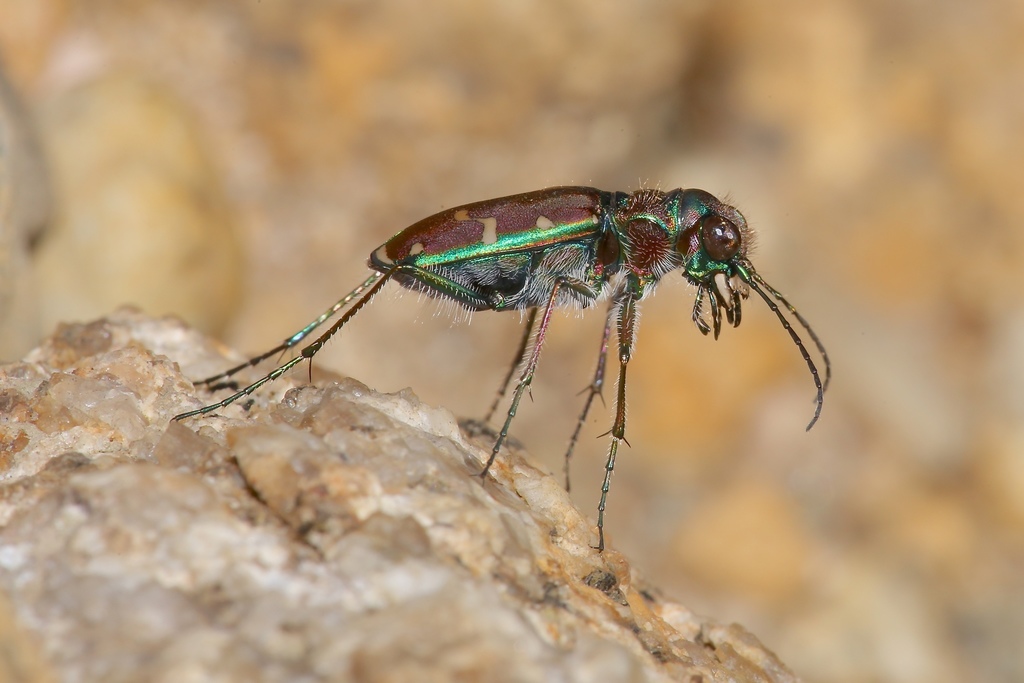
(c) Laura Gaudette, some rights reserved (CC BY) · licence
Family: Cicindelidae · Class: Insecta · Order: Coleoptera
Cicindela trifasciata (S-banded Tiger Beetle) is a California animal in the Cicindelidae family.
The S-banded Tiger Beetle (Cicindela trifasciata) is a predaceous ground beetle belonging to the family Cicindelidae. Adults typically measure 10-15 mm in length and display a metallic bronze to copper-colored dorsal surface with distinctive white or cream-colored markings that form an S-shaped pattern across the elytra, giving the species its common name. The head is large relative to body size, with prominent compound eyes and strong mandibles adapted for capturing prey. This species has a broad distribution across North America, extending from southern Canada through much of the United States. In California, Cicindela trifasciata occurs primarily in coastal and inland wetland areas, with documented populations in mudflat and salt marsh habitats. The subspecies C. t. sigmoidea is specifically associated with coastal mudflats and has been recorded from locations including the Ballona Wetlands in Los Angeles County. According to NatureServe, the species maintains a global conservation status of G5, indicating it is secure range-wide. The S-banded Tiger Beetle inhabits various wetland environments, including mudflats, salt marshes, alkali flats, and shorelines of saline or alkaline water bodies. In coastal California, populations are closely associated with pickleweed (Salicornia) and saltgrass communities. The species demonstrates tolerance for saline conditions and is often found in areas subject to tidal influence or seasonal flooding. Adults are typically observed on exposed mud or sand surfaces adjacent to vegetation. As active predators, S-banded Tiger Beetles pursue prey on foot and in flight, feeding on small arthropods including flies, ants, and other insects. Adults are primarily diurnal and exhibit rapid running speeds when hunting or escaping threats. The species completes its life cycle in mudflat substrates where larvae develop in vertical burrows, feeding on small invertebrates that fall within reach. Larvae construct silk-lined tunnels and position themselves at burrow entrances to ambush prey. Adult emergence typically occurs in spring and early summer, with peak activity during warmer months. While globally secure, certain subspecies face conservation challenges due to habitat loss and degradation. The mudflat subspecies C. t. sigmoidea has experienced range contractions in California coastal areas due to urban development, wetland filling, and altered hydrology. Coastal salt marsh and mudflat habitats continue to face pressure from sea level rise, development, and water management practices. Conservation efforts focus on protecting remaining wetland habitats and maintaining appropriate hydrological regimes that support both adult and larval populations. The species serves as an indicator of healthy mudflat ecosystems and benefits from broader wetland conservation initiatives throughout its range.
Classification
Class: Insecta · Order: Coleoptera · Family: Cicindelidae
Frequently asked questions
How is Cicindela trifasciata classified?
Cicindela trifasciata belongs to class Insecta, order Coleoptera, family Cicindelidae.
What family does Cicindela trifasciata belong to?
Cicindela trifasciata is in the Cicindelidae family.
What is Cicindela trifasciata?
The S-banded Tiger Beetle (Cicindela trifasciata) is a predaceous ground beetle belonging to the family Cicindelidae.
Is Cicindela trifasciata found in California?
Yes. Cicindela trifasciata is recorded in California in The California Species Project's catalogue.
Related species
Other California species in the same genus, family, or bioregion.
Data from The California Species Project — 14,000+ California species with verified data from CNPS, CDFW, USFWS, and more.