Cinclus mexicanus
American Dipper
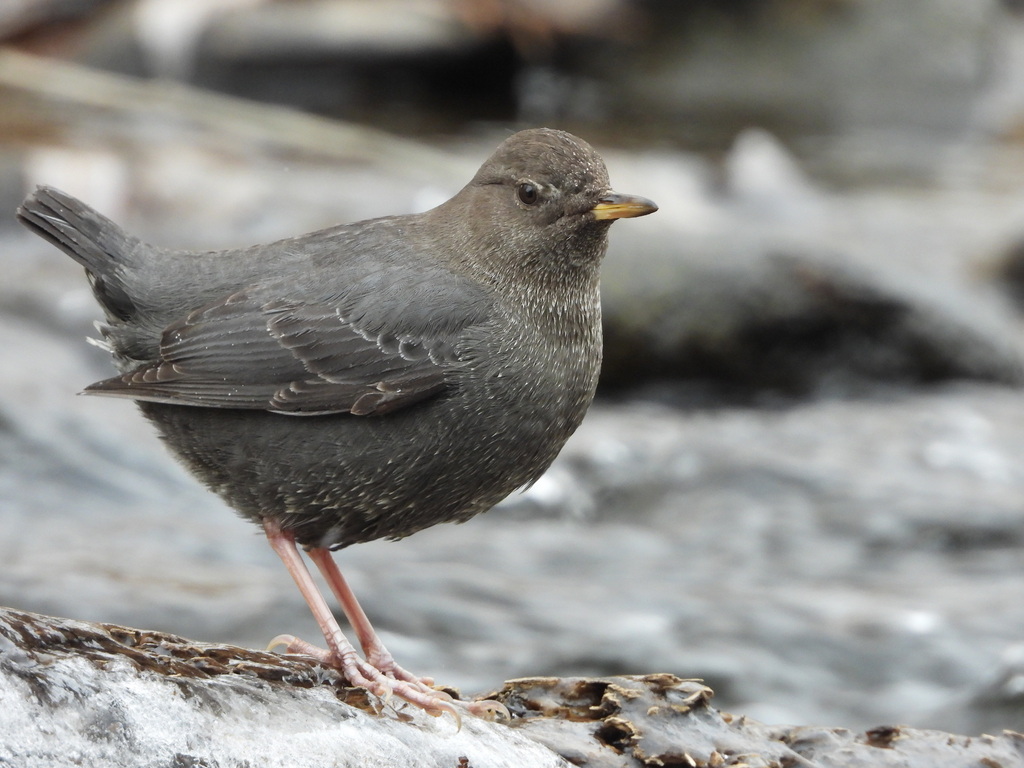
(c) Jared Shorma, some rights reserved (CC BY) · licence
Family: Cinclidae · Class: Aves · Order: Passeriformes
Cinclus mexicanus (American Dipper) is a California animal in the Cinclidae family.
The American Dipper is a stocky, gray songbird uniquely adapted for aquatic life along swift-flowing streams and rivers. Adults measure 16 to 20 cm (6.3 to 7.9 inches) in length with a wingspan of 23 to 28 cm (9.1 to 11.0 inches) and weigh 46 to 67 grams (1.6 to 2.4 ounces). The plumage is uniformly dark gray to brownish-gray, with a slightly paler head and throat. Juveniles display a lighter gray coloration with pale edging on wing and tail feathers. The species has a compact build with short wings, a short tail, and strong legs adapted for walking underwater. Dense feathering provides insulation, while specialized oil glands help waterproof the plumage. American Dippers range from Alaska through western North America to Panama, with populations occurring throughout California's mountainous regions. In California, the species inhabits the Sierra Nevada, Cascade Range, Coast Ranges, and Transverse Ranges. Populations are found in suitable habitat from Siskiyou County in the north to Los Angeles County in the south, typically at elevations from 150 to 3,400 meters (490 to 11,150 feet). The species requires clear, fast-flowing streams and rivers with rocky substrates and adequate insect populations. Suitable habitat includes mountain streams, cascading waterfalls, and boulder-strewn creeks with year-round water flow. Nesting sites are located on rock ledges, cliff faces, or artificial structures such as bridges, typically within 6 meters (20 feet) of flowing water. The species shows strong fidelity to perennial streams with cold, well-oxygenated water. American Dippers are primarily insectivorous, feeding on aquatic invertebrates including mayfly nymphs, caddisfly larvae, midges, and small fish. The species exhibits specialized underwater foraging behavior, diving and walking along stream bottoms while searching for prey. Individuals can remain submerged for up to 20 seconds and dive to depths of 1.5 meters (5 feet). Breeding occurs from March through July, with pairs constructing dome-shaped nests of moss, grass, and rootlets. Females lay 3 to 6 white eggs, which are incubated for 15 to 17 days. Young fledge after 20 to 25 days in the nest. The American Dipper is not federally or state listed and maintains stable populations across most of its range. The species faces localized threats from stream pollution, water diversions, mining activities, and climate change effects on snowpack and stream flow patterns. Habitat degradation from logging, grazing, and urban development can reduce prey availability and nesting sites. According to the North American Breeding Bird Survey, California populations have shown variable trends, with some regions experiencing declines while others remain stable. Conservation efforts focus on maintaining water quality and protecting riparian corridors along mountain streams.
Classification
Class: Aves · Order: Passeriformes · Family: Cinclidae
Frequently asked questions
How is Cinclus mexicanus classified?
Cinclus mexicanus belongs to class Aves, order Passeriformes, family Cinclidae.
What family does Cinclus mexicanus belong to?
Cinclus mexicanus is in the Cinclidae family.
What is Cinclus mexicanus?
The American Dipper is a stocky, gray songbird uniquely adapted for aquatic life along swift-flowing streams and rivers.
Is Cinclus mexicanus found in California?
Yes. Cinclus mexicanus is recorded in California in The California Species Project's catalogue.
More California species
This species has no close relatives in our California data — here are other species to explore.
Data from The California Species Project — 14,000+ California species with verified data from CNPS, CDFW, USFWS, and more.