Circus hudsonius
Northern Harrier
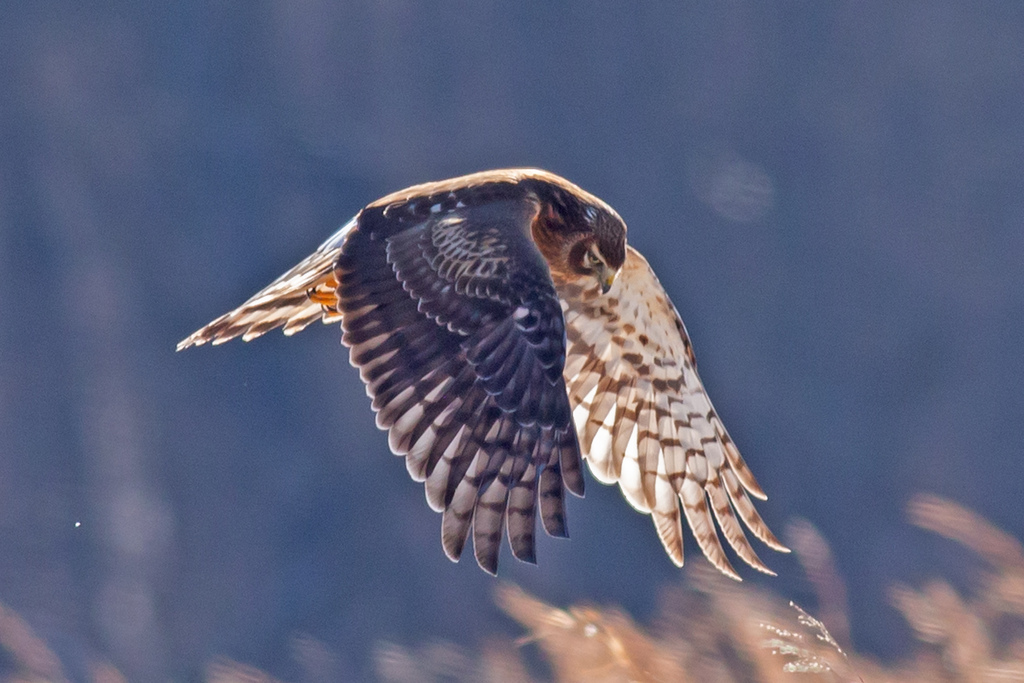
(c) Bill Keim, some rights reserved (CC BY) · licence
Family: Accipitridae · Class: Aves · Order: Accipitriformes
Conservation status: G5 S3
Circus hudsonius (Northern Harrier) is a California animal in the Accipitridae family.
The Northern Harrier is a medium-sized raptor with distinctive sexual dimorphism and unique hunting behavior among North American hawks. Males measure 41-46 cm (16-18 inches) in length with a wingspan of 97-109 cm (38-43 inches), weighing 290-400 grams. Females are notably larger, measuring 47-60 cm (19-24 inches) with a wingspan of 100-122 cm (39-48 inches) and weighing 390-750 grams. Adult males display gray upperparts with white underparts marked by rufous spotting. Females and juveniles are brown above with streaked brown and buff underparts. Both sexes exhibit a conspicuous white rump patch visible in flight and facial discs similar to those of owls, adaptations for enhanced hearing during hunting. Northern Harriers breed across much of North America, from Alaska and Canada south through most of the continental United States. In California, the species occurs as both a year-round resident and winter visitor, found throughout the Central Valley, coastal regions, and suitable habitats in the Sierra Nevada foothills and desert regions. Some populations are migratory, with northern breeders moving south for winter, while others remain resident year-round. The species was formerly considered conspecific with the Hen Harrier (Circus cyaneus) but is now recognized as distinct based on differences in morphology, plumage, and breeding habitat preferences. The species inhabits open grasslands, prairies, agricultural fields, marshes, and wetlands from sea level to approximately 2,100 meters (6,900 feet) elevation. Northern Harriers require large expanses of relatively undisturbed habitat for successful breeding and foraging. Nesting occurs on the ground in dense vegetation such as cattails, sedges, or tall grasses, typically in wetland margins or grassland areas. The species shows strong fidelity to traditional nesting areas when habitat remains suitable. Northern Harriers employ a distinctive low, coursing flight pattern while hunting, gliding 1-4 meters above ground with wings held in a shallow V-shape. Their diet consists primarily of small mammals including voles, mice, and ground squirrels, supplemented by birds, reptiles, amphibians, and occasionally fish. The species exhibits polygynous mating behavior, with males potentially mating with multiple females. Breeding occurs from April through August, with females constructing ground nests and laying 3-6 white or pale blue eggs. Incubation lasts 28-36 days, performed primarily by females while males provide food. With a global rank of G5 (secure) and California state rank of S3 (vulnerable), Northern Harriers face ongoing conservation challenges. Primary threats include habitat loss from agricultural intensification and urban development, particularly the conversion of grasslands and wetlands. Pesticide use reduces prey availability and may cause direct mortality. Wind energy development poses collision risks in some areas. According to the North American Bird Conservation Initiative, the species has experienced moderate population declines across portions of its range. Conservation efforts focus on protecting and restoring grassland and wetland habitats, implementing bird-friendly agricultural practices, and managing public lands to maintain suitable nesting areas.
Classification
Class: Aves · Order: Accipitriformes · Family: Accipitridae
Conservation status
G5 S3
Frequently asked questions
How is Circus hudsonius classified?
Circus hudsonius belongs to class Aves, order Accipitriformes, family Accipitridae.
What family does Circus hudsonius belong to?
Circus hudsonius is in the Accipitridae family.
Is Circus hudsonius protected or of conservation concern?
Circus hudsonius carries the following status: G5 S3.
What is Circus hudsonius?
The Northern Harrier is a medium-sized raptor with distinctive sexual dimorphism and unique hunting behavior among North American hawks.
Is Circus hudsonius found in California?
Yes. Circus hudsonius is recorded in California in The California Species Project's catalogue.
Related species
Other California species in the same genus, family, or bioregion.
Data from The California Species Project — 14,000+ California species with verified data from CNPS, CDFW, USFWS, and more.