Cisthene perrosea
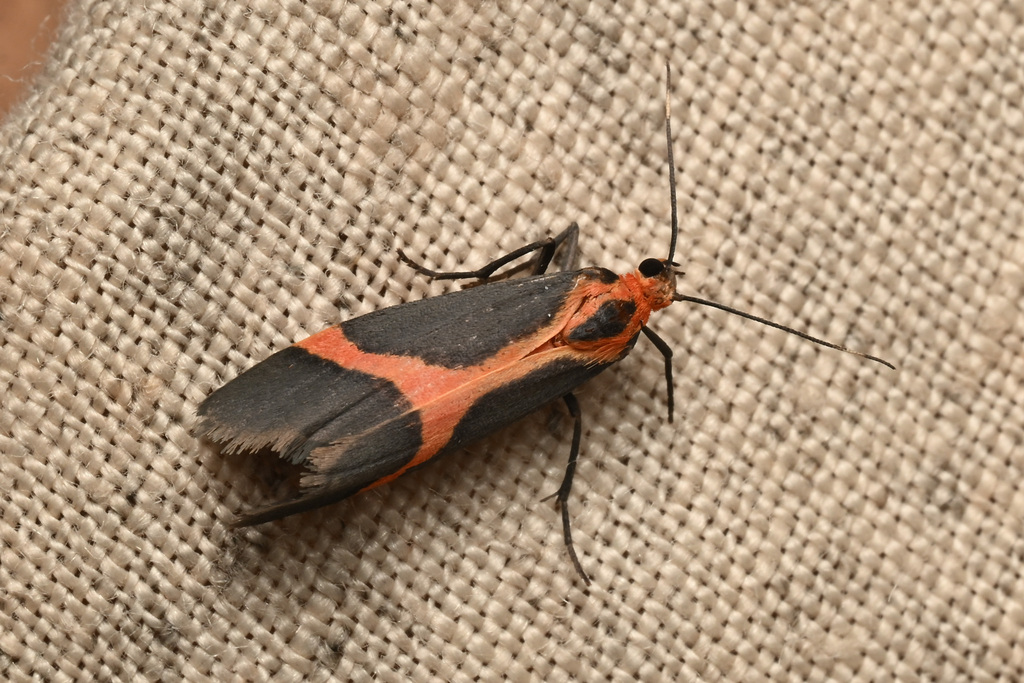
(c) Trevor Van Loon, some rights reserved (CC BY) · licence
Family: Erebidae · Class: Insecta · Order: Lepidoptera
Cisthene perrosea is a California animal in the Erebidae family.
Cisthene perrosea is a small moth species in the family Erebidae, subfamily Arctiinae. Adults have a wingspan typically measuring 12-16 mm, with forewings displaying a distinctive pattern of pale cream to yellowish-white ground color marked with scattered dark brown to reddish-brown spots and streaks. The hindwings are generally paler than the forewings, often appearing nearly translucent white with minimal markings. The thorax and abdomen are covered in dense, pale scales that may show slight pinkish or cream coloration. Like other members of the genus Cisthene, this species exhibits the characteristic lichen moth body structure with relatively broad wings in proportion to body size. Cisthene perrosea is endemic to western North America, with documented occurrences primarily in California and adjacent regions. The species has been recorded from scattered localities throughout the state, including specimens collected from coastal areas, interior valleys, and foothill regions. Historical records indicate presence in both northern and southern California, though current distribution patterns and population status remain poorly documented due to limited recent survey efforts. This species inhabits areas where suitable lichen growth occurs, typically in oak woodlands, chaparral, and mixed coniferous forests at elevations ranging from sea level to approximately 1,500 meters. Adults are most commonly encountered in areas with mature trees and established lichen communities, particularly on oak bark and rock surfaces. The species shows preference for microhabitats with moderate humidity levels and partial shade that support diverse crustose and foliose lichen species. Adult Cisthene perrosea are primarily nocturnal, with peak activity occurring during warm summer evenings. Males are attracted to artificial light sources and have been collected at mercury vapor and ultraviolet light traps. The flight period extends from May through August, with peak emergence typically occurring in June and July. Larvae feed exclusively on lichens growing on tree bark and rock surfaces, exhibiting the specialized dietary requirements characteristic of lichen moths. Females deposit eggs singly or in small clusters on lichen-covered substrates. Larval development occurs over several months, with pupation taking place in silk cocoons constructed among lichen growth or in bark crevices. The conservation status of Cisthene perrosea has not been formally evaluated by state or federal agencies. Like many lichen moth species, populations may be vulnerable to habitat degradation, air pollution, and climate change effects that impact lichen communities. Urban development, wildfire management practices, and forestry operations that remove mature trees with established lichen growth could potentially affect local populations. The species' dependence on specific lichen communities makes it sensitive to environmental changes that alter host availability. Current population trends and specific conservation needs remain largely unknown due to insufficient survey data and taxonomic uncertainty within the genus Cisthene.
Classification
Class: Insecta · Order: Lepidoptera · Family: Erebidae
Frequently asked questions
How is Cisthene perrosea classified?
Cisthene perrosea belongs to class Insecta, order Lepidoptera, family Erebidae.
What family does Cisthene perrosea belong to?
Cisthene perrosea is in the Erebidae family.
What is Cisthene perrosea?
Cisthene perrosea is a small moth species in the family Erebidae, subfamily Arctiinae.
Is Cisthene perrosea found in California?
Yes. Cisthene perrosea is recorded in California in The California Species Project's catalogue.
Related species
Other California species in the same genus, family, or bioregion.
Data from The California Species Project — 14,000+ California species with verified data from CNPS, CDFW, USFWS, and more.