Cistothorus palustris clarkae
Clark's Marsh Wren
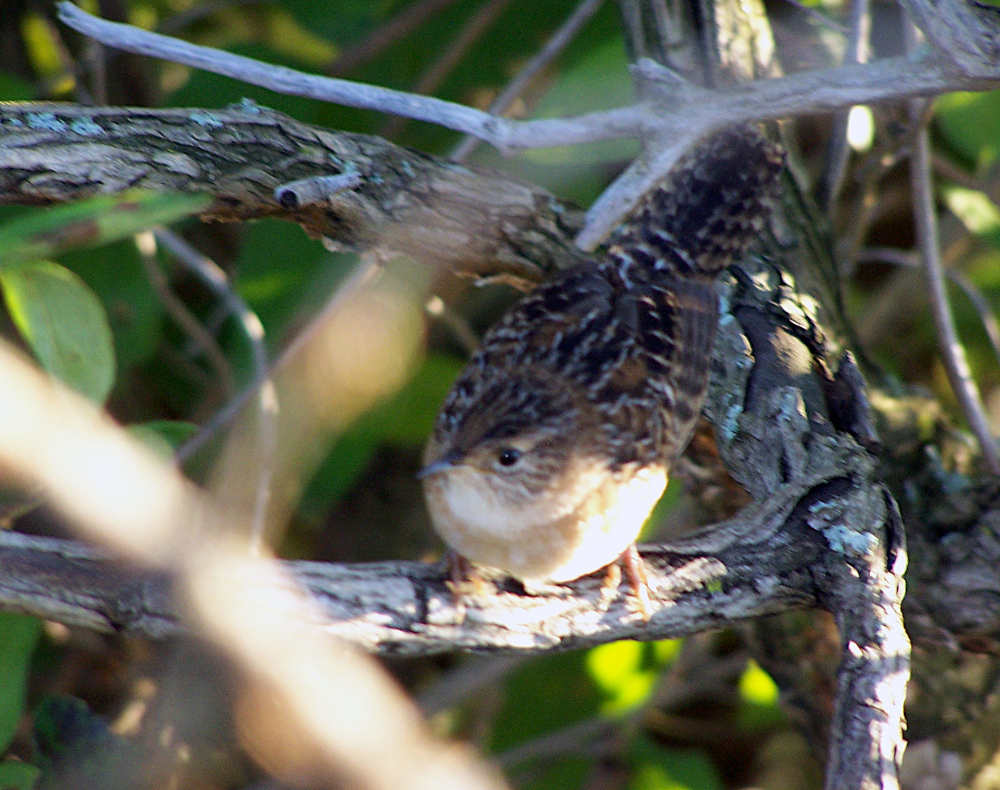
(c) psweet, some rights reserved (CC BY-SA) · licence
Family: Troglodytidae · Class: Aves · Order: Passeriformes
Conservation status: G5T2 S2
Cistothorus palustris clarkae (Clark's Marsh Wren) is a California animal in the Troglodytidae family.
Clark's Marsh Wren (Cistothorus palustris clarkae) is a small passerine bird endemic to coastal southern California. This subspecies of Marsh Wren measures approximately 9-14 cm (3.5-5.5 inches) in length and weighs 9-14 grams. Adults display brown upperparts with distinct blackish streaking on the back and crown, contrasting with whitish underparts. The tail is brown with darker barring, and a prominent white eyebrow stripe extends from the bill to behind the eye. Males and females appear similar, though males may be slightly larger. Clark's Marsh Wren occurs from southern Los Angeles County south through San Diego County, with irregular occurrence extending east to Riverside and Imperial counties (NatureServe Explorer). This subspecies is restricted to coastal and near-coastal regions of California, representing one of several geographically distinct subspecies of Marsh Wren across North America. The species inhabits emergent freshwater and brackish marshes dominated by cattails (Typha species), bulrushes (Scirpus species), and other tall marsh vegetation. Clark's Marsh Wren requires dense stands of emergent vegetation with water depths typically ranging from 15-60 cm. Unlike other Marsh Wren subspecies that may utilize upland habitats during migration, this subspecies remains closely associated with marsh environments year-round. Males are highly territorial during breeding season, constructing multiple dome-shaped nests suspended in cattails or bulrushes approximately 75-95 cm above water level. These structures serve both as courtship displays and potential nesting sites, with females selecting one nest for actual breeding. Breeding occurs primarily from March through July, with females laying 3-5 brown-spotted eggs. The species feeds primarily on insects and spiders gleaned from marsh vegetation, including aphids, caterpillars, and mosquitoes. Clark's Marsh Wren exhibits complex vocal behavior, with males producing elaborate songs consisting of reedy, gurgling notes and trills. These vocalizations serve both territorial and mate attraction functions. Males may destroy eggs and young of conspecifics and other marsh-nesting species, a behavior that may reduce competition for resources in limited habitat. The subspecies carries a conservation rank of G5T2 S2, indicating that while the species as a whole is secure globally, this particular subspecies faces significant conservation concerns. The primary threats include habitat loss and degradation due to urban development, water diversions, and invasive plant species that alter marsh structure. Many historical marsh sites in southern California have been filled or converted to other uses. Climate change poses additional risks through altered precipitation patterns and sea-level rise affecting coastal marshes. Conservation efforts focus on protecting remaining marsh habitats and restoring degraded sites. Water management practices that maintain appropriate hydroperiods are critical for sustaining suitable breeding habitat. The restricted range and specialized habitat requirements make this subspecies particularly vulnerable to environmental changes, emphasizing the importance of comprehensive marsh conservation strategies in southern California.
Classification
Class: Aves · Order: Passeriformes · Family: Troglodytidae
Conservation status
G5T2 S2
Frequently asked questions
How is Cistothorus palustris clarkae classified?
Cistothorus palustris clarkae belongs to class Aves, order Passeriformes, family Troglodytidae.
What family does Cistothorus palustris clarkae belong to?
Cistothorus palustris clarkae is in the Troglodytidae family.
Is Cistothorus palustris clarkae protected or of conservation concern?
Cistothorus palustris clarkae carries the following status: G5T2 S2.
What is Cistothorus palustris clarkae?
Clark's Marsh Wren (Cistothorus palustris clarkae) is a small passerine bird endemic to coastal southern California.
Is Cistothorus palustris clarkae found in California?
Yes. Cistothorus palustris clarkae is recorded in California in The California Species Project's catalogue.
Related species
Other California species in the same genus, family, or bioregion.
Data from The California Species Project — 14,000+ California species with verified data from CNPS, CDFW, USFWS, and more.