Cistothorus platensis
Sedge Wren
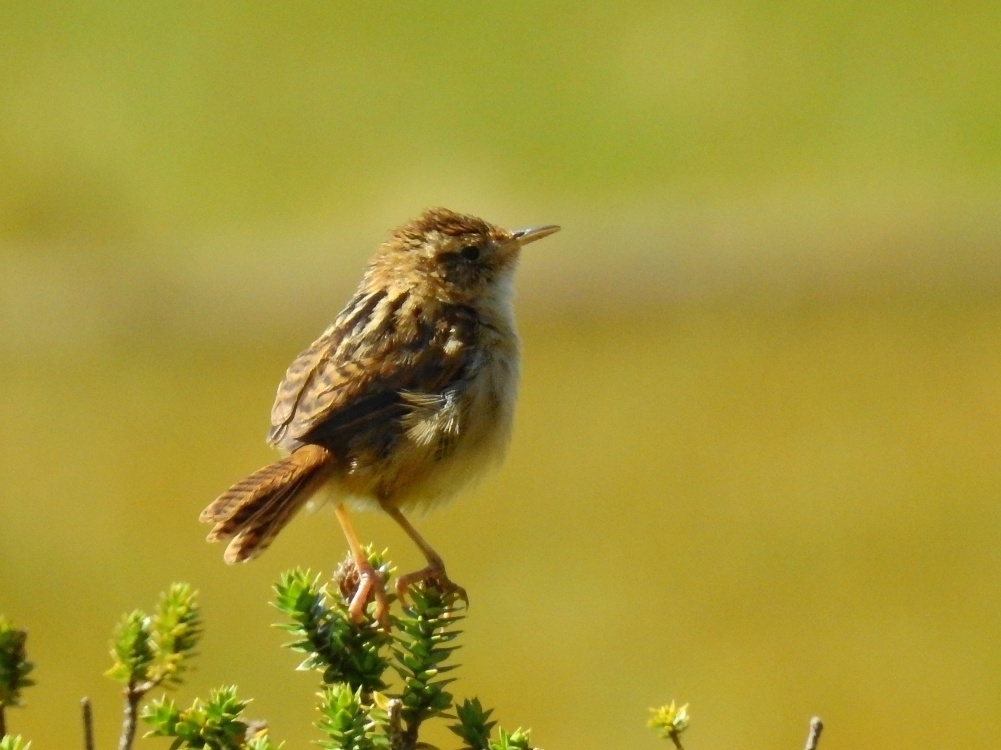
(c) Esteban Poveda, some rights reserved (CC BY) · licence
Family: Troglodytidae · Class: Aves · Order: Passeriformes
Cistothorus platensis (Sedge Wren) is a California animal in the Troglodytidae family.
The Sedge Wren is a small, secretive songbird measuring 10-12 cm (4-4.7 inches) in length with a wingspan of 12-14 cm (4.7-5.5 inches). Adults weigh 7-10 grams. The upperparts are brown with darker streaking, particularly prominent on the crown and back. The underparts are buff to pale brown with a whitish throat and belly. A distinctive pale eyebrow stripe contrasts with a dark eye line. The bill is thin, slightly curved, and dark brown. The tail is relatively short and often held cocked upward. Males and females appear similar, though males may show slightly more distinct markings during breeding season. The Sedge Wren has a broad distribution across North America, ranging from southern Canada through much of the central and eastern United States. In California, this species is considered a rare vagrant, with scattered records primarily from the Central Valley and coastal areas during migration periods. Most California observations occur during fall migration from August through October, with occasional spring records from April through May. The species is more regularly found in the Great Plains and Great Lakes regions, where it maintains breeding populations. Sedge Wrens inhabit wet meadows, sedge marshes, shallow wetland edges, and damp grasslands. They prefer areas with dense, emergent vegetation including sedges, rushes, and tall grasses, typically in water depths of 2-15 cm (0.8-6 inches). The species favors habitat mosaics combining open water, emergent vegetation, and adjacent upland areas. During migration, birds may utilize agricultural fields, particularly those with standing water or irrigation ditches. This species exhibits a complex breeding system with males often polygamous. Males construct multiple dome-shaped nests of woven grasses and sedges, typically placed 15-100 cm (6-39 inches) above water level in dense vegetation. Females select among completed nests and line the chosen structure with fine materials. Breeding occurs from May through August, with females laying 4-8 white to pale pink eggs. Incubation lasts 12-14 days, performed solely by the female. Young fledge after 12-14 days in the nest. Sedge Wrens are primarily insectivorous, foraging for spiders, beetles, caterpillars, and other small arthropods among dense vegetation. They glean prey from plant surfaces and occasionally capture insects in flight. The Sedge Wren is not federally listed and maintains stable populations across much of its core range. However, the species has experienced regional declines due to wetland loss and degradation. According to the North American Breeding Bird Survey, populations declined by approximately 1.8% annually from 1966 to 2019. Primary threats include drainage of wetlands for agriculture, urban development, and altered water management practices. Climate change may affect breeding habitat availability and migration timing. In California, the species' rarity as a vagrant means local conservation concerns are minimal, though maintaining quality wetland habitat benefits this and other migrant species.
Classification
Class: Aves · Order: Passeriformes · Family: Troglodytidae
Frequently asked questions
How is Cistothorus platensis classified?
Cistothorus platensis belongs to class Aves, order Passeriformes, family Troglodytidae.
What family does Cistothorus platensis belong to?
Cistothorus platensis is in the Troglodytidae family.
What is Cistothorus platensis?
The Sedge Wren is a small, secretive songbird measuring 10-12 cm (4-4.7 inches) in length with a wingspan of 12-14 cm (4.7-5.5 inches).
Is Cistothorus platensis found in California?
Yes. Cistothorus platensis is recorded in California in The California Species Project's catalogue.
Related species
Other California species in the same genus, family, or bioregion.
Data from The California Species Project — 14,000+ California species with verified data from CNPS, CDFW, USFWS, and more.