Clangula hyemalis
Long-tailed Duck
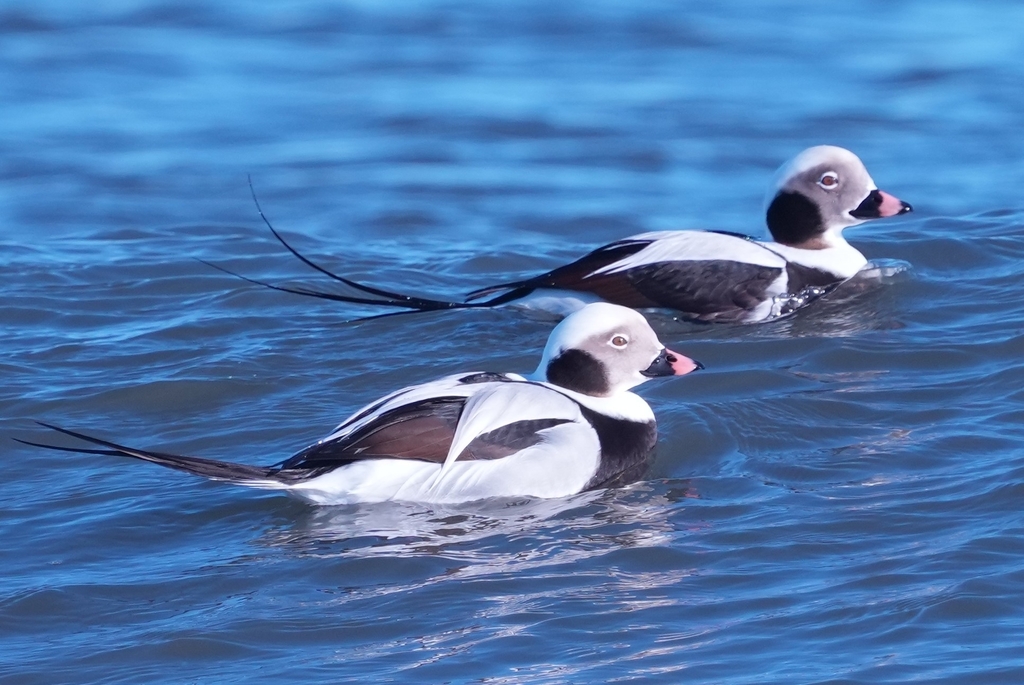
(c) carbenoid, some rights reserved (CC BY) · licence
Family: Anatidae · Class: Aves · Order: Anseriformes
Clangula hyemalis (Long-tailed Duck) is a California animal in the Anatidae family.
The Long-tailed Duck is a medium-sized sea duck with distinctive seasonal plumage variations and elongated tail feathers in breeding males. Adults measure 37 to 60 cm (14.5 to 23.6 inches) in length, with males significantly larger than females. Breeding males display striking black and white plumage with chocolate-brown patches on the face and neck, and possess dramatically elongated central tail feathers that can extend up to 13 cm (5 inches) beyond the body. Non-breeding males and females show more subdued brown and white coloration. Both sexes have dark wings with no white patches, distinguishing them from other sea ducks. Historically, Long-tailed Ducks bred across Arctic tundra regions of Alaska and northern Canada, with the species' range extending across the circumpolar Arctic. In California, this species occurs as an irregular winter visitor along the Pacific coast, typically appearing from October through April. Most California records come from offshore waters, bays, and coastal lagoons, with occasional sightings in the San Francisco Bay Area, Monterey Bay, and scattered locations along the central and northern coast. The species is considered uncommon to rare in California waters. Long-tailed Ducks inhabit marine and estuarine environments during winter, preferring offshore waters over shallow coastal areas. They are adapted to diving in waters ranging from 2 to 60 meters deep, though they commonly forage in depths of 3 to 10 meters. During breeding season, the species utilizes Arctic tundra ponds, lakes, and coastal lagoons. In California's marine environment, they favor areas with sandy or muddy bottoms where benthic invertebrates are abundant. This species exhibits exceptional diving abilities, using wings and feet for underwater propulsion while foraging for marine invertebrates, small fish, and crustaceans. During winter, their diet consists primarily of mollusks, amphipods, and polychaete worms. Long-tailed Ducks are gregarious outside the breeding season, forming loose flocks that may number in the hundreds. Breeding occurs on Arctic tundra, where females construct ground nests lined with down and lay 6 to 9 olive-buff eggs. The species demonstrates documented longevity exceeding 20 years for waterfowl. The Long-tailed Duck is not federally listed in the United States, but populations have experienced significant declines across their range. According to the North American Bird Conservation Initiative, the species has declined by approximately 65% since 1970. Primary threats include climate change affecting Arctic breeding habitats, oil spills and pollution in marine wintering areas, and bycatch in commercial fishing operations. The species' dependence on sea ice environments makes it particularly vulnerable to warming temperatures. In California, irregular occurrence patterns suggest the species may be shifting its winter distribution in response to changing ocean conditions and prey availability.
Classification
Class: Aves · Order: Anseriformes · Family: Anatidae
Frequently asked questions
How is Clangula hyemalis classified?
Clangula hyemalis belongs to class Aves, order Anseriformes, family Anatidae.
What family does Clangula hyemalis belong to?
Clangula hyemalis is in the Anatidae family.
What is Clangula hyemalis?
The Long-tailed Duck is a medium-sized sea duck with distinctive seasonal plumage variations and elongated tail feathers in breeding males.
Is Clangula hyemalis found in California?
Yes. Clangula hyemalis is recorded in California in The California Species Project's catalogue.
Related species
Other California species in the same genus, family, or bioregion.
Data from The California Species Project — 14,000+ California species with verified data from CNPS, CDFW, USFWS, and more.