Cleptes humboldti
Humboldt Cuckoo Wasp
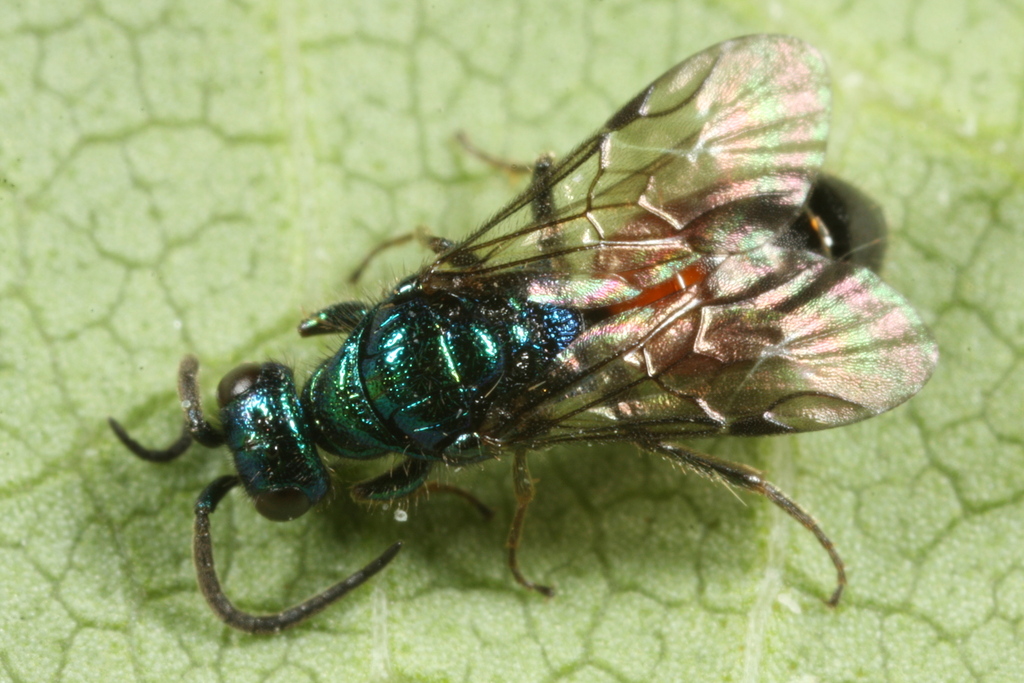
(c) ingridaltmann, some rights reserved (CC BY) · licence
Family: Chrysididae · Class: Insecta · Order: Hymenoptera
Conservation status: G1G2 S1S2
Cleptes humboldti (Humboldt Cuckoo Wasp) is a California animal in the Chrysididae family.
Cleptes humboldti is a small cuckoo wasp belonging to the family Chrysididae. Like other members of this family, it possesses the characteristic metallic sheen on its exoskeleton, though specific morphological details for this species remain poorly documented in the scientific literature. Cuckoo wasps are generally small insects, typically measuring 3-12 mm in length, with compact bodies and distinctive metallic coloration ranging from green to blue to bronze. The species is known only from California, where it has an extremely limited distribution. Based on available records, C. humboldti appears to be restricted to specific localities within the state, though the precise geographic boundaries of its range have not been comprehensively mapped. The species' distribution is so restricted that it has earned the conservation ranking of G1G2 globally and S1S2 within California, indicating it is critically imperiled to imperiled both globally and within the state. Habitat requirements for C. humboldti have not been well documented. Cuckoo wasps generally inhabit areas where their host species occur, as they are parasitoids or cleptoparasites. Most species in the genus Cleptes are associated with sawfly larvae, particularly those in the family Chrysididae, though the specific host relationships for C. humboldti remain unknown. The species likely occurs in habitats that support populations of its host insects, which could include various plant communities where sawflies develop. As a member of the cuckoo wasp family, C. humboldti is presumed to be a parasitoid, with females seeking out the nests or larvae of host insects to lay their eggs. Cuckoo wasps are known for their ability to invade the nests of other insects, where their larvae develop by consuming the host or its provisions. The adult wasps are typically active during warmer months, but specific details about the seasonal activity, reproductive biology, and host preferences of C. humboldti have not been studied or reported in accessible literature. The conservation status of C. humboldti reflects significant concern about its long-term viability. With global and state rankings of G1G2 and S1S2 respectively, the species is considered critically imperiled to imperiled, indicating that it faces a high risk of extinction. The extremely limited distribution and apparent rarity of this species make it particularly vulnerable to habitat loss, environmental changes, and other anthropogenic impacts. However, specific threats to the species have not been identified or studied, largely due to the lack of comprehensive research on its biology and ecology. Scientific documentation for C. humboldti remains extremely limited. The information presented here synthesizes available data from conservation databases, but detailed ecological studies, population assessments, and threat analyses are lacking. The species represents one of many poorly known invertebrates that may be at risk but require additional research to develop effective conservation strategies. This species is included on the California Department of Fish and Wildlife's Special Animals List. Enhanced survey efforts and taxonomic research are needed to better understand this species' distribution, habitat requirements, and conservation needs.
Classification
Class: Insecta · Order: Hymenoptera · Family: Chrysididae
Conservation status
G1G2 S1S2
Frequently asked questions
How is Cleptes humboldti classified?
Cleptes humboldti belongs to class Insecta, order Hymenoptera, family Chrysididae.
What family does Cleptes humboldti belong to?
Cleptes humboldti is in the Chrysididae family.
Is Cleptes humboldti protected or of conservation concern?
Cleptes humboldti carries the following status: G1G2 S1S2.
What is Cleptes humboldti?
Cleptes humboldti is a small cuckoo wasp belonging to the family Chrysididae.
Is Cleptes humboldti found in California?
Yes. Cleptes humboldti is recorded in California in The California Species Project's catalogue.
Related species
Other California species in the same genus, family, or bioregion.
Data from The California Species Project — 14,000+ California species with verified data from CNPS, CDFW, USFWS, and more.