Clostera inornata
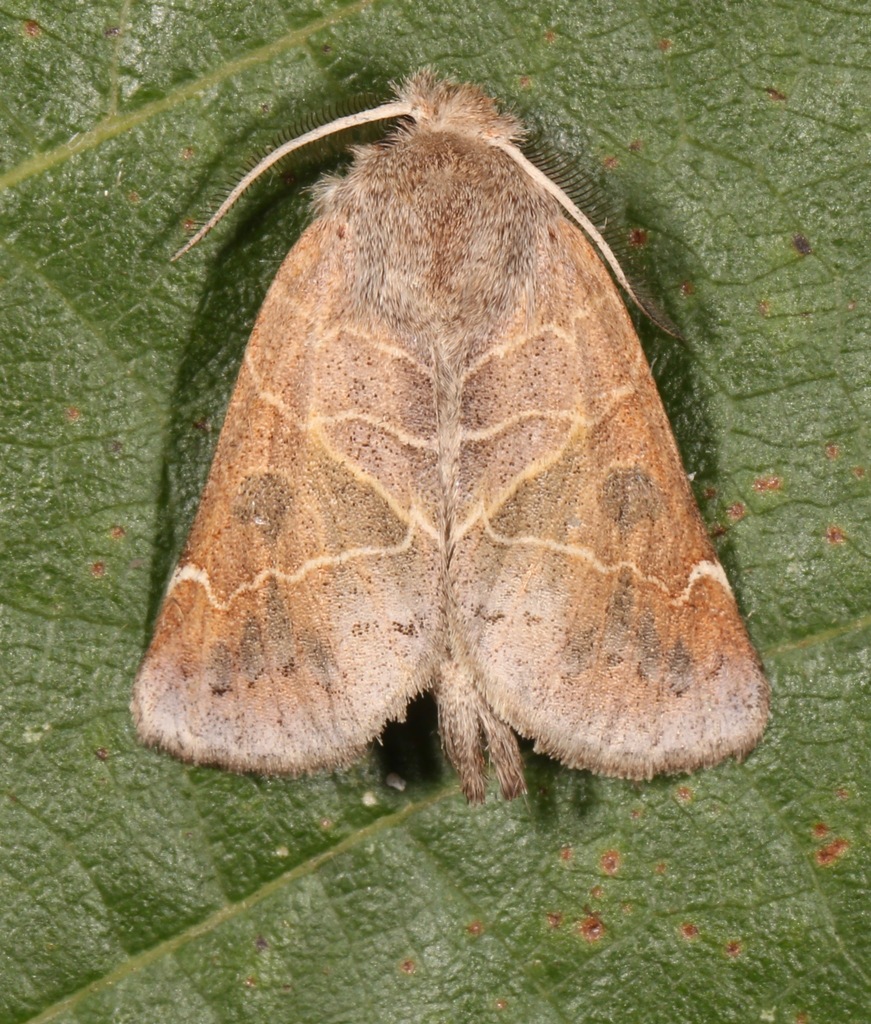
(c) Laura Gaudette, some rights reserved (CC BY) · licence
Family: Notodontidae · Class: Insecta · Order: Lepidoptera
Clostera inornata is a California animal in the Notodontidae family.
Clostera inornata is a moth species in the family Notodontidae, commonly known as the prominent moths. This species belongs to a genus of small to medium-sized moths characterized by their distinctive wing patterns and prominent forewings that often display raised tufts or scales when at rest. Adult Clostera inornata moths typically measure 25-35 mm (1.0-1.4 inches) in wingspan. The forewings are generally grayish-brown to brownish-gray with subtle darker markings and cross-lines. The hindwings are typically paler, ranging from light gray to whitish. Like other members of the genus Clostera, this species exhibits sexual dimorphism, with males possessing more feathery or pectinate antennae compared to the simpler antennae of females. The moths hold their wings in a tent-like position when at rest, with the forewings often displaying raised scales that give the family its common name of prominent moths. The range and distribution of Clostera inornata in California remains poorly documented in current literature. The species appears to have a limited distribution within the state, though specific county records and population data are not readily available from standard monitoring programs. This lack of comprehensive distributional data reflects the general knowledge gaps that exist for many moth species, particularly those that may be uncommon or have restricted ranges. Habitat preferences for Clostera inornata are not well-established in published literature. Members of the genus Clostera are typically associated with deciduous woodlands and areas supporting their larval host plants. The species likely occurs in riparian zones, mixed woodlands, or areas with suitable host plant communities, though specific elevation ranges and microhabitat requirements have not been thoroughly documented for this species in California. Like other Clostera species, C. inornata presumably has a univoltine or bivoltine life cycle, with adults emerging during specific flight periods that may vary by geographic location and local climate conditions. Larvae are likely external feeders on the foliage of woody plants, following the typical feeding pattern of notodontid moths. Specific information regarding host plant associations, larval development timing, overwintering stage, and adult activity patterns for this species in California is not well-documented in accessible scientific literature. The conservation status of Clostera inornata is not established through formal state or federal listing processes. The species does not appear on current endangered species lists or species of special concern designations in California as of December 2025. However, the lack of recent survey data and limited knowledge of its distribution, population trends, and ecological requirements makes it difficult to assess the species' conservation needs. Like many moth species, C. inornata may face threats from habitat loss, light pollution, pesticide use, and climate change, though specific threat assessments have not been conducted for this species.
Classification
Class: Insecta · Order: Lepidoptera · Family: Notodontidae
Frequently asked questions
How is Clostera inornata classified?
Clostera inornata belongs to class Insecta, order Lepidoptera, family Notodontidae.
What family does Clostera inornata belong to?
Clostera inornata is in the Notodontidae family.
What is Clostera inornata?
Clostera inornata is a moth species in the family Notodontidae, commonly known as the prominent moths.
Is Clostera inornata found in California?
Yes. Clostera inornata is recorded in California in The California Species Project's catalogue.
Related species
Other California species in the same genus, family, or bioregion.
Data from The California Species Project — 14,000+ California species with verified data from CNPS, CDFW, USFWS, and more.