Clypeotettix mexicanus
Mexican Pygmy Grasshopper
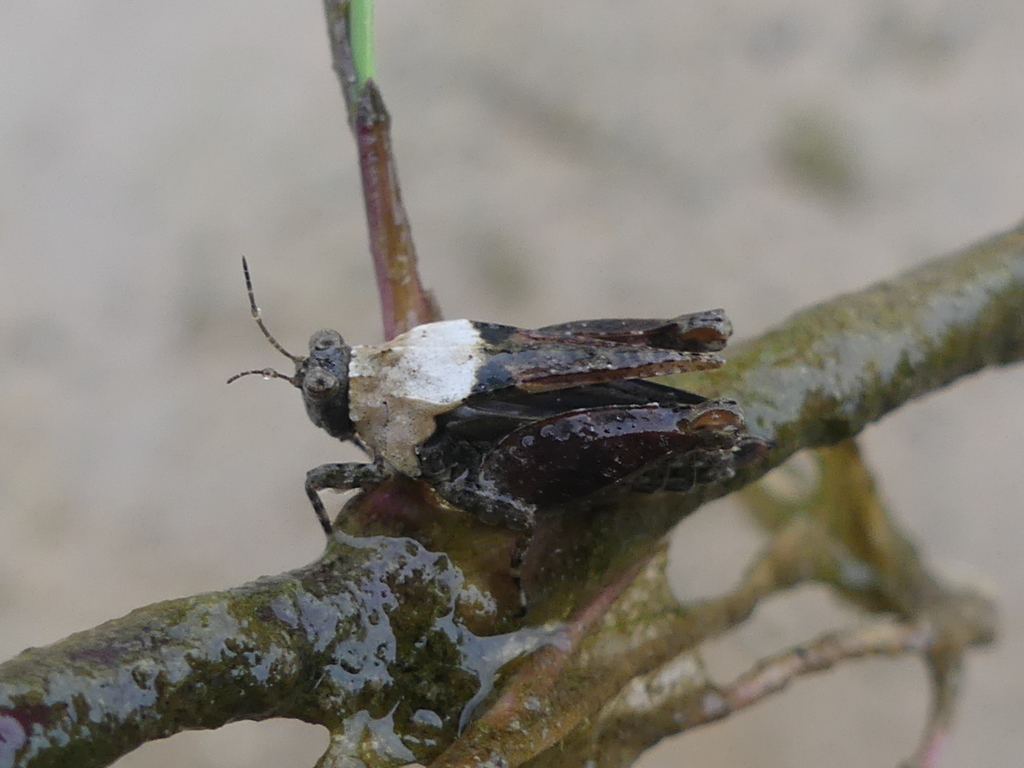
(c) Morgan Hay, some rights reserved (CC BY) · licence
Family: Tetrigidae · Class: Insecta · Order: Orthoptera
Clypeotettix mexicanus (Mexican Pygmy Grasshopper) is a California animal in the Tetrigidae family.
The Mexican Pygmy Grasshopper (Clypeotettix mexicanus) is a small orthopteran insect belonging to the family Tetrigidae, commonly known as grouse locusts or pygmy grasshoppers. Members of this family are characterized by their distinctive pronotal extension that typically covers much of the abdomen, reduced forewings, and generally small size compared to other grasshopper families. Tetrigids are typically 6-20 mm in length, with body coloration that often matches their substrate for camouflage. The species' range includes regions of Mexico, as indicated by its specific epithet "mexicanus." However, detailed distribution records for this species within California or other parts of North America have not been well documented in readily available scientific literature. The genus Clypeotettix contains several species distributed across North and Central America, but comprehensive range maps for individual species remain limited in public databases. Like other members of Tetrigidae, the Mexican Pygmy Grasshopper likely inhabits areas with moist soil conditions, as grouse locusts are typically associated with environments near water sources, muddy banks, and areas with organic debris. These grasshoppers are often found along stream margins, pond edges, and other riparian zones where they can exploit both terrestrial and semi-aquatic microhabitats. The family shows preference for areas with exposed soil, leaf litter, and low vegetation. Tetrigids exhibit several distinctive behavioral characteristics that likely apply to C. mexicanus. These grasshoppers are generally poor fliers due to their reduced forewings, relying instead on jumping for locomotion and escape from predators. They feed primarily on organic matter, including algae, fungi, decaying plant material, and occasionally fresh plant tissues. Unlike many grasshopper species, grouse locusts often remain active during cooler months and may overwinter as adults. Reproduction typically occurs in spring, with females depositing eggs in moist soil or organic substrates. No federal or state conservation status has been documented for the Mexican Pygmy Grasshopper, and it does not appear on current threatened or endangered species lists. The species' conservation status remains unclear due to limited research on its population trends, distribution, and ecological requirements. Many orthopteran species face challenges from habitat modification, agricultural practices, and climate change, but specific threats to C. mexicanus have not been thoroughly assessed. Scientific documentation for this species remains extremely limited despite comprehensive searches of federal databases and taxonomic resources. The information presented here is based on general knowledge of the Tetrigidae family and the species' taxonomic classification. Detailed studies on the Mexican Pygmy Grasshopper's morphology, ecology, distribution, and conservation needs are lacking. If you have additional verified information about this species' biology, distribution, or ecology, please contact us to help improve this species account.
Classification
Class: Insecta · Order: Orthoptera · Family: Tetrigidae
Frequently asked questions
How is Clypeotettix mexicanus classified?
Clypeotettix mexicanus belongs to class Insecta, order Orthoptera, family Tetrigidae.
What family does Clypeotettix mexicanus belong to?
Clypeotettix mexicanus is in the Tetrigidae family.
What is Clypeotettix mexicanus?
The Mexican Pygmy Grasshopper (Clypeotettix mexicanus) is a small orthopteran insect belonging to the family Tetrigidae, commonly known as grouse locusts or pygmy grasshoppers.
Is Clypeotettix mexicanus found in California?
Yes. Clypeotettix mexicanus is recorded in California in The California Species Project's catalogue.
Related species
Other California species in the same genus, family, or bioregion.
Data from The California Species Project — 14,000+ California species with verified data from CNPS, CDFW, USFWS, and more.