Coccinella monticola
Mountain Lady Beetle
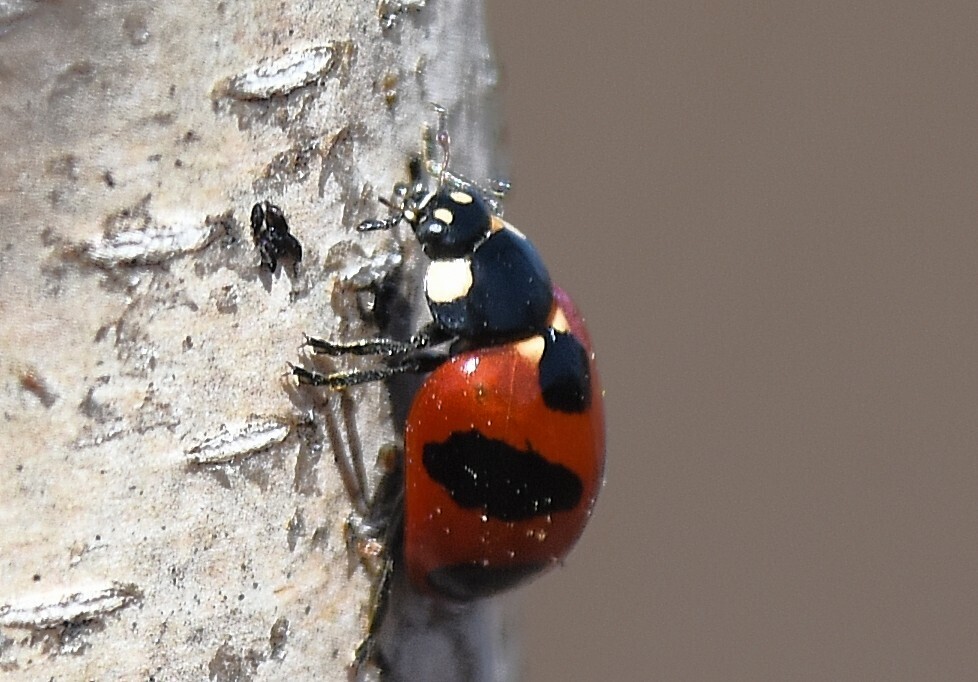
(c) Jimmy Dee, some rights reserved (CC BY-SA) · licence
Family: Coccinellidae · Class: Insecta · Order: Coleoptera
Coccinella monticola (Mountain Lady Beetle) is a California animal in the Coccinellidae family.
The Mountain Lady Beetle is a small, dome-shaped predatory beetle measuring approximately 5-7 mm in length. This species exhibits the typical coccinellid body form with a convex, oval shape and glossy elytra. Adults display variable coloration patterns, typically featuring a reddish to orange background with black markings. The species can be distinguished from similar Coccinella species by specific morphological characteristics, including the absence of a dark suture that is present in the closely related Coccinella alta (BugGuide). Coccinella monticola occurs in western North America, with documented populations in California, Utah, Colorado, and southwestern Alberta. The species has a scattered distribution pattern across mountainous regions of the western United States and southwestern Canada. In California, the species is found primarily in higher elevation areas of the Sierra Nevada and other mountain ranges. The scattered nature of known populations suggests the species may be locally distributed rather than continuously present across its range (BugGuide). As its common name suggests, the Mountain Lady Beetle inhabits high-altitude mountain environments. The species shows a preference for montane ecosystems, distinguishing it from many other lady beetle species that occupy lower elevation habitats. Like other members of the Coccinellidae family, this species likely utilizes various microhabitats within mountain environments, including areas with suitable vegetation that supports aphid populations and other soft-bodied insects that serve as prey. Mountain Lady Beetles are predatory insects that feed primarily on aphids and other small, soft-bodied arthropods. As with most coccinellids, both larvae and adults are voracious predators that play important roles in natural pest control. The species likely follows typical coccinellid life cycle patterns, with females laying clusters of yellow eggs on vegetation near aphid colonies. Larvae undergo three molts before pupating, with the entire development from egg to adult typically completed within several weeks during favorable conditions. Adults may overwinter in protected sites, following the general pattern observed in other lady beetle species that aggregate during winter months. Currently, Coccinella monticola has no formal conservation listing at federal or state levels. The species' conservation status remains poorly documented, with limited scientific literature available regarding population trends or specific threats. However, like many native lady beetle species, the Mountain Lady Beetle may face challenges from habitat modification in mountain environments and potential competition from introduced coccinellid species. The scattered distribution pattern and apparent rarity of observations suggest this species may warrant further study to assess its conservation needs. Climate change impacts on high-elevation habitats could pose additional long-term threats to mountain-adapted species like C. monticola. The limited available data highlights the need for additional research on this species' distribution, ecology, and population status to inform future conservation assessments.
Classification
Class: Insecta · Order: Coleoptera · Family: Coccinellidae
Frequently asked questions
How is Coccinella monticola classified?
Coccinella monticola belongs to class Insecta, order Coleoptera, family Coccinellidae.
What family does Coccinella monticola belong to?
Coccinella monticola is in the Coccinellidae family.
What is Coccinella monticola?
The Mountain Lady Beetle is a small, dome-shaped predatory beetle measuring approximately 5-7 mm in length.
Is Coccinella monticola found in California?
Yes. Coccinella monticola is recorded in California in The California Species Project's catalogue.
Related species
Other California species in the same genus, family, or bioregion.
Data from The California Species Project — 14,000+ California species with verified data from CNPS, CDFW, USFWS, and more.