Coccinella transversoguttata
Transverse Lady Beetle
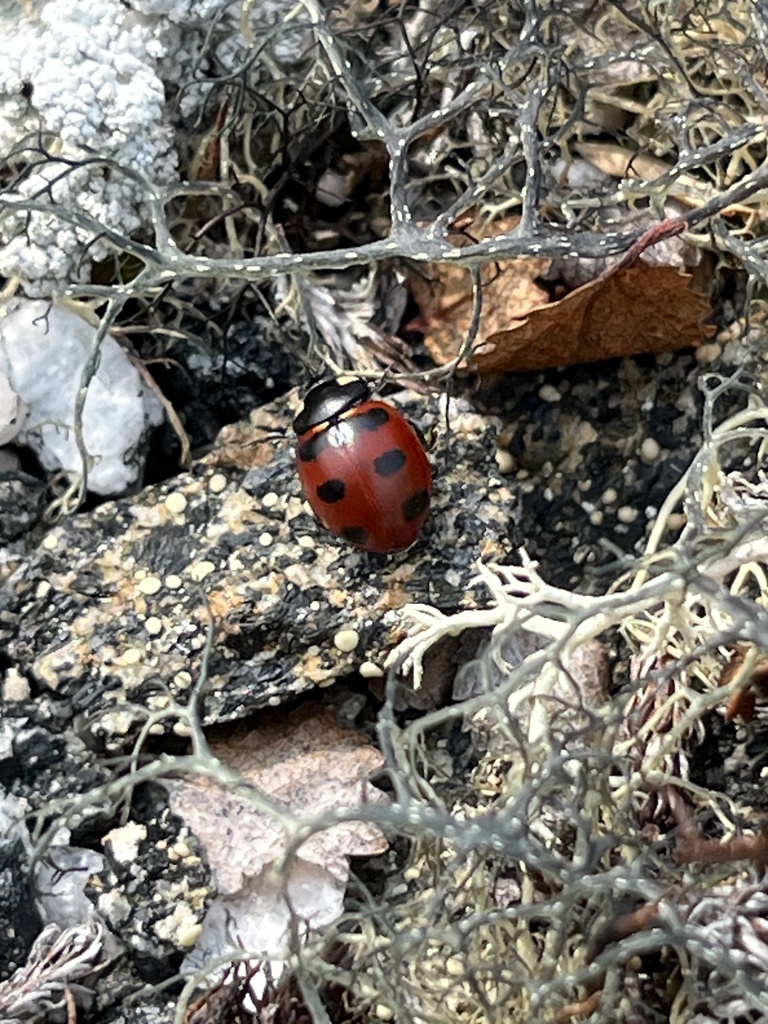
(c) Ida B D Jacobsen, some rights reserved (CC BY) · licence
Family: Coccinellidae · Class: Insecta · Order: Coleoptera
Coccinella transversoguttata (Transverse Lady Beetle) is a California animal in the Coccinellidae family.
The Transverse Lady Beetle is a small predatory beetle measuring approximately 5 to 8 mm (0.2 to 0.3 inches) in length. The species is characterized by its distinctive black transverse band across the front portion of the elytra, which gives the beetle its common name. The elytra are typically orange to red with variable black markings, and adults display a pale elytral suture running down the center of the back. The pronotum is usually orange with black markings, and the head may show white or pale coloration in some individuals. Historically, the Transverse Lady Beetle had a broad distribution across North America, ranging from Canada south through the United States. The species occurs across multiple western states and provinces, with documented populations in California, Washington, and extending into boreal regions of Canada including the Yukon Territory. Within California, the species has been recorded from various counties, though current distribution data suggests significant range contractions from historical levels. The species inhabits diverse terrestrial ecosystems including grasslands, agricultural areas, forest edges, and shrublands. Adults and larvae are typically found on vegetation where aphid populations provide their primary food source. The beetle shows preference for areas with adequate prey density and suitable overwintering sites, including leaf litter, bark crevices, and other protected locations during dormant periods. Transverse Lady Beetles are active predators throughout their life cycle, with both adults and larvae feeding primarily on aphids and other soft-bodied insects. Adults emerge from overwintering sites in spring and begin reproductive activities. Females deposit clusters of yellow eggs on plant surfaces near aphid colonies, ensuring larvae have immediate access to prey upon hatching. The species typically completes one to two generations per year depending on local climate conditions and prey availability. Adults seek protected overwintering sites in fall, often aggregating in large numbers under bark, rocks, or in leaf litter. Although not federally listed, the Transverse Lady Beetle faces significant conservation challenges across much of its range. According to BugGuide, studies in Maine, Manitoba, and South Dakota have documented substantial population declines following the introduction of non-native lady beetle species, particularly the Seven-Spotted Lady Beetle and Multicolored Asian Lady Beetle. New York State considers the species a Species of Greatest Conservation Need, reflecting broader regional conservation concerns. The species was documented as one of the at-risk taxa during recent biodiversity surveys in the Yukon, where some of the healthiest remaining populations persist (NatureServe 2023). Primary threats include competition from introduced lady beetle species, habitat loss, and pesticide use in agricultural areas. The decline of native lady beetle species like C. transversoguttata represents a significant shift in North American coccinellid communities, with potential cascading effects on aphid control and ecosystem function.
Classification
Class: Insecta · Order: Coleoptera · Family: Coccinellidae
Frequently asked questions
How is Coccinella transversoguttata classified?
Coccinella transversoguttata belongs to class Insecta, order Coleoptera, family Coccinellidae.
What family does Coccinella transversoguttata belong to?
Coccinella transversoguttata is in the Coccinellidae family.
What is Coccinella transversoguttata?
The Transverse Lady Beetle is a small predatory beetle measuring approximately 5 to 8 mm (0.2 to 0.3 inches) in length.
Is Coccinella transversoguttata found in California?
Yes. Coccinella transversoguttata is recorded in California in The California Species Project's catalogue.
Related species
Other California species in the same genus, family, or bioregion.
Data from The California Species Project — 14,000+ California species with verified data from CNPS, CDFW, USFWS, and more.