Coccothraustes vespertinus
Evening Grosbeak
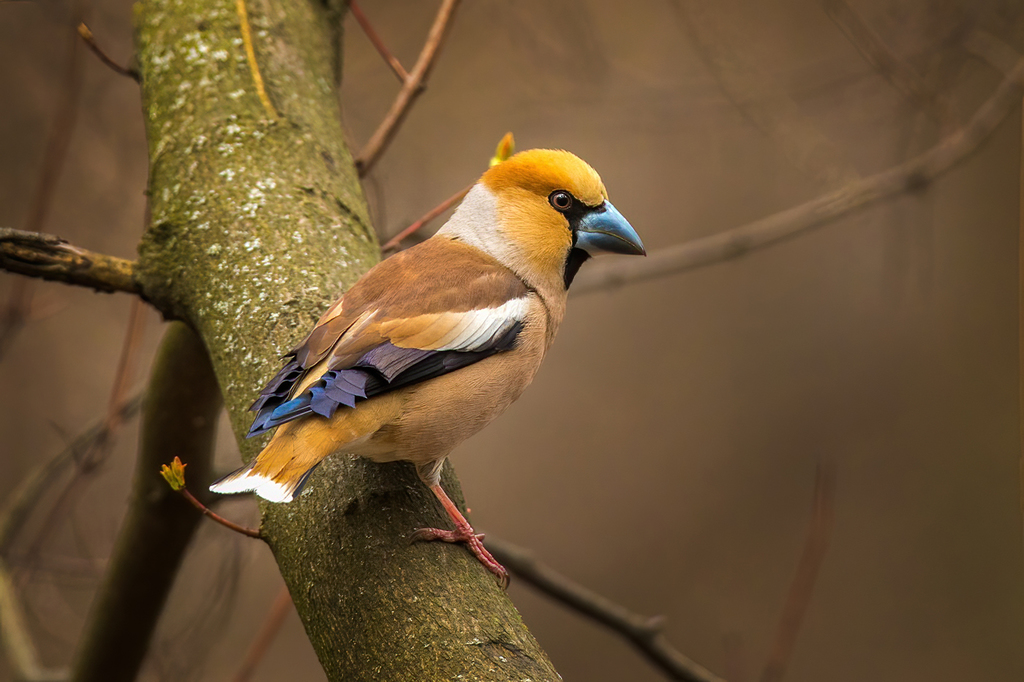
(c) egorbirder, some rights reserved (CC BY) · licence
Family: Fringillidae · Class: Aves · Order: Passeriformes
Coccothraustes vespertinus (Evening Grosbeak) is a California animal in the Fringillidae family.
The Evening Grosbeak is a large, robust finch measuring 16 to 22 cm (6.3 to 8.7 inches) in length with a wingspan of 30 to 36 cm (11.8 to 14.2 inches). Adult males display distinctive plumage with a bright yellow body, dark brown head marked by a prominent yellow eyebrow stripe, and black wings featuring large white patches. The massive, conical bill is pale yellow to greenish-yellow. Females are primarily grayish-brown with yellow tinges on the nape and sides, white wing patches, and a similar large bill. Both sexes have short, notched tails and sturdy legs adapted for perching on branches while feeding. Historically, Evening Grosbeaks bred primarily in coniferous forests across Canada and the northern United States, with populations extending into montane regions of western states including California. In California, the species occurs in the Sierra Nevada, Cascade Range, and northern Coast Ranges, typically at elevations between 1,200 and 2,400 meters (3,900 to 7,900 feet). Their range has contracted significantly since the mid-20th century, with breeding populations now largely restricted to higher elevation forests. Evening Grosbeaks inhabit mature coniferous and mixed forests dominated by fir, spruce, pine, and hemlock. They prefer areas with dense canopy cover and abundant cone-producing trees. During winter, flocks may descend to lower elevations and visit deciduous forests, parks, and residential areas with bird feeders. The species requires access to both nesting sites in tall conifers and feeding areas with diverse seed sources. These highly social birds form large, nomadic flocks outside the breeding season, with movements driven by food availability rather than traditional migration patterns. Evening Grosbeaks are primarily granivorous, feeding on seeds from conifers, maples, ash, and other trees. Their powerful bills allow them to crack open large, hard seeds that other birds cannot access. During breeding season, pairs become territorial and construct cup-shaped nests on horizontal branches 4 to 18 meters above ground. Females lay 2 to 5 pale blue eggs with brown markings between May and July. The species also consumes insects, particularly during the breeding season when feeding nestlings. Evening Grosbeak populations have experienced severe declines across North America since the 1960s. According to the North American Breeding Bird Survey, populations declined by approximately 92% between 1966 and 2019. In California, the species has virtually disappeared from many historical breeding areas. Primary threats include forest management practices that reduce mature conifer habitat, climate change affecting montane forest composition, and potential impacts from West Nile virus. The species is not currently listed under federal or state endangered species acts, but conservation organizations have identified it as a species of high concern requiring habitat protection and population monitoring.
Classification
Class: Aves · Order: Passeriformes · Family: Fringillidae
Frequently asked questions
How is Coccothraustes vespertinus classified?
Coccothraustes vespertinus belongs to class Aves, order Passeriformes, family Fringillidae.
What family does Coccothraustes vespertinus belong to?
Coccothraustes vespertinus is in the Fringillidae family.
What is Coccothraustes vespertinus?
The Evening Grosbeak is a large, robust finch measuring 16 to 22 cm (6.3 to 8.7 inches) in length with a wingspan of 30 to 36 cm (11.8 to 14.2 inches).
Is Coccothraustes vespertinus found in California?
Yes. Coccothraustes vespertinus is recorded in California in The California Species Project's catalogue.
Related species
Other California species in the same genus, family, or bioregion.
Data from The California Species Project — 14,000+ California species with verified data from CNPS, CDFW, USFWS, and more.