Cocytius duponchel
Duponchel's sphinx
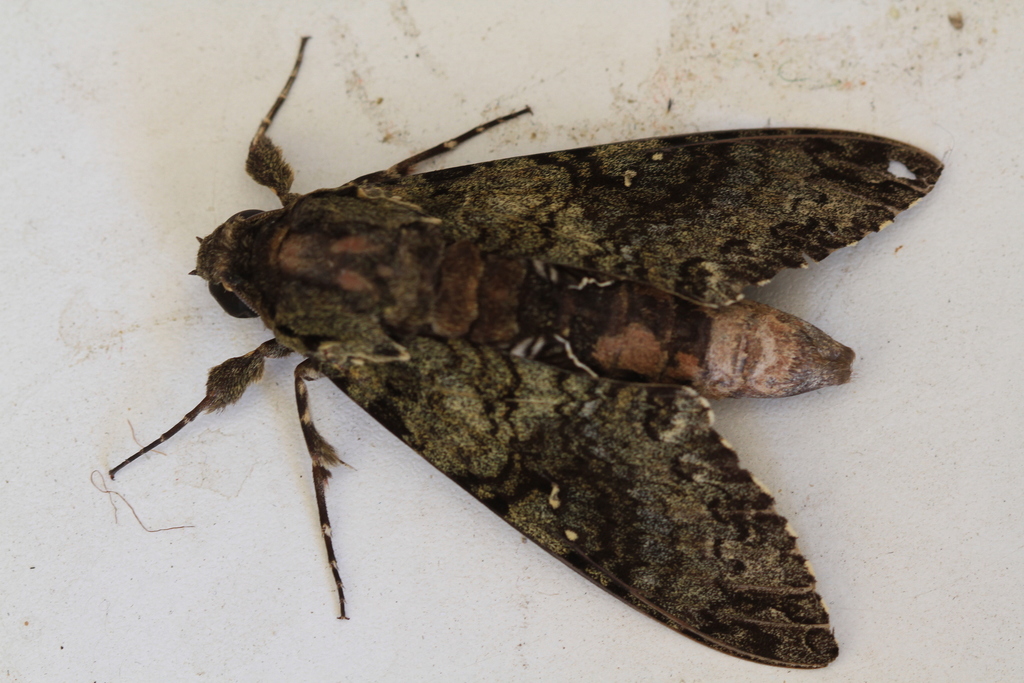
(c) Brian Oakes Haiti Hunter, some rights reserved (CC BY) · licence
Family: Sphingidae · Class: Insecta · Order: Lepidoptera
Cocytius duponchel (Duponchel's sphinx) is a California animal in the Sphingidae family.
Cocytius duponchel, known as Duponchel's sphinx, is a large hawkmoth in the family Sphingidae. Adults have a wingspan ranging from 100 to 130 mm (3.9 to 5.1 inches), making it one of the larger sphinx moths in the Americas. The forewings are elongated and pointed, displaying a mottled brown and gray pattern with darker brown transverse lines and pale patches. The hindwings are shorter and broader, typically brownish with subtle banding. The body is robust and densely scaled, with the thorax matching the wing coloration and the abdomen showing alternating light and dark bands. The head bears prominent compound eyes and a long, coiled proboscis adapted for nectar feeding. Duponchel's sphinx ranges from southern Brazil north through Central America, Mexico, and the West Indies. In the United States, this species occurs rarely in extreme southern Florida and southern Texas, representing the northern edge of its distribution. The moth's presence in these areas appears to be irregular, likely dependent on seasonal migration patterns and favorable weather conditions. Throughout its range, the species is associated with tropical and subtropical regions where its host plants naturally occur. The species inhabits tropical and subtropical forests, woodland edges, gardens, and cultivated areas where Annonaceae plants are present. In Florida, it is most likely to be encountered in hammock environments and residential areas with ornamental plantings. The moth prefers areas with sufficient nectar sources for adults, including flowering trees and shrubs that bloom during evening hours when the moth is active. Duponchel's sphinx larvae feed exclusively on plants in the Annonaceae family, with custard apple (Annona glabra) serving as the primary host plant. Other documented host plants include soursop (Annona muricata) and sugar apple (Annona squamosa). The large, green caterpillars can reach lengths of 100 mm (4 inches) and possess the characteristic horn at the posterior end typical of sphinx moth larvae. Pupation occurs in soil or leaf litter, with the species likely producing multiple generations per year in tropical climates. Adults are crepuscular and nocturnal, feeding on nectar from various flowers using their extended proboscis. Males are attracted to artificial lights and pheromone sources during their search for mates. Duponchel's sphinx does not appear on any federal or state conservation lists, and specific population data are not available for this species. As a tropical moth reaching only the extreme southern United States, it likely maintains stable populations throughout most of its extensive range in Central and South America. However, habitat modification and urbanization in tropical regions may affect local populations. The species' dependence on Annonaceae host plants means that conservation of native custard apple and related species is important for maintaining breeding habitat, particularly at the northern limits of its range in Florida and Texas.
Classification
Class: Insecta · Order: Lepidoptera · Family: Sphingidae
Frequently asked questions
How is Cocytius duponchel classified?
Cocytius duponchel belongs to class Insecta, order Lepidoptera, family Sphingidae.
What family does Cocytius duponchel belong to?
Cocytius duponchel is in the Sphingidae family.
What is Cocytius duponchel?
Cocytius duponchel, known as Duponchel's sphinx, is a large hawkmoth in the family Sphingidae.
Is Cocytius duponchel found in California?
Yes. Cocytius duponchel is recorded in California in The California Species Project's catalogue.
Related species
Other California species in the same genus, family, or bioregion.
Data from The California Species Project — 14,000+ California species with verified data from CNPS, CDFW, USFWS, and more.