Coelocnemis dilaticollis
California Broad-necked Darkling Beetle
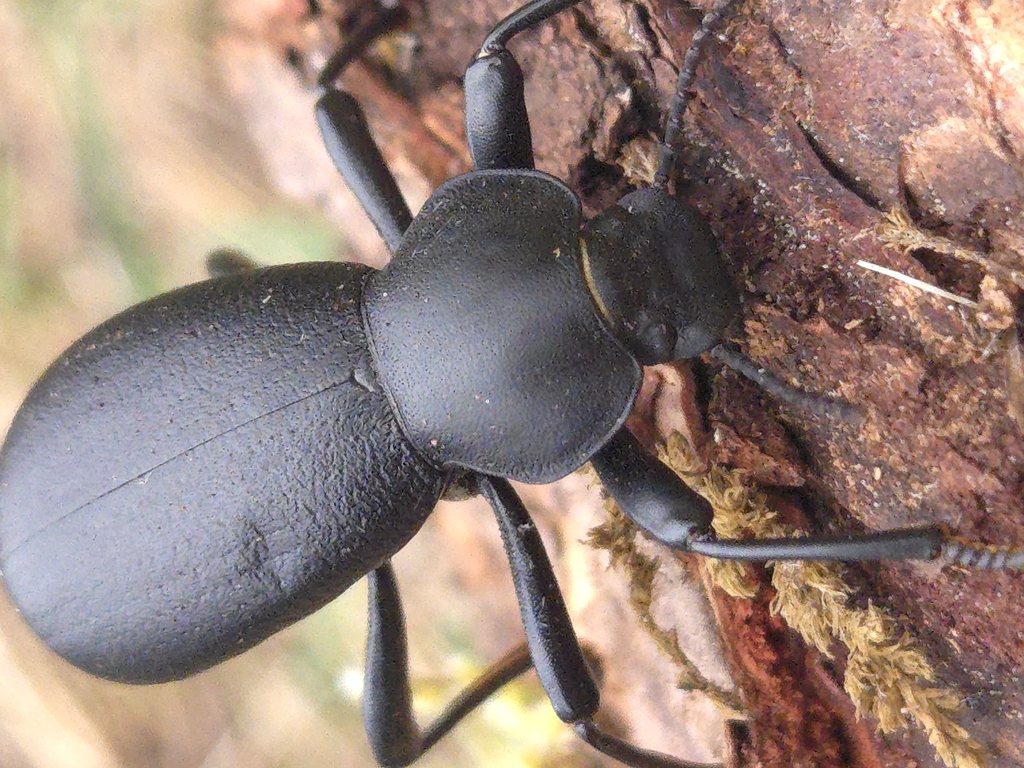
no rights reserved · CC0
Family: Tenebrionidae · Class: Insecta · Order: Coleoptera
Coelocnemis dilaticollis (California Broad-necked Darkling Beetle) is a California animal in the Tenebrionidae family.
The California Broad-necked Darkling Beetle is a large member of the darkling beetle family (Tenebrionidae) measuring approximately 24-25 mm in length. This robust beetle exhibits the characteristic dark coloration typical of its family, with a notably broad pronotum (the shield-like segment behind the head) that gives the species its common name. The body is elongated and convex, with well-developed legs adapted for terrestrial locomotion. This species has a broad distribution across southwestern Canada and the western United States (BugGuide). Within California, specimens have been documented in Placer County, including areas near Colfax along the north fork of the American River (BugGuide). The species extends beyond California's borders, with records from locations as distant as Sanders County, Montana, indicating a wide geographic range across western North America. Coelocnemis dilaticollis inhabits diverse terrestrial environments, from dry hillsides with loose gravel and scattered wildflowers to oak-dominated forest margins. Documented elevations include sites at approximately 253 meters above sea level in California's foothills (BugGuide). The species demonstrates habitat flexibility, occurring in areas ranging from open, sparsely vegetated slopes to forest edges and woodland environments. Adults are often found under cover objects such as logs, rocks, or accumulated debris, including firewood piles. As with most darkling beetles, this species is primarily nocturnal and exhibits cryptic behavior during daylight hours. Adults are typically encountered under natural or artificial cover where they shelter from temperature extremes and predation. The species appears to be active during spring months, with documented observations from April through June. Like other members of the Tenebrionidae, these beetles are likely omnivorous scavengers, feeding on decomposing organic matter, fungi, and plant material. Specific details regarding reproductive biology, larval development, and seasonal activity patterns have not been well documented in the scientific literature. Currently, Coelocnemis dilaticollis has no federal or state conservation listing status. NatureServe ranks the species as G5 (Secure), indicating stable populations across its range with no immediate conservation concerns. However, this assessment may reflect limited survey data rather than comprehensive population monitoring. The species appears on wildlife species lists for some federal refuges, suggesting it occurs within protected habitats, though its conservation status within California specifically has not been formally evaluated. The wide geographic distribution and apparent habitat flexibility suggest the species faces no immediate threats, though habitat loss and fragmentation from development could impact local populations. Climate change may affect this species through altered precipitation patterns and temperature regimes in its preferred habitats, particularly in California's drought-prone regions. Additional research is needed to better understand population trends, habitat requirements, and potential conservation needs for this relatively understudied beetle species.
Classification
Class: Insecta · Order: Coleoptera · Family: Tenebrionidae
Frequently asked questions
How is Coelocnemis dilaticollis classified?
Coelocnemis dilaticollis belongs to class Insecta, order Coleoptera, family Tenebrionidae.
What family does Coelocnemis dilaticollis belong to?
Coelocnemis dilaticollis is in the Tenebrionidae family.
What is Coelocnemis dilaticollis?
The California Broad-necked Darkling Beetle is a large member of the darkling beetle family (Tenebrionidae) measuring approximately 24-25 mm in length.
Is Coelocnemis dilaticollis found in California?
Yes. Coelocnemis dilaticollis is recorded in California in The California Species Project's catalogue.
Related species
Other California species in the same genus, family, or bioregion.
Data from The California Species Project — 14,000+ California species with verified data from CNPS, CDFW, USFWS, and more.