Coenonympha tullia
Common Ringlet
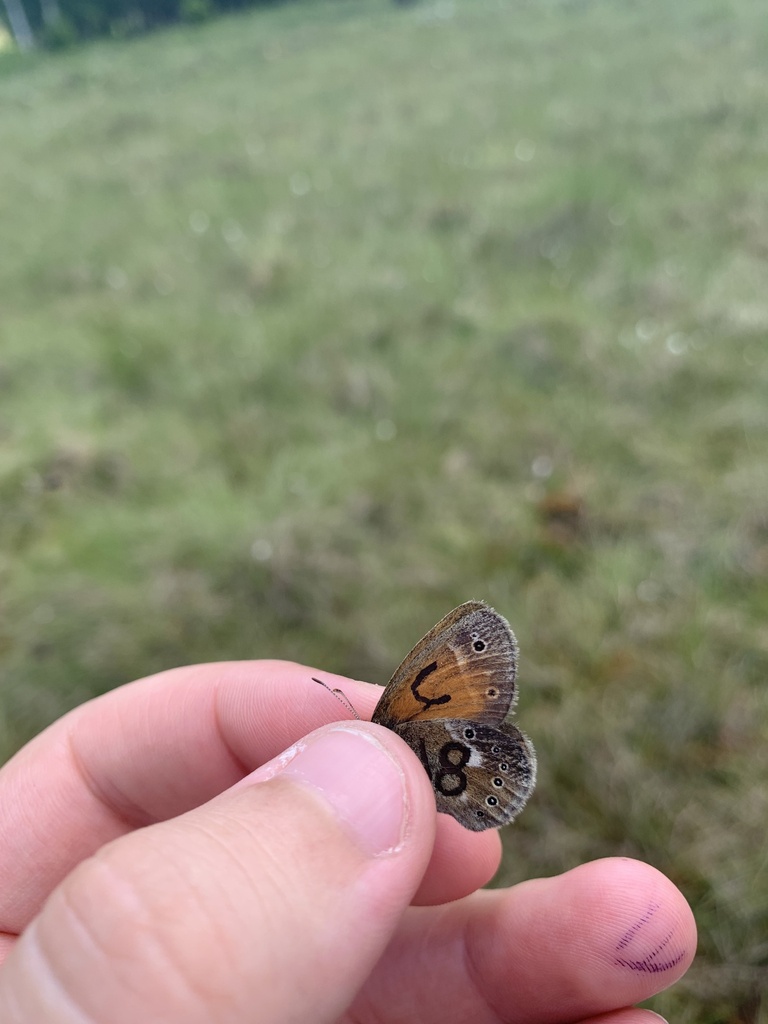
(c) Claudio Sbaraglia, some rights reserved (CC BY) · licence
Family: Nymphalidae · Class: Insecta · Order: Lepidoptera
Coenonympha tullia (Common Ringlet) is a California animal in the Nymphalidae family.
The Common Ringlet is a small to medium-sized butterfly with a wingspan ranging from 32 to 38 mm (1.3 to 1.5 inches). Adults display sexual dimorphism in coloration and pattern. Males typically exhibit brown to tan dorsal wing surfaces with a subtle orange-brown flush, while females are generally darker brown. The undersides of both sexes are pale gray-brown to buff colored. The species is characterized by small eyespots or ocelli on the wing undersides, though these markings are often faint or absent in some populations. The forewings typically show one to three small eyespots near the apex, while the hindwings may display a variable number of eyespots along the outer margin. Coenonympha tullia has a Holarctic distribution, occurring across northern regions of both North America and Eurasia. In North America, the species ranges from Alaska south through the western mountains to Baja California Norte, southeast Arizona, and central New Mexico. The distribution extends across southern Canada to Quebec and New England, reaching south to Long Island. Isolated populations persist in Newfoundland and New Brunswick, with the range reportedly still expanding eastward. Within California, populations occur primarily in montane and subalpine regions of the Sierra Nevada and Cascade Range. The Common Ringlet inhabits open grasslands, meadows, prairies, and forest clearings from sea level to elevations exceeding 3,000 meters (9,800 feet). The species shows particular affinity for moist meadows, bog margins, and areas with native bunch grasses. Adults are often found in habitats with mixed grass and sedge communities, including both natural prairies and managed grasslands. Adults are active from late spring through early fall, with peak flight periods varying by elevation and latitude. The species exhibits a single generation per year in most locations, though some southern populations may produce a partial second brood. Males engage in patrolling behavior, flying low over suitable habitat in search of females. Mating occurs during midday hours when temperatures are optimal. Females deposit eggs singly on or near host plants, which consist of various grasses and rushes. Larvae feed on grass blades and overwinter as partially grown caterpillars, completing development the following spring. The species demonstrates considerable ecological flexibility, utilizing numerous grass species including fescues, bluegrasses, and sedges. The Common Ringlet is not currently listed under federal or state endangered species legislation. While specific population data for California is limited, the species appears stable across much of its range. However, localized populations may face pressure from habitat conversion, particularly in agricultural regions and areas experiencing urban development. Grassland fragmentation and altered fire regimes potentially impact some populations. The species' broad host plant range and wide distribution contribute to its overall stability, though continued monitoring of montane populations is warranted given climate change impacts on high-elevation habitats.
Classification
Class: Insecta · Order: Lepidoptera · Family: Nymphalidae
Frequently asked questions
How is Coenonympha tullia classified?
Coenonympha tullia belongs to class Insecta, order Lepidoptera, family Nymphalidae.
What family does Coenonympha tullia belong to?
Coenonympha tullia is in the Nymphalidae family.
What is Coenonympha tullia?
The Common Ringlet is a small to medium-sized butterfly with a wingspan ranging from 32 to 38 mm (1.3 to 1.5 inches).
Is Coenonympha tullia found in California?
Yes. Coenonympha tullia is recorded in California in The California Species Project's catalogue.
Related species
Other California species in the same genus, family, or bioregion.
Data from The California Species Project — 14,000+ California species with verified data from CNPS, CDFW, USFWS, and more.