Cogia calchas
Mimosa Skipper
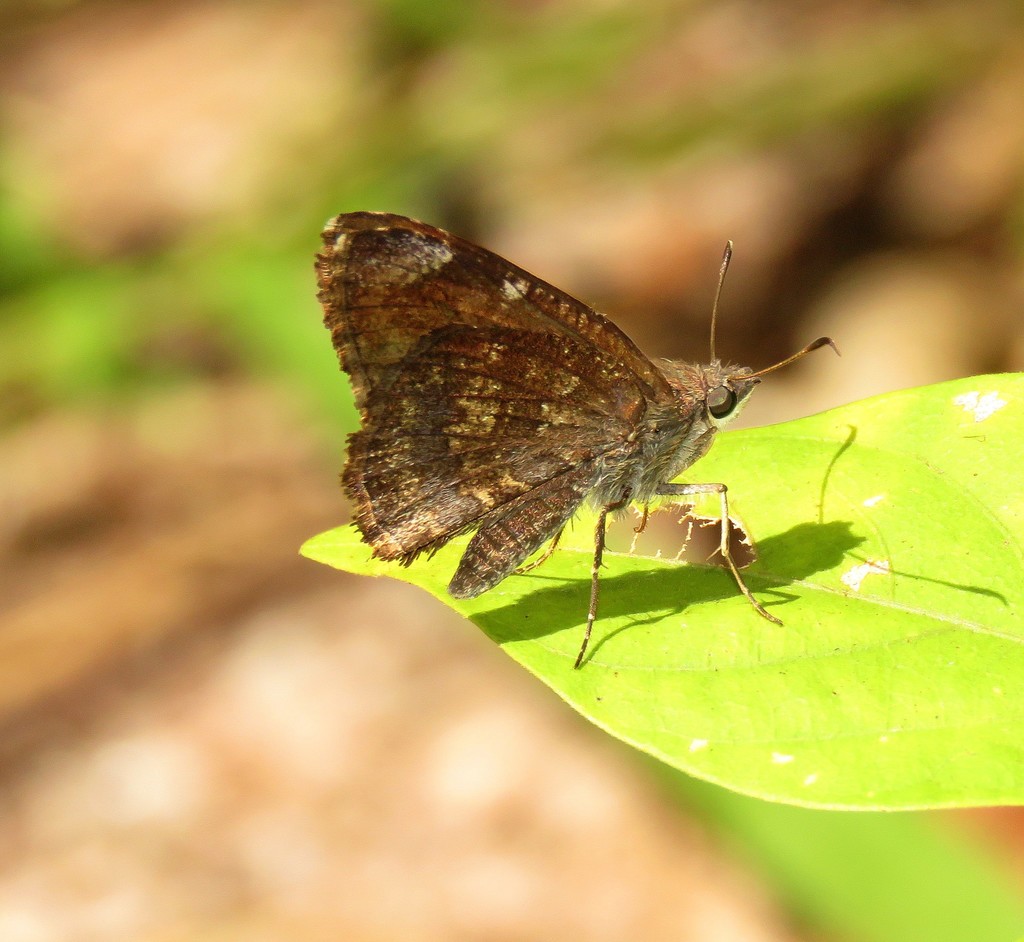
(c) Sidnei Dantas, some rights reserved (CC BY-SA) · licence
Family: Hesperiidae · Class: Insecta · Order: Lepidoptera
Cogia calchas (Mimosa Skipper) is a California animal in the Hesperiidae family.
The Mimosa Skipper (Cogia calchas) is a small butterfly in the family Hesperiidae, characterized by the rapid, darting flight pattern typical of skipper butterflies. Adults have a wingspan of approximately 25 to 32 mm (1.0 to 1.3 inches). The dorsal wing surfaces are dark brown to blackish-brown with white or pale yellow spots arranged in distinct patterns. Males typically display smaller, more angular spots compared to females, which have larger, more rounded markings. The ventral surfaces are lighter brown with prominent white spotting that creates a mottled appearance. The antennae are clubbed with a distinctive hooked tip, and the body is robust and densely covered with scales. The Mimosa Skipper ranges from Argentina north through Central America and Mexico to South Texas. This extensive distribution makes it one of the more widespread members of its genus. In the United States, confirmed populations occur only in extreme southern Texas, primarily in the Rio Grande Valley. The species appears to be a recent colonist in Texas, with first records dating to the 1990s, suggesting possible range expansion northward from Mexico. This species inhabits open areas, disturbed sites, and edge habitats where its host plants occur. In Texas, it is found in subtropical thorn scrub, riparian areas, and urban gardens at elevations below 200 meters (650 feet). The butterfly shows a strong association with areas containing dense stands of its larval food plants, particularly in areas with partial shade and adequate moisture. Mimosa Skippers utilize plants in the pea family (Fabaceae) as larval hosts, including Mimosa pigra, Indigofera, Malicia, and Schrankia species. Adults are active during daylight hours and feed on nectar from various flowering plants, showing particular attraction to small white or yellow flowers. Males establish territories in sunny openings and engage in perching behavior, darting out to investigate passing objects. Females deposit eggs singly on young leaves of host plants. The larval stage constructs silk shelters by folding or tying leaves together, feeding within these protective structures. In southern Texas, the species appears to have multiple broods per year, with adults recorded from March through November. The Mimosa Skipper is not federally or state listed and lacks formal conservation status designations. Population trends are poorly documented due to limited systematic monitoring. In Texas, the species appears stable within its restricted range, though habitat loss from urban development and agricultural conversion poses potential threats. The butterfly's dependence on specific host plants makes it vulnerable to changes in vegetation management and invasive species that alter plant communities. Climate change may affect the northern limits of its range, potentially allowing further expansion into suitable habitat in Texas and other Gulf Coast states.
Classification
Class: Insecta · Order: Lepidoptera · Family: Hesperiidae
Frequently asked questions
How is Cogia calchas classified?
Cogia calchas belongs to class Insecta, order Lepidoptera, family Hesperiidae.
What family does Cogia calchas belong to?
Cogia calchas is in the Hesperiidae family.
What is Cogia calchas?
The Mimosa Skipper (Cogia calchas) is a small butterfly in the family Hesperiidae, characterized by the rapid, darting flight pattern typical of skipper butterflies.
Is Cogia calchas found in California?
Yes. Cogia calchas is recorded in California in The California Species Project's catalogue.
Related species
Other California species in the same genus, family, or bioregion.
Data from The California Species Project — 14,000+ California species with verified data from CNPS, CDFW, USFWS, and more.