Colaptes auratus
Northern Flicker
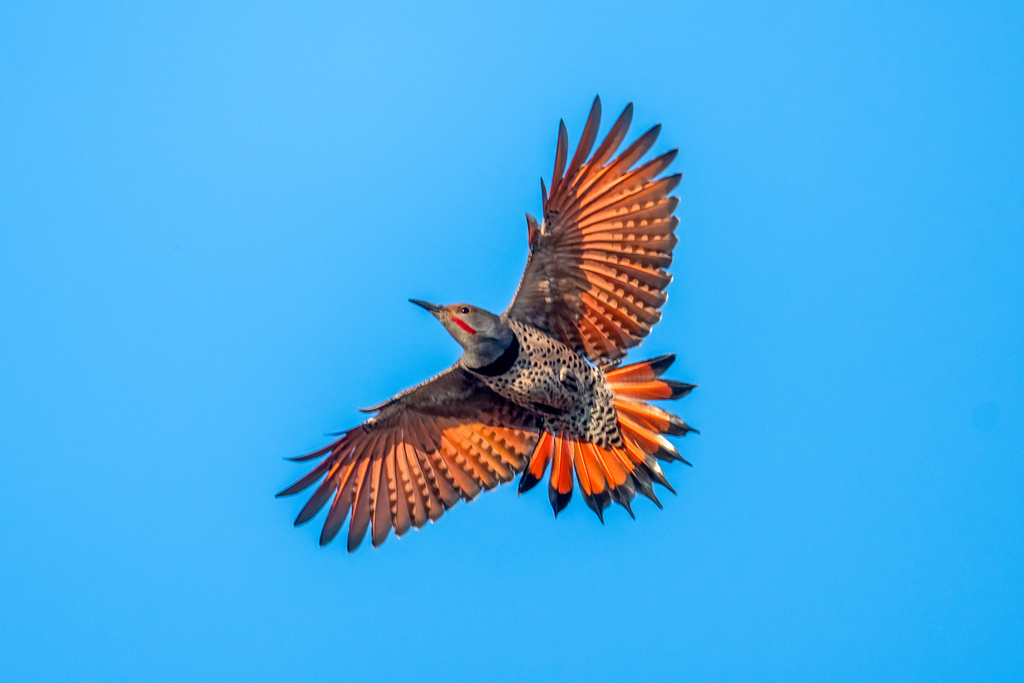
(c) Jonathan Eisen, some rights reserved (CC BY) · licence
Family: Picidae · Class: Aves · Order: Piciformes
Colaptes auratus (Northern Flicker) is a California animal in the Picidae family.
The Northern Flicker is a medium-sized woodpecker measuring 280-360 mm (11-14 inches) in length with a wingspan of 430-540 mm (17-21 inches). Adults weigh 86-167 grams (3-6 ounces). The species exhibits sexual dimorphism and regional variation. Males display a red or black malar stripe (mustache mark), while females lack this marking. The back and wings show brown barring, while the underparts are buff to tan with distinctive black spots. A prominent black bib crosses the upper chest. The rump patch is white in eastern populations and salmon-red in western populations. Two primary subspecies occur: the Yellow-shafted Flicker in eastern North America with bright yellow wing and tail linings, and the Red-shafted Flicker in western regions with salmon-red wing and tail linings. Northern Flickers range across North America from Alaska to Central America. In California, the species occurs throughout the state as both a breeding resident and winter visitor. Red-shafted Flickers breed in forested regions from sea level to 3,350 meters (11,000 feet) elevation. The species occupies diverse habitats including coniferous and deciduous forests, woodland edges, parks, suburbs, and agricultural areas with scattered trees. Northern Flickers require suitable nesting cavities in dead or dying trees and open areas for foraging. Unlike most woodpeckers, Northern Flickers spend considerable time foraging on the ground. Ants comprise 45-75% of their diet, supplemented by beetles, termites, caterpillars, and other insects. The species uses its barbed tongue, extending up to 50 mm beyond the bill tip, to extract prey from crevices and ant colonies. During fall and winter, flickers consume fruits and seeds including elderberries, sumac, and poison oak berries. Breeding occurs from March through July, varying by elevation and latitude. Northern Flickers excavate nest cavities 250-450 mm deep in dead wood, typically 1.8-18 meters (6-60 feet) above ground. Females lay 3-12 glossy white eggs, with clutches averaging 6-8 eggs. Both sexes incubate eggs for 11-14 days and feed nestlings for 24-27 days until fledging. The species typically produces one brood annually, though southern populations may attempt second broods. Northern Flickers are partially migratory. Northern populations move south for winter, while many western birds remain year-round residents. The species forms loose flocks during migration and winter, sometimes numbering in the hundreds. Flickers communicate through drumming on resonant surfaces and distinctive vocalizations including a loud "wick-wick-wick" call and a single-note "kleer." The Northern Flicker maintains stable populations across most of its range and is not federally or state listed in California. According to the North American Breeding Bird Survey, populations declined by approximately 1.2% annually between 1966-2019, primarily due to habitat loss and competition with European Starlings for nest cavities. The species benefits from forest management practices that retain snags and dead trees for nesting sites.
Classification
Class: Aves · Order: Piciformes · Family: Picidae
Frequently asked questions
How is Colaptes auratus classified?
Colaptes auratus belongs to class Aves, order Piciformes, family Picidae.
What family does Colaptes auratus belong to?
Colaptes auratus is in the Picidae family.
What is Colaptes auratus?
The Northern Flicker is a medium-sized woodpecker measuring 280-360 mm (11-14 inches) in length with a wingspan of 430-540 mm (17-21 inches).
Is Colaptes auratus found in California?
Yes. Colaptes auratus is recorded in California in The California Species Project's catalogue.
Related species
Other California species in the same genus, family, or bioregion.
Data from The California Species Project — 14,000+ California species with verified data from CNPS, CDFW, USFWS, and more.