Colaptes chrysoides
Gilded flicker
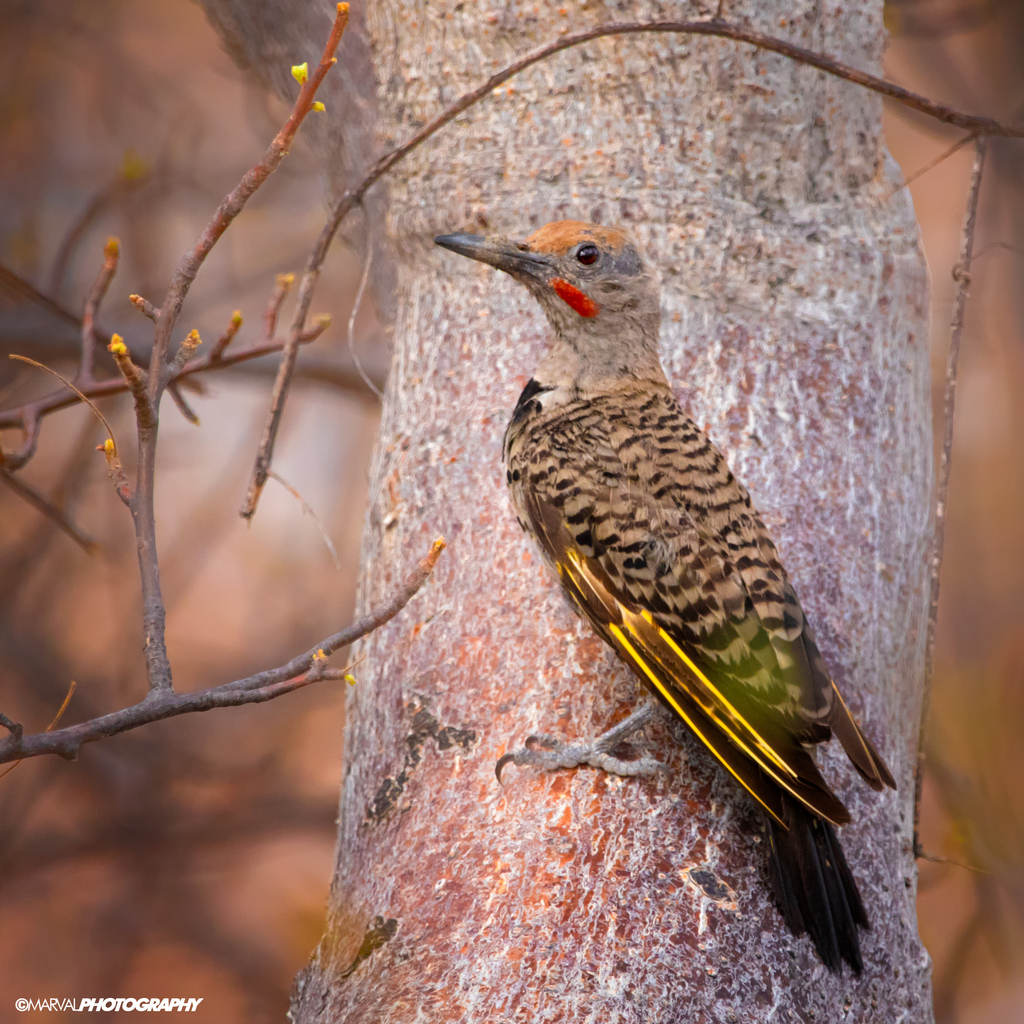
(c) MarvalPhotography19, some rights reserved (CC BY) · licence
Family: Picidae · Class: Aves · Order: Piciformes
Conservation status: SE · G4 S2
Colaptes chrysoides (Gilded flicker) is a California animal in the Picidae family.
The gilded flicker is a medium-sized woodpecker endemic to the Sonoran Desert region. Adults measure 28 to 31 centimeters (11 to 12 inches) in length with a wingspan of 42 to 54 centimeters (16.5 to 21 inches). The species weighs between 95 to 140 grams (3.4 to 4.9 ounces). Males display a distinctive red mustache stripe, while females lack this marking. Both sexes have brownish-gray backs with black barring, pale underparts with black spotting, and a prominent black bib across the upper chest. The underwing and tail surfaces show bright yellow coloration during flight. A gray-brown cap covers the head, distinguishing it from the red-capped northern flicker. Historically, gilded flickers ranged throughout the Colorado River valley and southeastern California's Sonoran Desert regions. The species occurs in Imperial, Riverside, and San Bernardino counties, with populations concentrated along the Colorado River corridor from the Mexican border north to the Nevada state line. Current distribution has contracted significantly from historical ranges, with many areas experiencing local extirpations. Gilded flickers inhabit mature desert riparian woodlands dominated by cottonwoods and willows, as well as desert washes with mesquite and palo verde trees. The species requires large trees for nesting cavities, typically selecting cottonwoods, willows, or saguaro cacti where available. Elevation ranges from below sea level in the Salton Sink to approximately 500 meters (1,640 feet) in desert mountain ranges. Dense understory vegetation provides foraging habitat for ground-dwelling arthropods. This species exhibits typical woodpecker foraging behavior, excavating insects from tree bark and probing ground surfaces for ants, beetles, and larvae. Unlike most woodpeckers, gilded flickers spend considerable time foraging on the ground, using their slightly curved bills to extract prey from soil and leaf litter. Breeding occurs from March through July, with pairs excavating nest cavities in dead or dying trees. Females lay three to eight glossy white eggs, with both parents sharing incubation duties for 11 to 14 days. Young fledge after 24 to 27 days but remain dependent on parents for several weeks. California lists the gilded flicker as endangered under the California Endangered Species Act. According to the California Department of Fish and Wildlife, the species is listed as Colaptes auratus chrysoides, reflecting its historical classification as a subspecies of northern flicker. Global populations remain stable with a G4 ranking, but California populations have declined drastically due to habitat loss and degradation. The state ranking of S2 indicates the species is imperiled within California, with fewer than 20 known breeding pairs remaining. Primary threats include riparian habitat destruction from water diversions, urban development, agricultural conversion, and invasive plant species that alter native vegetation structure. Livestock grazing degrades understory habitat essential for ground foraging. Climate change and prolonged drought stress desert riparian systems, reducing tree health and cavity availability.
Classification
Class: Aves · Order: Piciformes · Family: Picidae
Conservation status
SE · G4 S2
Frequently asked questions
How is Colaptes chrysoides classified?
Colaptes chrysoides belongs to class Aves, order Piciformes, family Picidae.
What family does Colaptes chrysoides belong to?
Colaptes chrysoides is in the Picidae family.
Is Colaptes chrysoides protected or of conservation concern?
Colaptes chrysoides carries the following status: SE · G4 S2.
What is Colaptes chrysoides?
The gilded flicker is a medium-sized woodpecker endemic to the Sonoran Desert region.
Is Colaptes chrysoides found in California?
Yes. Colaptes chrysoides is recorded in California in The California Species Project's catalogue.
Related species
Other California species in the same genus, family, or bioregion.
Data from The California Species Project — 14,000+ California species with verified data from CNPS, CDFW, USFWS, and more.