Coleonyx switaki
Barefoot banded gecko
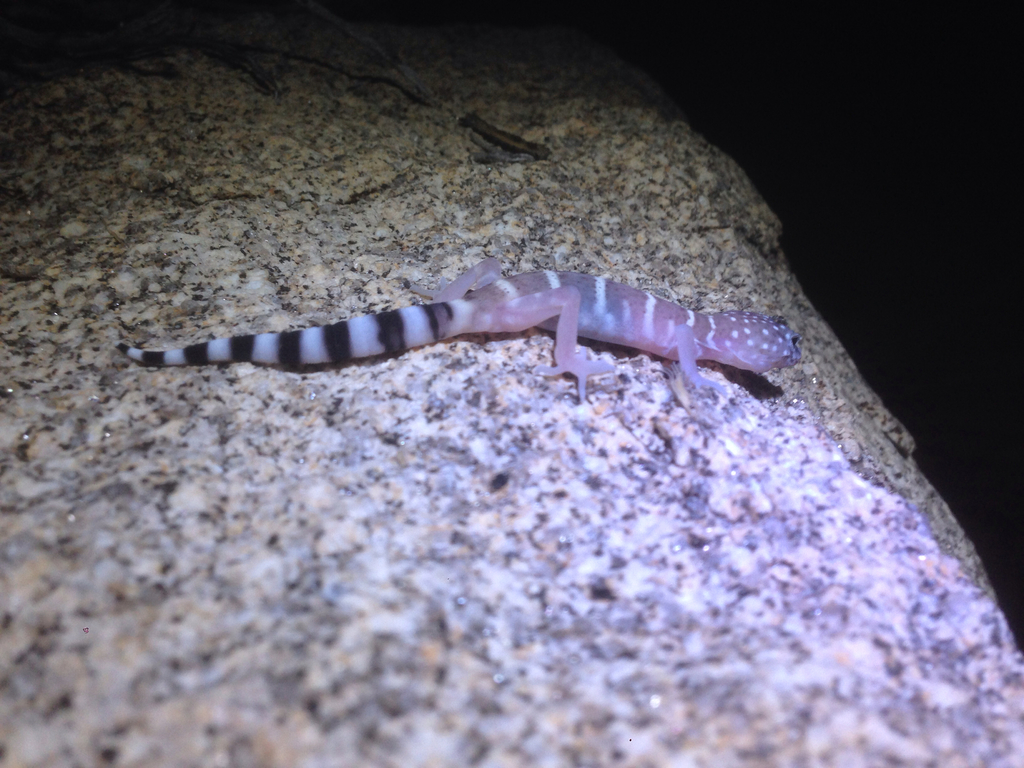
(c) Adam J. Searcy, some rights reserved (CC BY) · licence
Family: Gekkonidae · Class: Reptilia · Order: Squamata
Conservation status: ST · G4 S3
Coleonyx switaki (Barefoot banded gecko) is a California animal in the Gekkonidae family.
The barefoot banded gecko (Coleonyx switaki) is a small, nocturnal lizard native to the southwestern United States and northwestern Mexico. Adults typically measure 100 to 127 mm (3.9 to 5.0 inches) in total length, with approximately half of this length comprising the tail. The species is distinguished by its characteristic banded pattern of dark brown or black crossbands alternating with cream or pale yellow bands across the back and tail. The head is relatively large and triangular, with prominent eyes adapted for night vision. Unlike many gecko species, barefoot banded geckos lack adhesive toe pads, hence the common name "barefoot gecko." The skin is soft and granular, lacking the keeled scales found in many other lizard species. The barefoot banded gecko has a limited range in California, occurring primarily in the desert regions of Imperial, Riverside, and San Bernardino counties. The species extends southward into Baja California, Mexico, and eastward into Arizona. In California, populations are concentrated in the Colorado Desert region, including areas near the Salton Sea and along the Colorado River valley. The species reaches its northernmost distribution limits in the Coachella Valley. This species inhabits rocky desert areas, including boulder fields, rocky hillsides, and canyon walls in the Sonoran Desert ecosystem. Barefoot banded geckos are typically found at elevations ranging from below sea level near the Salton Sea to approximately 1,500 meters (4,900 feet) in mountainous terrain. They prefer areas with abundant rock crevices and overhangs that provide daytime retreat sites. The species is closely associated with granite and volcanic rock formations, which offer suitable microhabitats for thermoregulation and protection from predators. Barefoot banded geckos are strictly nocturnal, emerging after sunset to forage for arthropod prey including crickets, beetles, spiders, and moths. During winter months, individuals enter a period of reduced activity and may remain in rock crevices for extended periods. Breeding occurs in spring, typically from March through May. Females deposit one to two hard-shelled eggs in protected locations such as rock crevices or beneath boulders. Incubation lasts approximately 45 to 65 days, depending on temperature. Juveniles reach sexual maturity at approximately two years of age. The barefoot banded gecko is listed as threatened under the California Endangered Species Act. According to the California Department of Fish and Wildlife, the species faces threats from habitat loss due to urban development, renewable energy projects, and recreational activities in desert areas. Off-highway vehicle use has degraded habitat quality in some areas through soil compaction and vegetation removal. Climate change poses additional concerns through increased temperatures and altered precipitation patterns that may affect prey availability and suitable microhabitat conditions. Collection for the pet trade historically impacted some populations, though this threat has diminished with protective regulations.
Classification
Class: Reptilia · Order: Squamata · Family: Gekkonidae
Conservation status
ST · G4 S3
Frequently asked questions
How is Coleonyx switaki classified?
Coleonyx switaki belongs to class Reptilia, order Squamata, family Gekkonidae.
What family does Coleonyx switaki belong to?
Coleonyx switaki is in the Gekkonidae family.
Is Coleonyx switaki protected or of conservation concern?
Coleonyx switaki carries the following status: ST · G4 S3.
What is Coleonyx switaki?
The barefoot banded gecko (Coleonyx switaki) is a small, nocturnal lizard native to the southwestern United States and northwestern Mexico.
Is Coleonyx switaki found in California?
Yes. Coleonyx switaki is recorded in California in The California Species Project's catalogue.
Related species
Other California species in the same genus, family, or bioregion.
Data from The California Species Project — 14,000+ California species with verified data from CNPS, CDFW, USFWS, and more.