Coleonyx variegatus
Western Banded Gecko
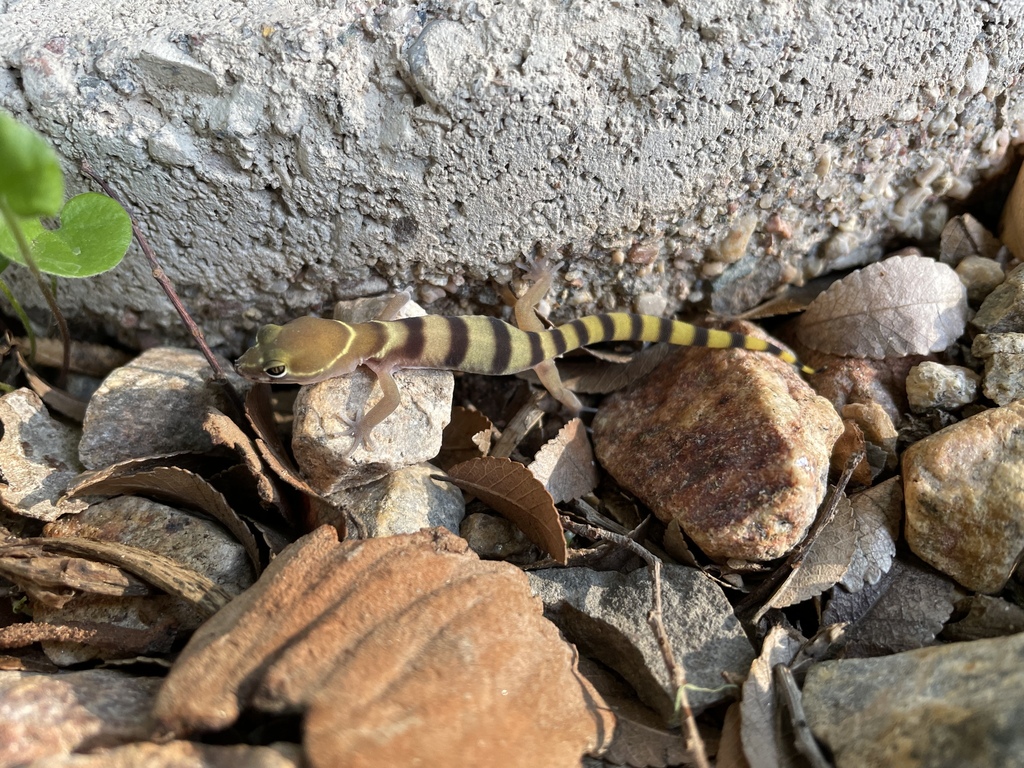
(c) Branson Khounvichith, some rights reserved (CC BY-SA) · licence
Family: Gekkonidae · Class: Reptilia · Order: Squamata
Coleonyx variegatus (Western Banded Gecko) is a California animal in the Gekkonidae family.
The Western Banded Gecko is a small, nocturnal lizard native to the southwestern United States and northwestern Mexico. Adults typically measure 100 to 152 mm (4 to 6 inches) in total length, with approximately half consisting of the tail. The body is slender and flattened, with a large head relative to body size. The skin appears soft and granular, lacking the overlapping scales found in most lizards. Coloration consists of alternating bands of pale yellow, cream, or white contrasting with darker brown or purple bands across the back and tail. The ventral surface is typically cream or pale yellow. Juveniles display more pronounced banding that may fade with age. The eyes are large with vertical pupils adapted for nighttime activity, and the toes lack adhesive pads, distinguishing this species from other geckos. In California, the Western Banded Gecko occurs primarily in the southeastern desert regions, including portions of the Mojave and Colorado deserts. The species ranges through Imperial, Riverside, and eastern San Bernardino counties, extending north to the vicinity of Twenty-nine Palms and Barstow. The California distribution represents the northwestern edge of a range that extends east through Arizona, Nevada, and Utah, and south into Baja California and Sonora, Mexico. This species inhabits arid and semi-arid environments, typically in areas receiving less than 250 mm (10 inches) of annual precipitation. Western Banded Geckos occupy rocky outcrops, boulder fields, desert washes, and areas with scattered desert shrubs. They are commonly found in creosote bush scrub, desert pavement, and bajadas from sea level to approximately 1,520 meters (5,000 feet) elevation. The species requires shelter sites such as rock crevices, burrows, or spaces beneath large rocks for daytime refuge and protection from temperature extremes. Western Banded Geckos are strictly nocturnal, emerging after sunset to hunt for prey. Their diet consists primarily of small arthropods, including crickets, moths, beetles, spiders, and scorpions. Hunting occurs on the ground surface, where they use their excellent night vision to locate prey. The species is oviparous, with females laying one to two soft-shelled eggs typically between May and September. Eggs are deposited in sandy soil or beneath rocks, with incubation lasting approximately 60 days depending on temperature. Males establish territories during breeding season and may engage in aggressive encounters with other males. The Western Banded Gecko is not federally or state listed and is considered relatively stable throughout most of its range. The species adapts well to certain types of habitat modification and can persist in areas with moderate development. Primary threats include habitat loss from urbanization, mining, and renewable energy development in desert regions. Off-road vehicle activity can degrade habitat quality, and collection for the pet trade may impact some populations. Climate change poses potential long-term threats through altered precipitation patterns and increased temperature extremes in desert environments.
Classification
Class: Reptilia · Order: Squamata · Family: Gekkonidae
Frequently asked questions
How is Coleonyx variegatus classified?
Coleonyx variegatus belongs to class Reptilia, order Squamata, family Gekkonidae.
What family does Coleonyx variegatus belong to?
Coleonyx variegatus is in the Gekkonidae family.
What is Coleonyx variegatus?
The Western Banded Gecko is a small, nocturnal lizard native to the southwestern United States and northwestern Mexico.
Is Coleonyx variegatus found in California?
Yes. Coleonyx variegatus is recorded in California in The California Species Project's catalogue.
Related species
Other California species in the same genus, family, or bioregion.
Data from The California Species Project — 14,000+ California species with verified data from CNPS, CDFW, USFWS, and more.