Coleonyx variegatus abbotti
San Diego Banded Gecko
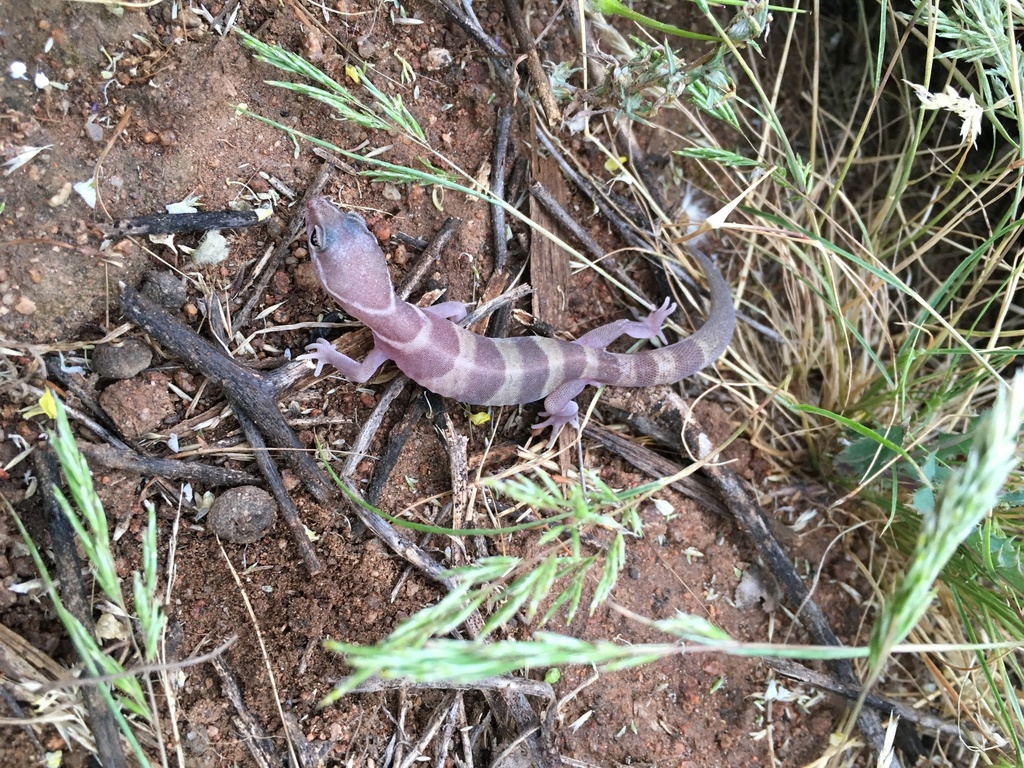
(c) kclarksdnhmorg, some rights reserved (CC BY) · licence
Family: Gekkonidae · Class: Reptilia · Order: Squamata
Conservation status: G5T5 S1S2
Coleonyx variegatus abbotti (San Diego Banded Gecko) is a California animal in the Gekkonidae family.
The San Diego Banded Gecko is a small, nocturnal lizard endemic to southern California and Baja California, Mexico. Adults typically measure 100 to 150 mm (4 to 6 inches) in total length, with approximately half of this length comprised of the tail. The body is characterized by alternating bands of light and dark coloration, with cream or pale yellow bands separated by brown or gray crossbands. Unlike many gecko species, San Diego Banded Geckos possess movable eyelids and lack adhesive toe pads, instead having small claws adapted for terrestrial locomotion. The skin appears granular with small, bead-like scales covering the body surface. When threatened, individuals can autotomize their tail, which will regenerate over time, though the replacement tail typically differs in appearance from the original. The subspecies Coleonyx variegatus abbotti occurs in extreme southwestern California, primarily in San Diego and southwestern Riverside counties, extending south into Baja California, Mexico. The species Coleonyx variegatus ranges throughout much of southern California, extending north into extreme southern Nevada and southwestern Utah, across Arizona into southwestern New Mexico, and south through western Sonora and the length of Baja California (California Herps). In California, the San Diego Banded Gecko represents the westernmost population of this desert-adapted species complex. This subspecies inhabits rocky areas within coastal sage scrub and chaparral communities, distinguishing it from other subspecies that occupy more typical desert environments (California Herps). The species shows a strong preference for rocky substrates, utilizing crevices and boulder fields for shelter during daylight hours. California Department of Fish and Wildlife lists this subspecies as a Species of Special Concern, reflecting its limited California range and specific habitat requirements. San Diego Banded Geckos are primarily nocturnal, emerging after sunset to forage for small invertebrates including insects, spiders, and other arthropods (California Herps). During cooler months, activity decreases significantly, and individuals may enter periods of reduced activity or brumation. Breeding occurs during April and May, with females depositing one to two soft-shelled eggs from May through September. Eggs require approximately 45 days to hatch under favorable conditions (California Herps). The species exhibits typical gecko behaviors including territorial displays and vocalizations, though these are less pronounced than in climbing gecko species. The San Diego Banded Gecko's conservation status reflects its restricted range within California and vulnerability to habitat modification. Urban development, recreational activities, and habitat fragmentation pose primary threats to remaining populations. The subspecies' dependence on specific rocky habitat within coastal sage scrub communities makes it particularly susceptible to ecosystem changes. Climate change may also impact this subspecies through altered precipitation patterns and increased fire frequency in its chaparral and coastal sage scrub habitat. Current population trends and precise distribution limits require additional study to inform conservation planning efforts.
Classification
Class: Reptilia · Order: Squamata · Family: Gekkonidae
Conservation status
G5T5 S1S2
Frequently asked questions
How is Coleonyx variegatus abbotti classified?
Coleonyx variegatus abbotti belongs to class Reptilia, order Squamata, family Gekkonidae.
What family does Coleonyx variegatus abbotti belong to?
Coleonyx variegatus abbotti is in the Gekkonidae family.
Is Coleonyx variegatus abbotti protected or of conservation concern?
Coleonyx variegatus abbotti carries the following status: G5T5 S1S2.
What is Coleonyx variegatus abbotti?
The San Diego Banded Gecko is a small, nocturnal lizard endemic to southern California and Baja California, Mexico.
Is Coleonyx variegatus abbotti found in California?
Yes. Coleonyx variegatus abbotti is recorded in California in The California Species Project's catalogue.
Related species
Other California species in the same genus, family, or bioregion.
Data from The California Species Project — 14,000+ California species with verified data from CNPS, CDFW, USFWS, and more.