Coleophora discostriata
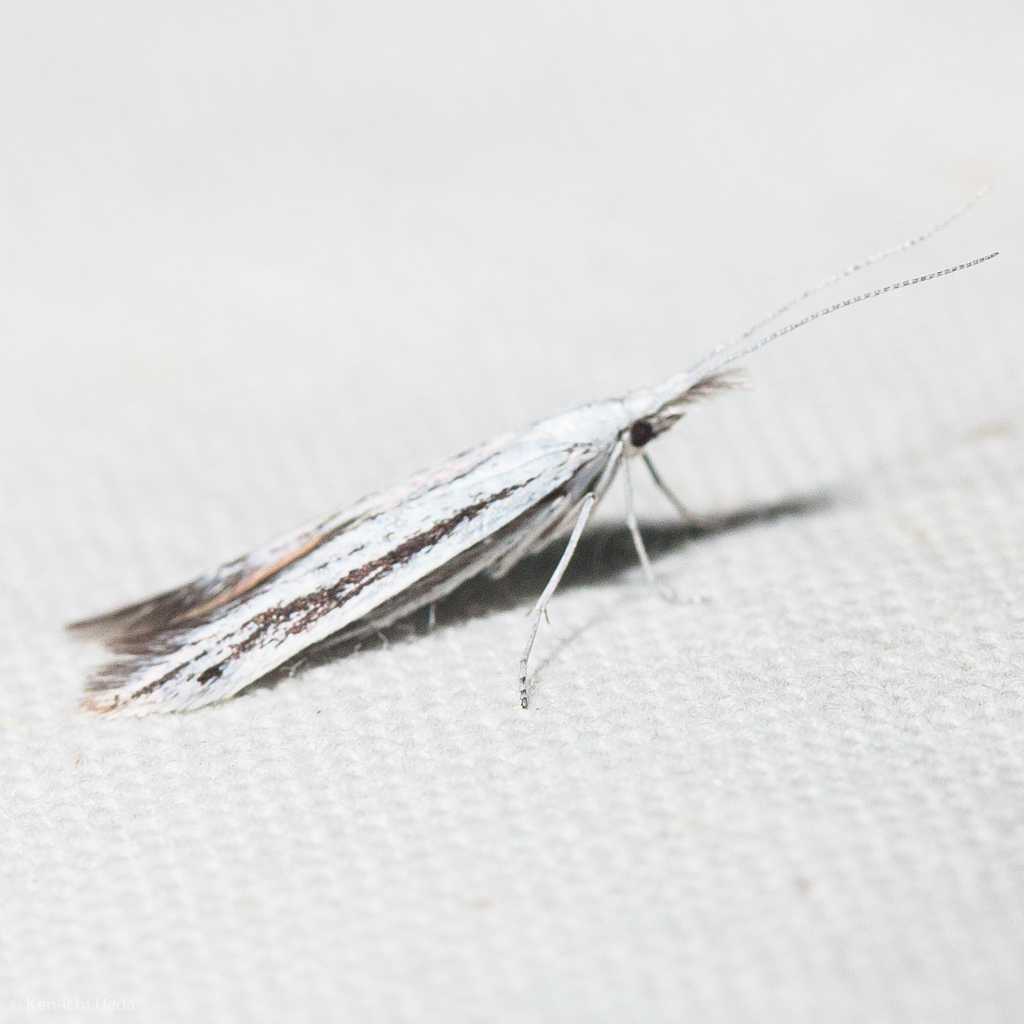
(c) Ken-ichi Ueda, some rights reserved (CC BY) · licence
Family: Coleophoridae · Class: Insecta · Order: Lepidoptera
Coleophora discostriata is a California animal in the Coleophoridae family.
Coleophora discostriata is a small casebearer moth in the family Coleophoridae, first described by Walsingham in 1882. This microlepidopteran species exhibits the characteristic features of the genus Coleophora, with adults typically measuring 8-12 mm in wingspan. The forewings display a mottled brown and gray pattern with subtle striations that give the species its name "discostriata," referring to the discontinuous or broken stripes along the wing surface. The hindwings are typically pale gray to white with long, hair-like fringes extending beyond the wing margin. Coleophora discostriata occurs in western North America, with documented populations in California and other western states. Within California, the species has been recorded from various counties, though specific distributional data remains limited. The moth appears to have a patchy distribution corresponding to the availability of suitable host plants and habitat conditions. The species inhabits areas where its host plants are present, primarily in oak woodland, chaparral, and mixed forest communities. According to the Moth Photographers Group, the larvae feed on plants in two families: Fagaceae and Rhamnaceae, with documented host genera including Ceanothus and Quercus (Shropshire & Douglas 2025). However, some taxonomic sources indicate uncertainty regarding Quercus as a host, as Bucheli et al. (2002) did not list oak species in their host plant documentation. The larvae are leaf miners, feeding within the leaf tissue and creating characteristic feeding damage patterns. Like other Coleophora species, C. discostriata exhibits a complex life cycle involving a larval case-bearing stage. The larvae construct portable cases from plant material and frass, which they carry as they move and feed. This casebearer behavior is a defining characteristic of the genus and provides protection during the vulnerable larval stage. Adults are typically active during warmer months, though specific flight periods for this species have not been well documented. The species likely has one generation per year, typical of many Coleophora moths in temperate climates. The conservation status of Coleophora discostriata has not been formally evaluated by state or federal agencies. As with many microlepidopteran species, population trends and threats are poorly understood due to limited research and monitoring efforts. The species does not appear on any endangered species lists, suggesting it is not currently considered at risk of extinction. However, habitat loss and fragmentation in California's oak woodlands and chaparral ecosystems could potentially affect populations, particularly given the species' apparent dependence on specific host plant genera. Climate change impacts on host plant distributions may also influence the species' long-term persistence. Detailed ecological studies of this species are lacking. The information presented here synthesizes available data from taxonomic sources and moth photography databases. Additional research is needed to better understand the species' distribution, population status, and ecological requirements in California.
Classification
Class: Insecta · Order: Lepidoptera · Family: Coleophoridae
Frequently asked questions
How is Coleophora discostriata classified?
Coleophora discostriata belongs to class Insecta, order Lepidoptera, family Coleophoridae.
What family does Coleophora discostriata belong to?
Coleophora discostriata is in the Coleophoridae family.
What is Coleophora discostriata?
Coleophora discostriata is a small casebearer moth in the family Coleophoridae, first described by Walsingham in 1882.
Is Coleophora discostriata found in California?
Yes. Coleophora discostriata is recorded in California in The California Species Project's catalogue.
Related species
Other California species in the same genus, family, or bioregion.
Data from The California Species Project — 14,000+ California species with verified data from CNPS, CDFW, USFWS, and more.