Colias behrii
Sierra Sulphur
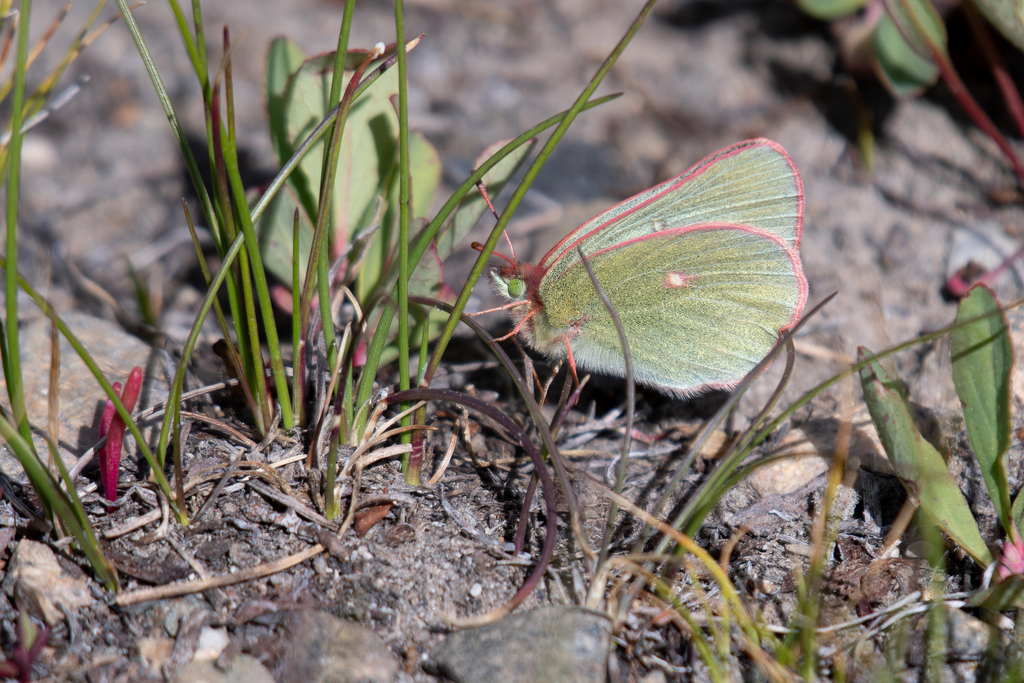
(c) Rajan Rao, some rights reserved (CC BY) · licence
Family: Pieridae · Class: Insecta · Order: Lepidoptera
Colias behrii (Sierra Sulphur) is a California animal in the Pieridae family.
The Sierra Sulphur is a medium-sized butterfly in the family Pieridae, endemic to California's high-elevation mountain ecosystems. Adults have a wingspan of 38 to 50 mm (1.5 to 2.0 inches). Males display bright sulfur-yellow wings with black borders along the margins, while females are typically pale yellow to white with more extensive dark markings. Both sexes exhibit orange spots on the hindwings and distinctive black cell spots on the forewings. The underside of the hindwings shows a greenish-yellow coloration with white spotting that provides effective camouflage when at rest. This species has an isolated range in California's Sierra Nevada, extending from Tuolumne County south to Tulare County. The distribution is fragmented across high-elevation sites, with populations separated by unsuitable habitat at lower elevations. Historical records document the species from locations including Yosemite National Park, Sequoia National Park, and surrounding wilderness areas. The species' range reflects its adaptation to specific montane conditions found only in this portion of the Sierra Nevada. Sierra Sulphur inhabits subalpine and alpine meadows typically between 2,100 and 3,400 meters (7,000 to 11,200 feet) in elevation. The species requires areas with abundant host plants and appropriate microclimatic conditions. Preferred habitat includes wet meadows, boggy areas, and slopes with scattered granite outcrops where moisture persists through the growing season. These environments are characterized by short growing seasons, significant snowpack, and specialized plant communities adapted to harsh mountain conditions. Adults are active from mid-June through August, with peak flight occurring in July. The species exhibits a single generation per year, typical of high-elevation butterflies with short activity periods. Males patrol territories around host plant patches and engage in hilltopping behavior on nearby ridges and peaks. Females deposit eggs singly on the leaves of low blueberries (Vaccinium species) in the heath family (Ericaceae) and gentian (Gentiana newberryi). Larvae feed exclusively on these host plants, developing slowly through multiple instars before overwintering as pupae. The species has adapted to the extreme conditions of its high-elevation habitat, with development synchronized to the brief mountain summer. The Sierra Sulphur faces conservation challenges related to its restricted range and specialized habitat requirements. Climate change poses a significant threat as warming temperatures push suitable habitat to higher elevations, potentially eliminating lower-elevation populations and fragmenting remaining habitat. The species' dependence on specific host plants and moisture-dependent meadow systems makes it vulnerable to altered precipitation patterns and earlier snowmelt. Recreational activities in wilderness areas may cause localized habitat disturbance, though impacts are generally limited due to the remote nature of occupied sites. While not currently listed under federal or state endangered species acts, the Sierra Sulphur's narrow distribution and specialized ecology warrant continued monitoring to assess population trends and habitat conditions.
Classification
Class: Insecta · Order: Lepidoptera · Family: Pieridae
Frequently asked questions
How is Colias behrii classified?
Colias behrii belongs to class Insecta, order Lepidoptera, family Pieridae.
What family does Colias behrii belong to?
Colias behrii is in the Pieridae family.
What is Colias behrii?
The Sierra Sulphur is a medium-sized butterfly in the family Pieridae, endemic to California's high-elevation mountain ecosystems.
Is Colias behrii found in California?
Yes. Colias behrii is recorded in California in The California Species Project's catalogue.
Related species
Other California species in the same genus, family, or bioregion.
Data from The California Species Project — 14,000+ California species with verified data from CNPS, CDFW, USFWS, and more.