Colias eurytheme
Orange Sulphur
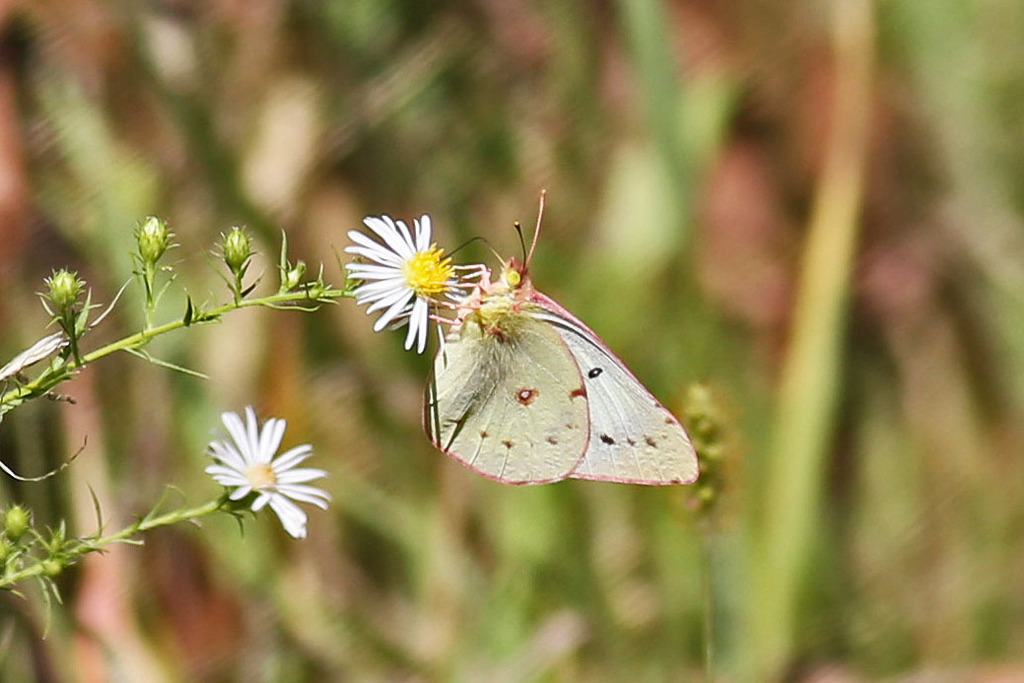
(c) Bill Keim, some rights reserved (CC BY) · licence
Family: Pieridae · Class: Insecta · Order: Lepidoptera
Colias eurytheme (Orange Sulphur) is a California animal in the Pieridae family.
The Orange Sulphur is a medium-sized butterfly with a wingspan ranging from 44 to 54 millimeters (1.7 to 2.1 inches). Males display bright orange dorsal wing surfaces with distinct black borders, while females exhibit more variable coloration, ranging from orange to pale yellow or white. Both sexes possess a prominent orange or yellow spot on the hindwing underside and subtle silver spotting. The underwing surfaces are typically yellow-green with a pinkish hue along the wing margins. Females may occur in a white form, particularly in cooler regions, creating confusion with other sulphur species. The Orange Sulphur maintains one of the most extensive distributions of any North American butterfly, ranging from southern Canada to central Mexico and occurring coast to coast throughout the United States, with the notable exception of the Florida peninsula. In California, the species is found throughout the state from sea level to mountainous regions, with populations occurring in all counties. The species demonstrates strong dispersal capabilities and seasonal migration patterns, with northern populations reinforced by southern immigrants during spring and summer months. This butterfly inhabits a diverse array of open habitats including agricultural areas, fields, roadsides, parks, gardens, and disturbed lands. The species thrives in areas where leguminous host plants are abundant, particularly in agricultural landscapes where alfalfa cultivation provides extensive breeding habitat. Orange Sulphurs are commonly observed in elevations ranging from sea level to approximately 3,000 meters (9,800 feet), demonstrating extensive habitat adaptability. Orange Sulphurs are multivoltine, producing multiple generations per year with continuous broods in warmer climates and three to four generations in temperate regions. Adults are active from early spring through late fall, with peak activity during warm, sunny conditions. Males engage in patrolling behavior, flying low over host plants to locate females. Females deposit single, pale yellow eggs on the upper surfaces of host plant leaves. The larval stage feeds exclusively on plants in the pea family (Fabaceae), with primary hosts including alfalfa (Medicago sativa), white clover (Trifolium repens), and white sweet clover (Melilotus alba). Larvae are green with lateral white stripes and complete development in approximately three to four weeks. Pupation occurs in a chrysalis attached to plant stems or nearby structures. The Orange Sulphur is not federally or state listed and maintains stable populations throughout its range. The species has benefited significantly from agricultural practices, particularly alfalfa cultivation, which has expanded suitable habitat. Climate change may affect northern range limits, but the species' adaptability and dispersal capabilities suggest continued population stability. In some regions, hybridization with the closely related Clouded Sulphur (Colias philodice) occurs, creating identification challenges but not conservation concerns. The species serves as an important pollinator and agricultural pest indicator, with larvae occasionally causing minor damage to crop legumes.
Classification
Class: Insecta · Order: Lepidoptera · Family: Pieridae
Frequently asked questions
How is Colias eurytheme classified?
Colias eurytheme belongs to class Insecta, order Lepidoptera, family Pieridae.
What family does Colias eurytheme belong to?
Colias eurytheme is in the Pieridae family.
What is Colias eurytheme?
The Orange Sulphur is a medium-sized butterfly with a wingspan ranging from 44 to 54 millimeters (1.7 to 2.1 inches).
Is Colias eurytheme found in California?
Yes. Colias eurytheme is recorded in California in The California Species Project's catalogue.
Related species
Other California species in the same genus, family, or bioregion.
Data from The California Species Project — 14,000+ California species with verified data from CNPS, CDFW, USFWS, and more.