Colias harfordii
Harford's Sulphur
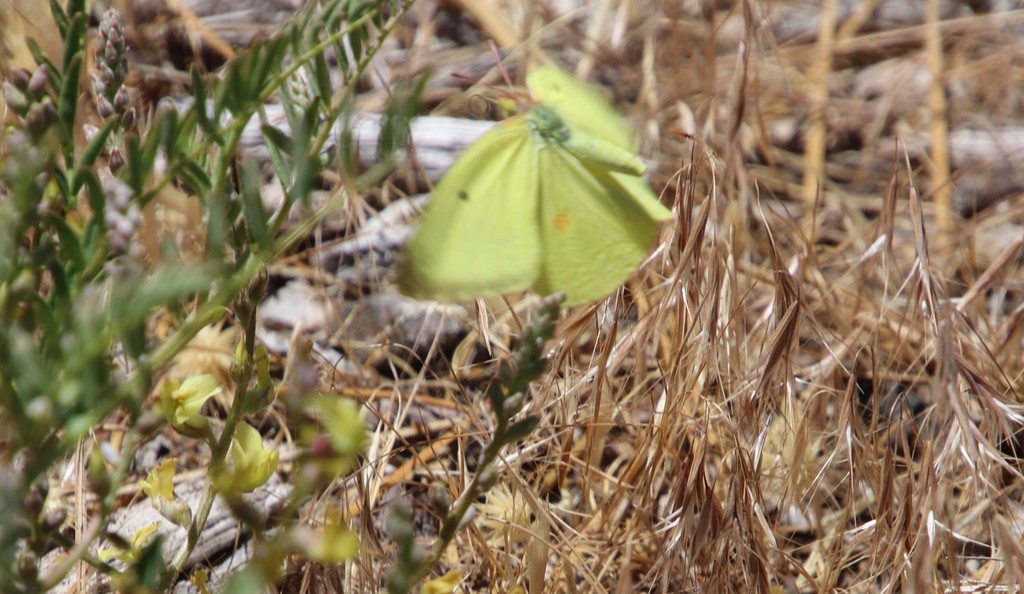
(c) Millie Basden, some rights reserved (CC BY) · licence
Family: Pieridae · Class: Insecta · Order: Lepidoptera
Colias harfordii (Harford's Sulphur) is a California animal in the Pieridae family.
Harford's sulphur is a medium-sized butterfly in the family Pieridae, with forewings measuring 20 to 25 mm (0.8 to 1.0 inches) in length. Males display bright yellow dorsal wing surfaces with distinctive black borders along the wing margins. The forewings feature a prominent black cell spot and black marginal bands that are typically narrower than in related species. Females exhibit dimorphic coloration, with some individuals showing yellow wings similar to males while others display pale yellow to white wing surfaces. The ventral surfaces of both sexes are pale yellow with subtle silvery markings, and hindwings feature a characteristic white or pale yellow spot rimmed with pink or red. Harford's sulphur occurs in southern California coastal ranges and canyons from Kern County south to San Diego County. The species inhabits foothills, mountain slopes, and canyon systems within the Transverse and Peninsular Ranges. Populations have been documented in the San Gabriel Mountains, Santa Monica Mountains, Santa Ana Mountains, and various mountain ranges in San Diego County. The distribution is closely tied to the presence of its host plant and suitable habitat conditions. This species occupies chaparral, coastal sage scrub, and oak woodland habitats at elevations ranging from 150 to 1,500 meters (500 to 4,900 feet). Harford's sulphur shows a strong preference for areas with abundant flowering plants that provide nectar sources, including buckwheat, ceanothus, and various composite flowers. The butterfly is most commonly found in sunny, open areas within these plant communities, particularly along ridgelines, slopes, and canyon bottoms where host plants occur. The species exhibits a close ecological relationship with rattleweed (Astragalus douglasii) in the pea family (Fabaceae), which serves as its primary larval host plant. Adult females deposit eggs singly on young leaves and flower buds of the host plant. Larvae feed exclusively on rattleweed foliage and develop through five instars over several weeks. The species produces multiple generations per year, with flight periods typically occurring from March through October, depending on local climate conditions and host plant availability. Adults are active during warm, sunny periods and engage in rapid, erratic flight patterns while searching for mates and nectar sources. Peak adult activity occurs during spring and fall months when temperatures are moderate and host plants are actively growing. Males establish territories near host plant patches and engage in aerial courtship displays. The species overwinters in the pupal stage, with pupae attached to host plant stems or nearby vegetation. Harford's sulphur is not currently listed under federal or state endangered species legislation, but faces ongoing threats from habitat loss and fragmentation due to urban development, fire suppression, and invasive plant species. Coastal development has reduced available habitat in portions of the species' range, particularly in Orange and San Diego counties. Climate change may affect the distribution and timing of both the butterfly and its host plant, potentially disrupting synchronized life cycles.
Classification
Class: Insecta · Order: Lepidoptera · Family: Pieridae
Frequently asked questions
How is Colias harfordii classified?
Colias harfordii belongs to class Insecta, order Lepidoptera, family Pieridae.
What family does Colias harfordii belong to?
Colias harfordii is in the Pieridae family.
What is Colias harfordii?
Harford's sulphur is a medium-sized butterfly in the family Pieridae, with forewings measuring 20 to 25 mm (0.8 to 1.0 inches) in length.
Is Colias harfordii found in California?
Yes. Colias harfordii is recorded in California in The California Species Project's catalogue.
Related species
Other California species in the same genus, family, or bioregion.
Data from The California Species Project — 14,000+ California species with verified data from CNPS, CDFW, USFWS, and more.