Colias occidentalis
Western Sulphur
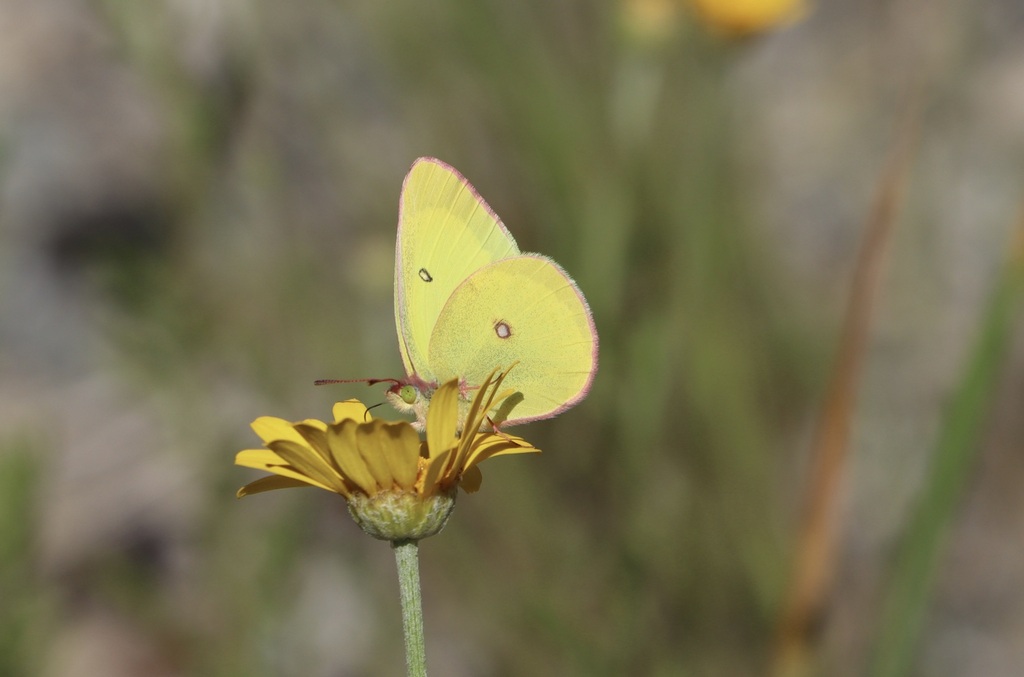
no rights reserved · CC0
Family: Pieridae · Class: Insecta · Order: Lepidoptera
Colias occidentalis (Western Sulphur) is a California animal in the Pieridae family.
The Western Sulphur is a medium-sized butterfly in the family Pieridae, with a wingspan ranging from 32 to 50 mm (1.3 to 2.0 inches). Males display bright yellow wings with distinct black borders along the outer margins, while females exhibit dimorphic coloration—appearing either yellow like males or white with reduced black markings. Both sexes possess a distinctive orange or reddish spot on the hindwing underside, though this marking may be faint or absent in some individuals. The wing undersides are typically pale yellow or greenish-yellow with scattered dark spots. The Western Sulphur ranges from extreme southern British Columbia and the northwestern United States south to north coastal California and central Utah. In California, the species occurs primarily in mountainous regions and foothills, with documented populations in the Sierra Nevada, Cascade Range, and coastal mountains. The species reaches its southern range limit in the northern counties of California, including Siskiyou, Modoc, Shasta, and Lassen counties. This butterfly inhabits open areas including mountain meadows, forest clearings, grasslands, and disturbed sites at elevations typically ranging from 300 to 2,400 meters (1,000 to 8,000 feet). Western Sulphurs prefer areas with abundant nectar sources and host plants, often occurring in proximity to streams, springs, or other water sources. The species adapts well to human-modified landscapes, frequenting roadsides, agricultural edges, and suburban areas where suitable host plants persist. Western Sulphurs are multivoltine, producing two to three broods annually depending on local climate conditions. Adults are most active during warm, sunny days and exhibit strong flight patterns while searching for mates and nectar sources. Males engage in patrolling behavior, flying along ridgelines and open areas to locate females. Mating typically occurs during mid-morning to early afternoon hours. Females deposit single, pale yellow eggs on the leaves or flower buds of host plants. Larvae feed exclusively on plants of the pea family (Fabaceae), including vetch (Vicia angustifolia), sweet vetch (Hedysarum), lupines (Lupinus), and white sweet clover (Melilotus alba). Caterpillars are green with white lateral stripes and complete development through five instars over approximately three to four weeks. Pupation occurs in a chrysalis attached to the host plant or nearby vegetation. The species overwinters as a chrysalis in most of its range. Adult Western Sulphurs nectar on various flowering plants including dandelions, asters, rabbitbrush, and other composite flowers. The species serves as a pollinator for numerous wildflower species throughout its range. Western Sulphurs currently maintain stable populations across most of their range and are not listed under federal or state endangered species acts. However, localized populations may face pressure from habitat loss due to development, agricultural conversion, and invasive plant species that displace native host plants.
Classification
Class: Insecta · Order: Lepidoptera · Family: Pieridae
Frequently asked questions
How is Colias occidentalis classified?
Colias occidentalis belongs to class Insecta, order Lepidoptera, family Pieridae.
What family does Colias occidentalis belong to?
Colias occidentalis is in the Pieridae family.
What is Colias occidentalis?
The Western Sulphur is a medium-sized butterfly in the family Pieridae, with a wingspan ranging from 32 to 50 mm (1.3 to 2.0 inches).
Is Colias occidentalis found in California?
Yes. Colias occidentalis is recorded in California in The California Species Project's catalogue.
Related species
Other California species in the same genus, family, or bioregion.
Data from The California Species Project — 14,000+ California species with verified data from CNPS, CDFW, USFWS, and more.