Colias philodice
Clouded Sulphur
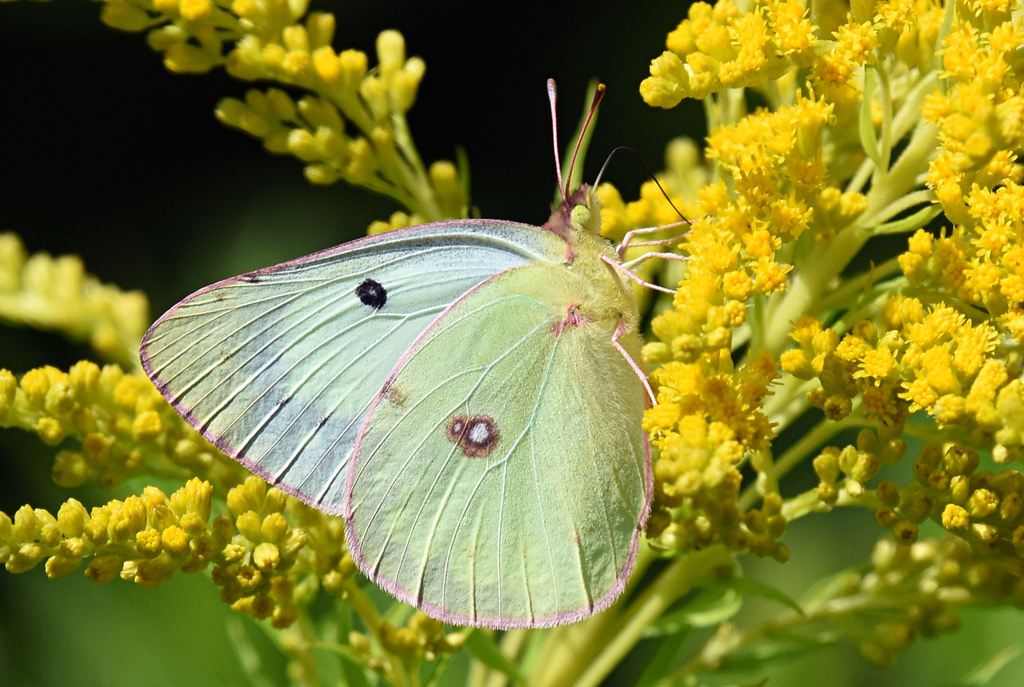
(c) Jimmy Dee, some rights reserved (CC BY-SA) · licence
Family: Pieridae · Class: Insecta · Order: Lepidoptera
Colias philodice (Clouded Sulphur) is a California animal in the Pieridae family.
The Clouded Sulphur is a medium-sized butterfly in the family Pieridae, with adults exhibiting pronounced sexual dimorphism in wing coloration. Males display bright yellow wings with distinct black borders along the forewings and hindwings, while females present either yellow or white wing surfaces with more diffuse dark borders. Both sexes measure 32-44 mm (1.3-1.7 inches) in wingspan. The dorsal wing surfaces feature a characteristic orange spot on each hindwing, and males possess specialized scent patches called androconial patches on their forewings. The ventral wing surfaces are pale yellow to white with silver-centered spots, providing effective camouflage when at rest. The Clouded Sulphur occupies one of the most extensive ranges of any North American butterfly, extending from Alaska south through central and southeast Canada, and throughout the conterminous United States except much of California, south Texas, and most of Florida. This broad distribution reflects the species' adaptability to diverse climatic conditions and its association with widely distributed host plants. In California, the species occurs primarily in the northern and eastern regions, with populations concentrated in areas where suitable host plants are abundant. This butterfly inhabits open areas including agricultural fields, pastures, roadsides, parks, and disturbed habitats where leguminous plants flourish. The species thrives from sea level to elevations exceeding 3,000 meters (9,800 feet) in mountainous regions. Adults prefer sunny locations with nectar sources and require areas with low-growing vegetation for oviposition and larval development. Clouded Sulphurs are multivoltine, producing two to four generations annually depending on latitude and local climate conditions. Adults are active from spring through fall, with peak flight periods varying by region. Males engage in patrolling behavior, flying low over open areas to locate receptive females. Mating occurs after courtship flights that involve chemical communication through pheromones. Females deposit single, pale yellow eggs on the upper surfaces of host plant leaves. Plants in the pea family (Fabaceae) serve as larval hosts, including alfalfa (Medicago sativa), white clover (Trifolium repens), and pea (Pisum sativum). Larvae develop through five instars, feeding primarily during daylight hours. The caterpillars are green with lateral white stripes and reach lengths of approximately 25 mm (1 inch) before pupating. Chrysalids are typically green or brown and may overwinter in northern portions of the range. The Clouded Sulphur maintains stable populations across most of its range and holds no special conservation status at federal or state levels. The species benefits from human agricultural activities, particularly cultivation of leguminous crops that provide abundant larval host plants. Climate change may affect northern range limits and voltinism patterns, but the species' broad ecological tolerance and dispersal capabilities likely provide resilience against environmental changes. Agricultural intensification and pesticide use represent potential localized threats, though widespread availability of host plants in both cultivated and natural settings supports continued population stability.
Classification
Class: Insecta · Order: Lepidoptera · Family: Pieridae
Frequently asked questions
How is Colias philodice classified?
Colias philodice belongs to class Insecta, order Lepidoptera, family Pieridae.
What family does Colias philodice belong to?
Colias philodice is in the Pieridae family.
What is Colias philodice?
The Clouded Sulphur is a medium-sized butterfly in the family Pieridae, with adults exhibiting pronounced sexual dimorphism in wing coloration.
Is Colias philodice found in California?
Yes. Colias philodice is recorded in California in The California Species Project's catalogue.
Related species
Other California species in the same genus, family, or bioregion.
Data from The California Species Project — 14,000+ California species with verified data from CNPS, CDFW, USFWS, and more.