Colibri thalassinus
Green Violet-ear
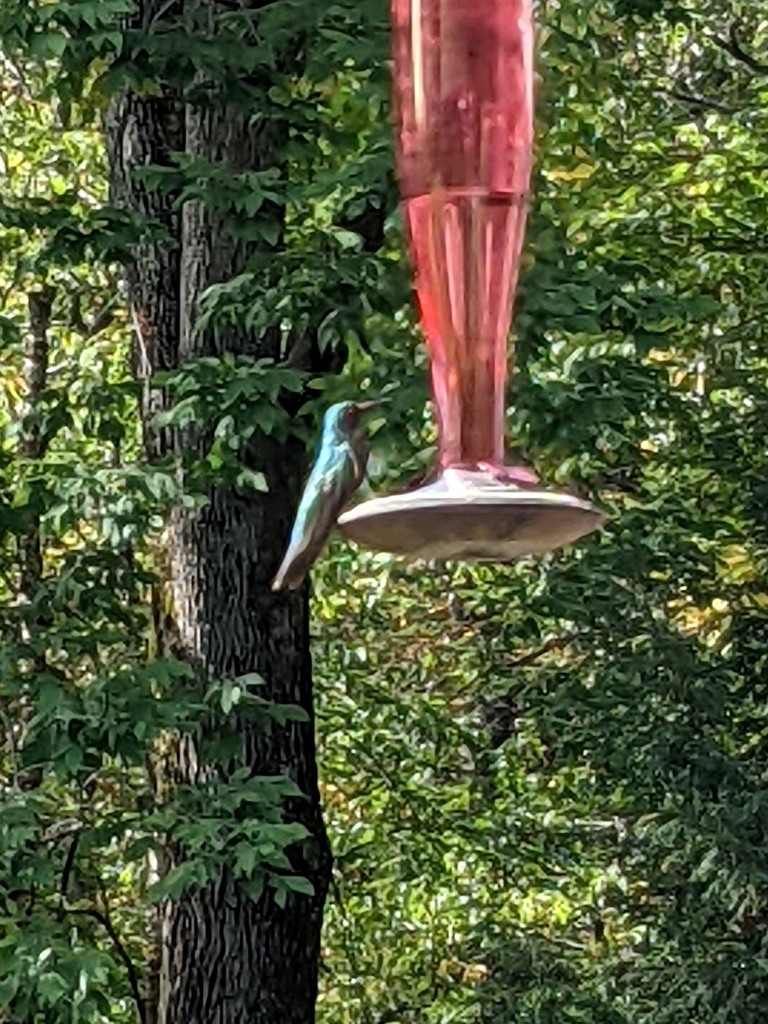
(c) Jason Hill, some rights reserved (CC BY) · licence
Family: Trochilidae · Class: Aves · Order: Apodiformes
Colibri thalassinus (Green Violet-ear) is a California animal in the Trochilidae family.
The Green Violet-ear is a medium-sized hummingbird measuring 9.5 to 12 centimeters (3.7 to 4.7 inches) in length and weighing 4.8 to 5.6 grams. Males display brilliant emerald-green plumage on the head, back, and underparts, with distinctive violet-blue patches extending from the ear coverts down the sides of the neck. The tail is steel-blue with a broad dark subterminal band. Females are similar but slightly duller, with less extensive violet coloration. Both sexes have a straight, medium-length black bill and dark eyes. The species was formerly known as the Mexican Violetear. The Green Violet-ear ranges from central Mexico through Central America to northern South America, extending to Bolivia and northern Argentina. In North America, the species is considered a vagrant, with documented sightings primarily in Texas and along the Gulf Coast. California records are extremely rare, with only a handful of confirmed observations, typically involving individual birds appearing at feeders during late summer or fall migration periods. Most California sightings have occurred in coastal counties, though documentation remains limited. This species inhabits montane forests, forest edges, and semi-open areas with scattered trees at elevations ranging from 1,200 to 3,000 meters (3,900 to 9,800 feet) throughout its primary range. In Mexico and Central America, Green Violet-ears frequent pine-oak forests, cloud forests, and adjacent clearings. They show preference for areas with abundant flowering plants and are commonly observed in gardens and parks near forested regions. The species adapts to various habitat types but requires access to nectar sources and suitable perching sites. Green Violet-ears are aggressive and territorial, often dominating feeding territories around rich nectar sources. They feed primarily on flower nectar, particularly favoring plants in the families Bromeliaceae, Ericaceae, and Rubiaceae. The species also consumes small insects and spiders for protein, capturing prey through hawking and gleaning behaviors. Males perform elaborate display flights, flying in repeated oval or figure-eight patterns while producing loud wing sounds. Breeding occurs from March through August, with females constructing small cup nests on horizontal branches 2 to 4 meters above ground. Females lay two white eggs and incubate them for 14 to 19 days. The Green Violet-ear is not federally listed in the United States, as it is not considered a resident breeding species. The species maintains stable populations throughout its primary range in Mexico and Central America, where it is classified as Least Concern by the International Union for Conservation of Nature. In California, the species has no conservation status due to its extremely rare occurrence as a vagrant. Climate change and habitat loss in montane regions of Mexico and Central America represent potential long-term threats to the species' core populations, but current population trends remain stable across most of its range.
Classification
Class: Aves · Order: Apodiformes · Family: Trochilidae
Frequently asked questions
How is Colibri thalassinus classified?
Colibri thalassinus belongs to class Aves, order Apodiformes, family Trochilidae.
What family does Colibri thalassinus belong to?
Colibri thalassinus is in the Trochilidae family.
What is Colibri thalassinus?
The Green Violet-ear is a medium-sized hummingbird measuring 9.5 to 12 centimeters (3.7 to 4.7 inches) in length and weighing 4.8 to 5.6 grams.
Is Colibri thalassinus found in California?
Yes. Colibri thalassinus is recorded in California in The California Species Project's catalogue.
Related species
Other California species in the same genus, family, or bioregion.
Data from The California Species Project — 14,000+ California species with verified data from CNPS, CDFW, USFWS, and more.