Collops versatilis
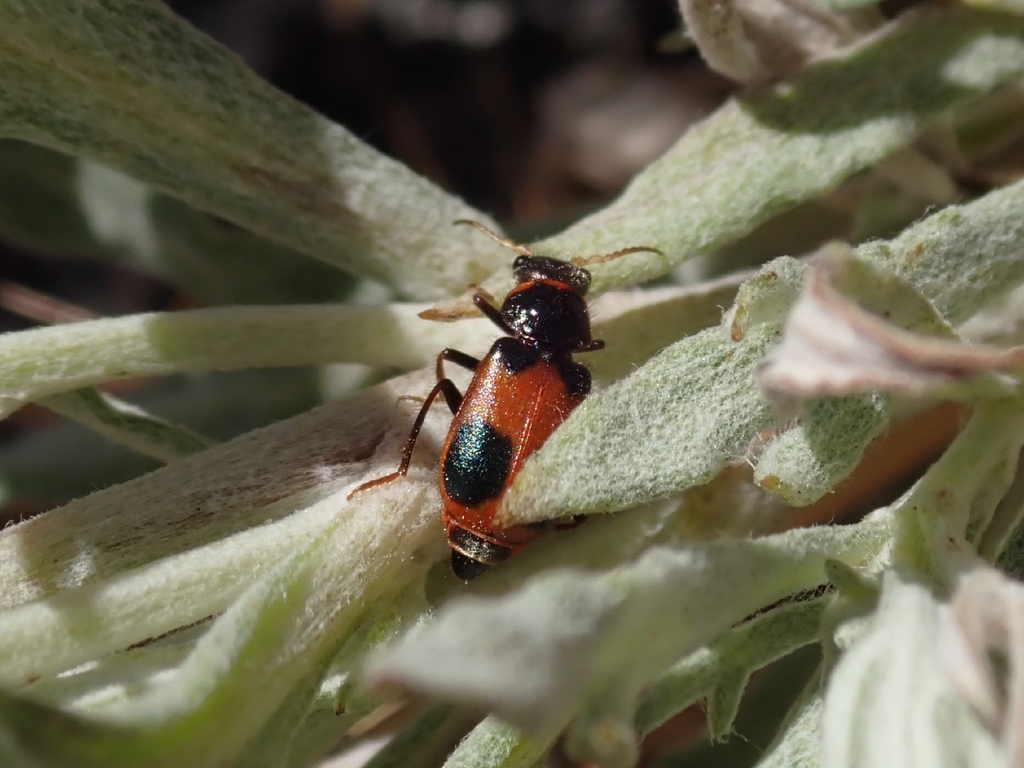
(c) Daniel S., some rights reserved (CC BY) · licence
Family: Melyridae · Class: Insecta · Order: Coleoptera
Collops versatilis is a California animal in the Melyridae family.
Collops versatilis is a small beetle belonging to the family Melyridae, commonly known as soft-winged flower beetles. Adults typically measure 3-6 mm in length, displaying a somewhat elongated, cylindrical body form characteristic of the genus. The species exhibits variable coloration, as suggested by its specific epithet "versatilis," with individuals ranging from dark metallic blue-green to bronze or black. The elytra (wing covers) are typically soft and flexible compared to many other beetle families, and the antennae are serrate or thread-like. Sexual dimorphism is common in Melyridae, with males often possessing enlarged or modified structures on the head or thorax. The distribution of Collops versatilis in California remains poorly documented in the scientific literature. Like other Collops species, this beetle likely occurs in multiple regions throughout the state, potentially ranging from coastal areas to interior valleys. The genus Collops is widely distributed across North America, with various species adapted to different climatic zones and elevation ranges. Specific county records and elevation preferences for C. versatilis have not been comprehensively catalogued in available databases. Collops beetles are typically associated with flowering plants, where adults feed on pollen, nectar, and small arthropods. They are commonly found on flowers of various plant families, including Asteraceae, Rosaceae, and Apiaceae. The species likely inhabits diverse habitats including chaparral, oak woodlands, grasslands, and riparian areas where suitable flowering plants occur. Adults are most active during the spring and early summer flowering period when nectar sources are abundant. Adults are predatory and beneficial, feeding on aphids, thrips, mites, and other small soft-bodied insects, while also consuming pollen and nectar. This dual feeding strategy makes them important both as pollinators and biological control agents. Larvae develop in soil or leaf litter, where they are predatory on small arthropods and their eggs. The life cycle is typically annual, with adults emerging in spring to coincide with peak flowering periods. Mating occurs on flowers, and females deposit eggs in soil or organic matter near the base of host plants. No federal or state conservation status has been assigned to Collops versatilis, and the species does not appear on any special status lists. Like many small arthropods, population trends and conservation needs are not well studied. Potential threats may include habitat loss from urban development, agricultural intensification, and pesticide applications that affect both the beetles and their prey species. The species' apparent reliance on diverse flowering plant communities suggests that maintenance of native plant diversity is important for its continued persistence. Climate change may affect the timing of adult emergence relative to flowering periods of host plants. Scientific documentation for this species remains limited. The information presented here synthesizes general knowledge of Collops biology and ecology. Additional field studies are needed to better understand the specific habitat requirements, distribution, and conservation status of C. versatilis in California.
Classification
Class: Insecta · Order: Coleoptera · Family: Melyridae
Frequently asked questions
How is Collops versatilis classified?
Collops versatilis belongs to class Insecta, order Coleoptera, family Melyridae.
What family does Collops versatilis belong to?
Collops versatilis is in the Melyridae family.
What is Collops versatilis?
Collops versatilis is a small beetle belonging to the family Melyridae, commonly known as soft-winged flower beetles.
Is Collops versatilis found in California?
Yes. Collops versatilis is recorded in California in The California Species Project's catalogue.
Related species
Other California species in the same genus, family, or bioregion.
Data from The California Species Project — 14,000+ California species with verified data from CNPS, CDFW, USFWS, and more.