Collops vittatus
Striped Collops
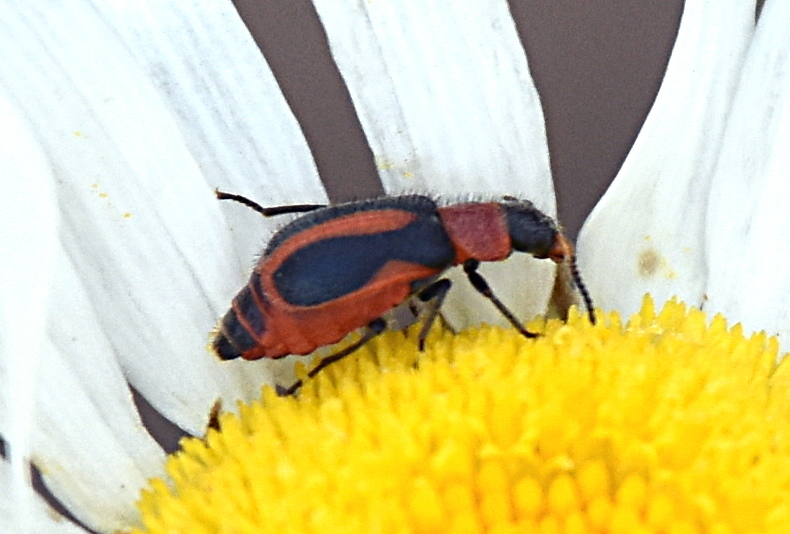
(c) Jimmy Dee, some rights reserved (CC BY-SA) · licence
Family: Melyridae · Class: Insecta · Order: Coleoptera
Collops vittatus (Striped Collops) is a California animal in the Melyridae family.
Collops vittatus is a small soft-winged flower beetle measuring approximately 5 mm (0.2 inches) in length. The species exhibits distinctive coloration with a black body marked by prominent red or orange stripes, giving rise to its common name. These longitudinal stripes extend along the elytra (wing covers), creating a characteristic banded pattern. The body form is typical of the family Melyridae, with relatively soft wing covers and a somewhat elongated oval shape. Males can be distinguished from the closely related C. marginellus by the shape of their basal antennal segment, which is distinctively longer than wide when viewed frontally (BugGuide). The striped collops occurs across much of North America, with confirmed records from California. Within the state, the species has been documented in Alameda County, specifically at Hayward Regional Shoreline (BugGuide). The distribution extends beyond California to other western and southwestern states, though comprehensive range mapping remains incomplete. The species appears to have a relatively broad geographic distribution across suitable habitat types. This beetle inhabits diverse environments including shoreline areas, desert regions, and various terrestrial habitats. Documented locations include both coastal and inland sites, suggesting adaptability to different moisture and temperature regimes. The species has been recorded from sea level locations near San Francisco Bay to desert environments in southeastern California (BugGuide). Specific microhabitat preferences and elevation ranges have not been thoroughly documented in the scientific literature. As a member of the soft-winged flower beetle family, C. vittatus likely exhibits predatory behavior typical of melyrids, feeding on small arthropods and soft-bodied insects. Many Collops species are known to be beneficial predators of aphids, thrips, and other pest insects, though specific prey preferences for this species require further study. Adult activity patterns, seasonal occurrence, and reproductive biology have not been well documented. Like other melyrids, adults are typically found on flowers and vegetation where they hunt for prey. The conservation status of Collops vittatus has not been formally assessed by state or federal agencies. The species lacks federal or California state listing status, and population trends are unknown. Limited scientific documentation suggests the species may be overlooked rather than rare, as is common with many small predatory beetles. Taxonomic challenges within the genus Collops may contribute to underreporting, as species identification often requires detailed morphological examination of male specimens (BugGuide). The species' apparent habitat flexibility may provide some resilience to environmental changes, though specific threats have not been identified. Detailed ecological studies of this species are lacking. The above information synthesizes available observations from taxonomic databases and field reports. Additional research is needed to understand the species' full distribution, ecological role, habitat requirements, and conservation needs within California's diverse ecosystems.
Classification
Class: Insecta · Order: Coleoptera · Family: Melyridae
Frequently asked questions
How is Collops vittatus classified?
Collops vittatus belongs to class Insecta, order Coleoptera, family Melyridae.
What family does Collops vittatus belong to?
Collops vittatus is in the Melyridae family.
What is Collops vittatus?
Collops vittatus is a small soft-winged flower beetle measuring approximately 5 mm (0.2 inches) in length.
Is Collops vittatus found in California?
Yes. Collops vittatus is recorded in California in The California Species Project's catalogue.
Related species
Other California species in the same genus, family, or bioregion.
Data from The California Species Project — 14,000+ California species with verified data from CNPS, CDFW, USFWS, and more.