Colonus hesperus
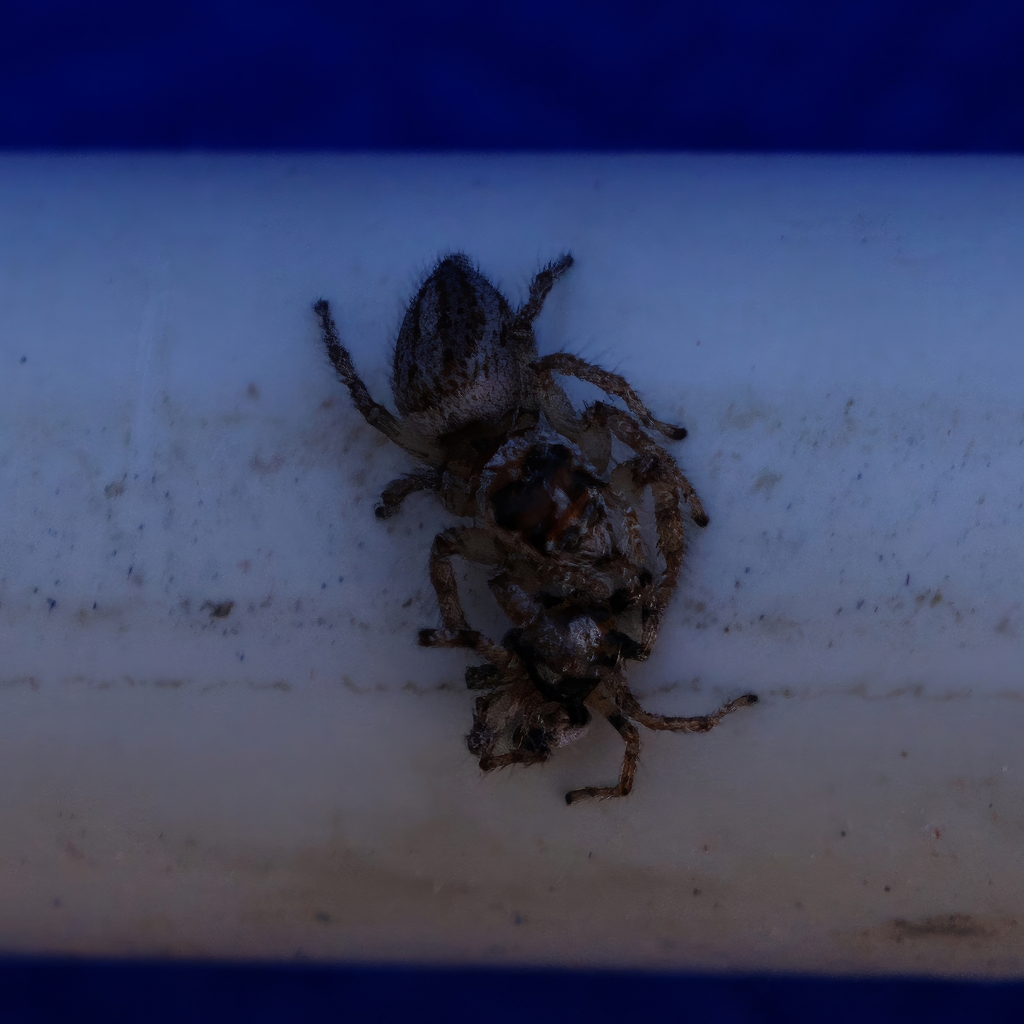
(c) Bill Levine, some rights reserved (CC BY) · licence
Family: Salticidae · Class: Arachnida · Order: Araneae
Colonus hesperus is a California animal in the Salticidae family.
Colonus hesperus is a jumping spider in the family Salticidae, distinguished from other members of its genus by its unique abdominal coloration pattern. Unlike related species such as C. sylvanus and C. puerperus, this species lacks the two longitudinal white stripes on the abdomen that characterize other Colonus species. Instead, the abdomen displays a yellowish coloration with scattered black setae and numerous black dots distributed across the surface (BugGuide 2025). Jumping spiders in the genus Colonus are typically small to medium-sized arachnids, with adults generally measuring 4-8 mm in body length. Members of this genus are characterized by their excellent vision, facilitated by large anterior median eyes, and their ability to leap several times their body length when hunting or escaping predators. The cephalothorax is typically brownish to dark brown, while leg coloration varies among individuals. The range and distribution of Colonus hesperus in California remains poorly documented in scientific literature. Jumping spiders of the genus Colonus are generally found across western North America, but specific locality records for C. hesperus are limited. The species likely occurs in multiple habitat types given the ecological flexibility demonstrated by related Colonus species. Habitat preferences for this species have not been thoroughly studied, though other Colonus species typically inhabit a variety of terrestrial environments including woodland edges, grasslands, and scrub habitats. They are generally found on vegetation, tree bark, rocks, and human-made structures where they hunt for prey. Jumping spiders are active hunters that do not construct webs for prey capture, instead relying on their exceptional eyesight and jumping ability. Like other jumping spiders, Colonus hesperus is likely an active diurnal predator that feeds primarily on small insects and other arthropods. Hunting behavior typically involves stalking prey using visual cues, followed by a precision leap to capture the target. Mating in jumping spiders often involves elaborate courtship displays by males, which may include leg waving, body positioning, and vibratory signals to attract females. Females typically lay eggs in silk retreats constructed in protected locations. The conservation status of Colonus hesperus has not been formally assessed. No federal or state listing status exists for this species, and it does not appear on conservation watch lists. However, like many arthropod species, detailed population data and trend information are lacking. The species' conservation needs remain undetermined due to limited ecological research and distributional surveys. Scientific documentation for this species remains extremely limited. The information presented here is based on available sources including taxonomic databases and comparative morphology with related species. Detailed ecological studies, comprehensive distributional surveys, and population assessments are needed to better understand this species' biology and conservation requirements. If you have additional verified information about this species' distribution, ecology, or natural history, please contact us to help improve this species account.
Classification
Class: Arachnida · Order: Araneae · Family: Salticidae
Frequently asked questions
How is Colonus hesperus classified?
Colonus hesperus belongs to class Arachnida, order Araneae, family Salticidae.
What family does Colonus hesperus belong to?
Colonus hesperus is in the Salticidae family.
What is Colonus hesperus?
Colonus hesperus is a jumping spider in the family Salticidae, distinguished from other members of its genus by its unique abdominal coloration pattern.
Is Colonus hesperus found in California?
Yes. Colonus hesperus is recorded in California in The California Species Project's catalogue.
Related species
Other California species in the same genus, family, or bioregion.
Data from The California Species Project — 14,000+ California species with verified data from CNPS, CDFW, USFWS, and more.