Coloradia pandora
Pandora pinemoth
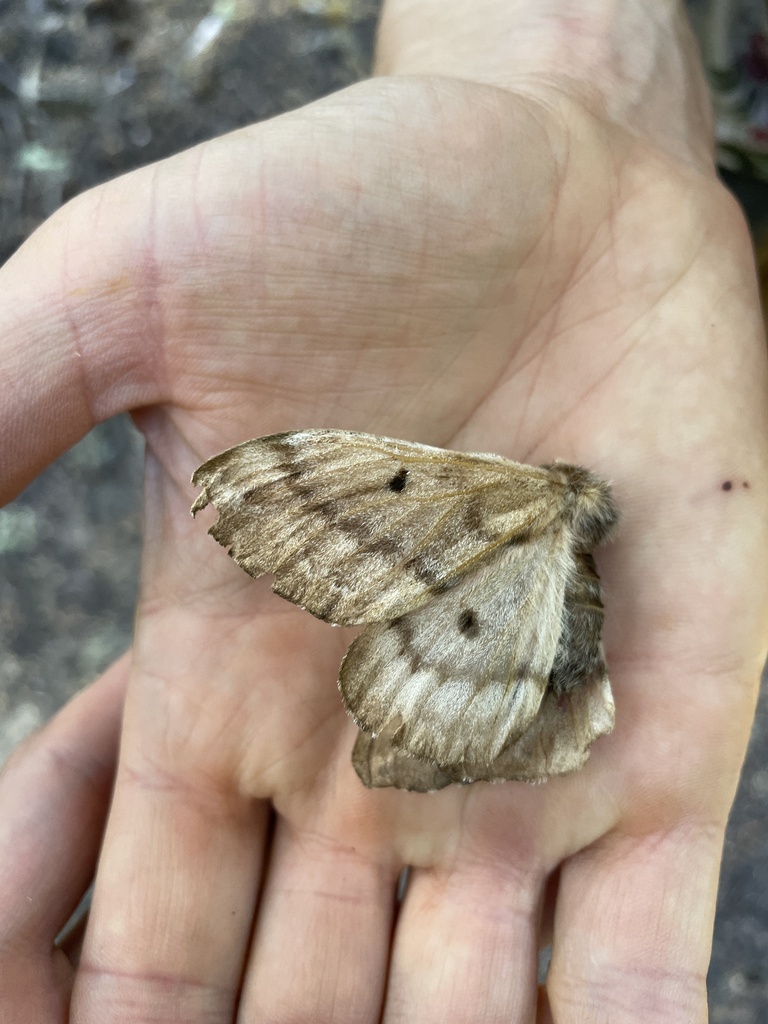
(c) Hilary Rose Dawson, some rights reserved (CC BY) · licence
Family: Saturniidae · Class: Insecta · Order: Lepidoptera
Coloradia pandora (Pandora pinemoth) is a California animal in the Saturniidae family.
The Pandora pinemoth is a large moth in the family Saturniidae, with adults displaying wingspan measurements of 75 to 100 mm (3.0 to 3.9 inches). Males are typically smaller than females and exhibit more feathered antennae. The forewings are predominantly gray-brown with darker banding patterns, while the hindwings show reddish-brown coloration with distinctive eyespots. The body is robust and densely covered with scales, characteristic of giant silk moths. The species occurs from Oregon south through California, extending into the Spring Mountains of western Nevada, northern Utah, Colorado, Wyoming, the Black Hills of South Dakota, and the Nebraska National Forest in Nebraska. In California, populations are distributed throughout mountainous regions where suitable pine forests occur, including the Sierra Nevada, Cascade Range, and coastal mountains. The subspecies davisi, which feeds specifically on pinyon pine and exhibits late seasonal flight patterns, may represent a distinct species requiring taxonomic revision. Pandora pinemoth inhabits coniferous forests dominated by various pine species, typically at elevations ranging from 1,200 to 3,000 meters (4,000 to 10,000 feet). The species shows strong host plant specificity, utilizing ponderosa pine, Jeffrey pine, lodgepole pine, sugar pine, pinyon pine, and Coulter pine. Larvae develop within the bark and cambium layer of these host trees, creating characteristic feeding galleries. Adults are most commonly found in mature pine forests with adequate canopy coverage and minimal human disturbance. Larvae are wood borers that spend one to two years developing within host trees, feeding on the inner bark and creating extensive tunnel systems. Pupation occurs within the host tree in chambers constructed by mature larvae. Adult emergence typically occurs from late spring through early summer, though flight periods vary by elevation and latitude. The subspecies davisi exhibits notably later flight timing than other populations. Adults do not feed and focus exclusively on mating and reproduction. Females deposit eggs in bark crevices of suitable host trees. The Pandora pinemoth is not currently listed under federal or state endangered species legislation. However, populations may face localized threats from forest management practices, including timber harvesting that removes mature host trees and prescribed burning that eliminates suitable habitat. Climate change impacts on montane pine forests, including increased frequency of drought and bark beetle outbreaks, may affect long-term population stability. The species' dependence on mature pine forests makes it vulnerable to habitat fragmentation and changes in forest composition. Forest health initiatives that maintain diverse age classes of pine trees support population persistence across the species' range.
Classification
Class: Insecta · Order: Lepidoptera · Family: Saturniidae
Frequently asked questions
How is Coloradia pandora classified?
Coloradia pandora belongs to class Insecta, order Lepidoptera, family Saturniidae.
What family does Coloradia pandora belong to?
Coloradia pandora is in the Saturniidae family.
What is Coloradia pandora?
The Pandora pinemoth is a large moth in the family Saturniidae, with adults displaying wingspan measurements of 75 to 100 mm (3.0 to 3.9 inches).
Is Coloradia pandora found in California?
Yes. Coloradia pandora is recorded in California in The California Species Project's catalogue.
Related species
Other California species in the same genus, family, or bioregion.
Data from The California Species Project — 14,000+ California species with verified data from CNPS, CDFW, USFWS, and more.